Talk to a Counsellor
 Support
SLAT Syllabus 2027: Detailed Syllabus PDF (All Sections)
Get the complete SLAT Syllabus 2027 with section-wise topics, exam pattern, reasoning areas, GK, reading comprehension, and a free downloadable PDF.
Last Updated on 22 Aug 2026

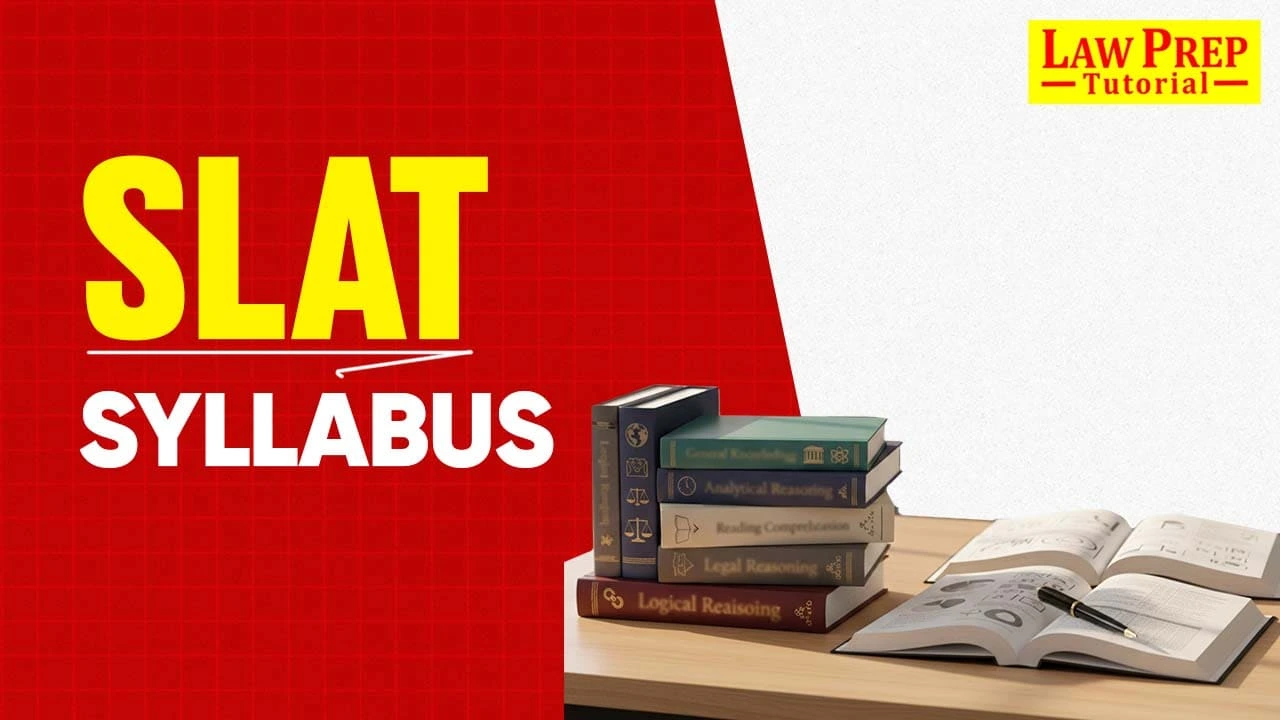
Having a clear idea about the SLAT syllabus is essential before you begin your preparation, as the exam tests multiple skills within a tight one-hour format. The SLAT 2027 syllabus covers five key areas-Logical Reasoning, Legal Reasoning, Analytical Reasoning, Reading Comprehension, and General Knowledge.
Each section carries equal weight, making balanced preparation crucial for scoring well. SLAT exam focuses on aptitude, interpretation, and reasoning rather than factual memorisation, which makes it different from traditional law entrance test.
Knowing the exact syllabus structure helps you plan your study time, prioritise topics, and take SLAT mock tests more effectively.
Table of Contents
Jump to sectionSections in SLAT 2027 Syllabus
There are five sections in the SLAT exam syllabus:
| Section | Number of Questions | Marks |
| Logical Reasoning | 12 | 12 |
| Legal Reasoning | 12 | 12 |
| Analytical Reasoning | 12 | 12 |
| Reading Comprehension | 12 | 12 |
| General Knowledge | 12 | 12 |
| Total | 60 | 60 |
SLAT Syllabus 2027
This is the latest syllabus of SLAT 2027:
| Section | Topics Covered |
| Logical Reasoning | • Assertion–Reason • Logical Consistency • Statement & Assumption • Statement & Arguments • Statement & Conclusion • Statement & Course of Action • Statement & Inference • Cause & Effect • Data Arrangement • Directions • Coding–Decoding |
| Analytical Reasoning | • Figure Counting • Algebra • Percentage • Profit & Loss • Ratio & Proportion • Number Series • Decision Making • Time & Work • Analogy • Odd-One-Out • Arithmetic Reasoning • Blood Relations • Series (Number/Alphabet/Alphanumeric) • Clock • Calendar • Distance & Directions |
| Legal Reasoning | • Indian Constitution • Law of Torts • Law of Contract • Law of Crimes • Family Law • International Law • Important Judgments • Intellectual Property Rights (IPR) • Legal Maxims • Legal Terms |
| General Knowledge (Static + Current Affairs) | • National Affairs • International Affairs • State Affairs • Government Schemes & Plans • Awards & Honours • Books & Authors • Agreements & Deals • Sports • Science & Defence • Summits & Conferences Current Economy • National & International Appointments Static GK: • History (Ancient–Modern–World) • Geography • National Parks & Wildlife Sanctuaries • Arts & Culture • General Science • Headquarters of Organisations • Economy • Currency • Capital |
| Reading Comprehension (English) | • Vocabulary Grammar • Synonyms • Antonyms • Word Usage • Inference-based Questions • Foreign Words/Phrases • Para Jumbles |
SLAT Syllabus PDF
Want the complete SLAT syllabus in one place? Download our SLAT Syllabus 2027 PDF to get the section-wise topics, exam pattern, recommended books, and preparation roadmap in a neatly formatted document.
SLAT Exam Pattern
Know the latest exam pattern of SLAT:
| Component | Details |
| Total Sections | 5 (LR, Legal, Analytical, RC, GK) |
| Total Questions | 60 |
| Questions per Section | 12 each |
| Total Marks | 60 |
| Marks per Section | 12 marks each |
| Duration of Exam | 60 minutes |
| Mode of Exam | Computer-Based Test (CBT) |
| Type of Questions | Multiple Choice Questions (MCQs) |
| Marking Scheme | +1 for correct answer |
| Negative Marking | None |
| Attempts Allowed | 2 (Best score considered) |
Explore important resources for SLAT preparation here:
SLAT Syllabus for Logical Reasoning
The Logical Reasoning section evaluates your ability to analyse arguments, identify patterns, understand relationships, and draw valid conclusions. It measures your critical thinking and decision-making ability: essential skills for law school.
LR questions in SLAT are usually moderate and can be solved quickly with good conceptual clarity. Since the section carries 12 marks, strong LR performance helps you build momentum and secure easy, high-accuracy marks early in the test.
| Topic | Description |
| Assertion & Reason | Identify relationships between statements and choose the correct explanation |
| Logical Consistency | Evaluate whether statements follow logically |
| Statement & Assumption | Identify implicit assumptions in arguments |
| Statement & Arguments | Determine whether arguments are strong or weak |
| Statement & Conclusion | Analyse and derive logically correct conclusions |
| Statement & Course of Action | Suggest practical solutions based on scenarios |
| Statement & Inference | Draw inferences based on given data |
| Cause & Effect | Identify causal relationships between events |
| Data Arrangement | Arrange information logically |
| Directions | Solve direction-based reasoning problems |
| Coding–Decoding | Decode patterns or rules applied to codes |
Skills Tested
- Critical & analytical thinking
- Understanding arguments
- Ability to identify hidden assumptions
- Decision-making & elimination skills
SLAT Syllabus for Analytical Reasoning
Analytical Reasoning focuses on your problem-solving ability using numbers, patterns, and logical sequences. This section is more calculation-oriented than LR and tests how quickly you can interpret data and identify relationships.
Many questions are based on basic arithmetic and logical puzzles. Mastering AR helps boost speed, which is crucial in SLAT’s 60-minute format.
| Topic | Description |
| Figure Counting | Identify shapes and count patterns |
| Algebra | Solve equations and expressions |
| Percentage | Calculate percentage changes and comparisons |
| Profit & Loss | Apply formulas to business transactions |
| Ratio & Proportion | Compare quantities and find proportions |
| Number Series | Identify the rule governing number sequences |
| Decision Making | Solve logic-based situational questions |
| Time & Work | Calculate work efficiency and time required |
| Analogy | Identify relationships between pairs |
| Odd-One-Out | Spot dissimilar objects or patterns |
| Arithmetic Reasoning | Apply arithmetic logic to scenarios |
| Blood Relations | Decode family relationships |
| Series (Number/Alphabet/Alphanumeric) | Identify progression rules |
| Clock | Time-based logical problems |
| Calendar | Day/date-based reasoning |
| Distance & Directions | Spatial reasoning questions |
Skills Tested
- Numerical logic
- Pattern recognition
- Data interpretation
- Structured and sequential thinking
SLAT Syllabus for Legal Reasoning
Legal Reasoning is a core component of law entrance exams. SLAT tests your ability to apply legal principles to factual situations, not your legal knowledge. You must read a principle, apply it logically, and choose the answer that follows from the law.
This section is often considered game-changing because it rewards logical clarity, not memorization.
| Topic | Description |
| Indian Constitution | Basic principles, rights, duties, structures |
| Law of Torts | Negligence, strict liability, damages |
| Law of Contract | Offer, acceptance, consideration, breach |
| Law of Crimes | IPC basics, mens rea, actus reus |
| Family Law | Marriage, divorce, maintenance concepts |
| International Law | Treaties, organisations, global legal concepts |
| Important Judgments | Landmark case principles |
| Intellectual Property Rights | Copyrights, patents, trademarks basics |
| Legal Maxims | Latin maxims used in law |
| Legal Terms | Basic legal vocabulary |
Skills Tested
- Principle application
- Logical reasoning in legal context
- Reading & interpreting factual scenarios
- Eliminating irrelevant information
Know more about Symbiosis Law Colleges in India:
| Symbiosis Law Schools | Symbiosis Law School Pune |
| SLS Pune Fees Structure |
SLAT Syllabus for General Knowledge (GK & Current Affairs)
The GK section tests your awareness of national and global events. It includes both static topics and current affairs from the past 6–12 months.
Questions are mostly factual and can be solved very quickly, making GK a high-value section for saving time. For this, follow the daily SLAT current affairs.
| Topic | Description |
| National & International Affairs | Major events, government initiatives |
| State Affairs | State policies, developments |
| Government Schemes | Central & state programs |
| Awards & Honours | National & international recognitions |
| Books & Authors | Famous publications & writers |
| Agreements & Deals | Bilateral & multilateral pacts |
| Sports | Tournaments, winners, records |
| Science & Defence | ISRO, DRDO, discoveries |
| Summits & Conferences | International gatherings |
| Current Economy | Reports, indices, markets |
| Appointments | National & global appointments |
| Static GK Topics | — |
| History (Ancient–Modern) | Key events, dynasties, revolutions |
| Geography | Physical & political geography |
| National Parks & Sanctuaries | Wildlife conservation areas |
| Arts & Culture | Festivals, heritage, traditions |
| General Science | Basic physics, chemistry, biology |
| Headquarters of Organizations | UN, WHO, IMF, etc. |
| Economy | Basics of finance & economics |
| Currency & Capitals | Countries and capitals |
Skills Tested
- Awareness of events
- Quick recall ability
- Reading & retaining factual information
SLAT Syllabus for Reading Comprehension
The RC section evaluates your reading speed, comprehension ability, and clarity of thought. Passages are drawn from topics such as law, politics, current affairs, philosophy, and general issues.
Questions are inference-based and test how well you understand ideas, tone, vocabulary, and arguments.
| Topic | Description |
| Vocabulary | Meaning, usage, application |
| Grammar | Basic grammar understanding |
| Synonyms | Similar words |
| Antonyms | Opposite words |
| Word Usage | Context-based usage questions |
| Inference-based questions | Draw conclusions from passages |
| Foreign Words/Phrases | Commonly used imports in English |
| Para Jumble | Arrange jumbled sentences logically |
Skills Tested
- Reading speed
- Interpretation of ideas
- Inferential reasoning
- Vocabulary & contextual understanding
How to Prepare for SLAT Syllabus 2027?
1. Strengthen Your Reading Skills for Faster Comprehension
SLAT includes questions across RC, Legal Reasoning, and GK that require quick reading and accurate interpretation. Read editorials, legal summaries, and opinion articles daily.
This improves your vocabulary, inference skills, and speed—three essential components of SLAT success.
2. Build Strong Fundamentals in Logical & Analytical Reasoning
LR and AR together make up 24 marks, and both sections rely heavily on core reasoning concepts. Before jumping into advanced puzzles, ensure your basics—assumptions, conclusions, series, deductions, and patterns—are fully clear. Consistent practice avoids confusion and increases accuracy.
3. Practice Principle–Fact-Based Legal Reasoning Regularly
Legal Reasoning does not require legal knowledge but demands clarity in applying principles to facts. Practice short caselets daily. Focus on identifying the principle, eliminating irrelevant information, and choosing the option that logically follows. This builds precision and reduces silly errors.
4. Make GK a Daily Habit, Not a Last-Minute Task
The GK section can be completed in minutes, but only with consistent preparation. Read monthly current affairs, government schemes, legal news, and international updates. Maintain a notebook of important events and revise it weekly to retain crucial facts.
5. Solve SLAT-Specific Mock Tests for Pattern Familiarity
SLAT’s one-hour, 60-question format is unique. Practicing SLAT mock tests helps you understand the exact question style and difficulty. Aim for at least 10–12 full-length SLAT mocks before the exam to fine-tune timing and accuracy.
6. Improve Calculation Speed for Analytical Reasoning
A big part of AR involves quick calculations—percentages, ratios, time & work, series, and more. Build your calculation speed through daily drills and mental math. Faster calculations leave more time for RC and Legal Reasoning passages.
7. Analyse Every Practice Test to Identify Weak Areas
Solving questions alone isn’t enough. Review every mock:
- Where did you lose marks?
- Which section consumed extra time?
- Which question types need revision?
Use this analysis to create a personalized improvement plan.
Best Books for SLAT 2027 Syllabus
Use these books for SLAT preparation:
| Section | Book Title | Author / Publisher |
| Logical Reasoning | Verbal & Non-Verbal Reasoning | R.S. Aggarwal |
| A Modern Approach to Logical Reasoning | R.S. Aggarwal | |
| Analytical Reasoning | M.K. Pandey | |
| Legal Reasoning | Legal Awareness & Legal Reasoning for CLAT & LL.B Exams | A.P. Bhardwaj |
| Legal Aptitude for CLAT & Other Law Entrance Exams (Workbook) | A.P. Bhardwaj | |
| Thinking Like a Lawyer | Frederick Schauer | |
| Analytical Reasoning | Quantitative Aptitude | R.S. Aggarwal |
| Analytical Reasoning | M.K. Pandey | |
| Reading Comprehension | Objective General English | R.S. Aggarwal |
| Word Power Made Easy | Norman Lewis | |
| GK & Current Affairs | Lucent’s General Knowledge | Lucent Publications |
| Pratiyogita Darpan | Upkar Prakashan | |
| Economic and Political Weekly | Sameeksha Trust | |
| CLAT Express | Law Prep Tutorial |
FAQs on SLAT Syllabus

SEO Head
Virendra heads SEO & Content at LPT. A writer at heart, he focuses on building exam-focused content that informs, guides, and supports aspirants in their preparation journey.
SLAT Trending Blogs
Other Related Blogs