 Talk to a Counsellor
 Support
Difference Between CLAT vs NLSAT: Exam Pattern, Syllabus, Difficulty (Comparison)
NLSAT and CLAT serve different law admission goals. NLSAT-LL.B. is conducted for admission to the three-year LL.B. (Hons.) programme at NLSIU Bengaluru, which graduates from any discipline can pursue. CLAT UG is for admission to five-year integrated law programmes offered by participating National Law Universities (NLUs).
Last Updated on 16 Oct 2026

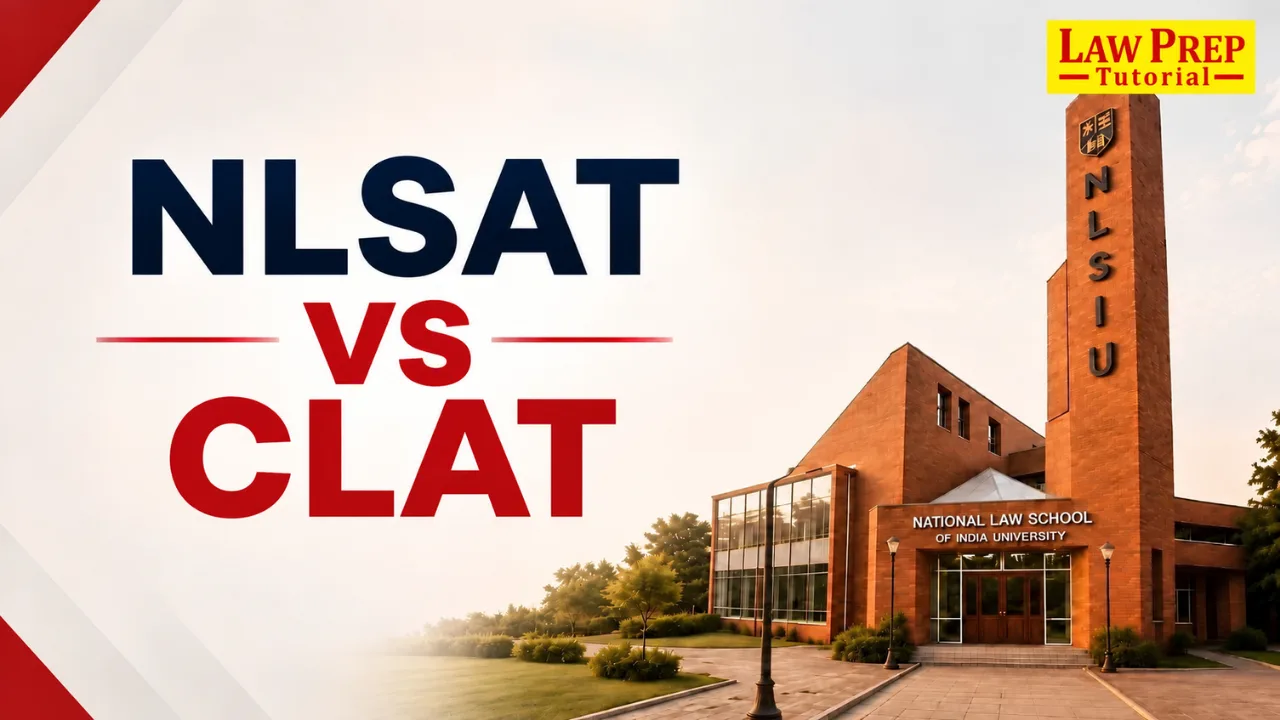
The main difference between NLSAT vs CLAT is the assessment format. NLSAT combines objective questions with subjective legal reasoning and essay writing, while CLAT UG tests candidates through 120 multiple-choice questions across five sections. Their eligibility rules, syllabus coverage, and preparation methods also differ, so candidates must choose a strategy based on the degree they want to pursue.
Table of Contents
Jump to sectionNLSAT vs CLAT: Key Differences
Check the overview of CLAT vs NLSAT in the table below:
| Comparison Factor | NLSAT-LL.B. | CLAT UG |
|---|---|---|
| Full Form | National Law School Admissions Test | Common Law Admission Test |
| Purpose | Admission to the three-year LL.B. (Hons.) programme at NLSIU Bengaluru | Admission to five-year integrated LL.B. programmes at participating NLUs |
| Target Candidates | Graduates from any discipline and eligible final-year bachelor’s students | Class 12 graduates and eligible students appearing for their qualifying examination |
| Exam Level | Graduate-entry law admission | Undergraduate law admission |
| Exam Mode | Offline paper-based examination | Offline examination |
| Exam Date | April 25, 2027 | December 6, 2026 |
| Total Questions | Part A has 75 MCQs; Part B contains subjective questions | 120 MCQs |
| Maximum Marks | 150 marks across both parts | 120 marks |
| Duration | 150 minutes | 2 hours |
| Sections | Reading and Comprehension, General Awareness, Critical Reasoning, Legal Aptitude/Reasoning and Analytical Ability | English Language, Current Affairs including GK, Legal Reasoning, Logical Reasoning and Quantitative Techniques |
| Negative Marking | Part A deducts 0.25 marks for a wrong or unanswered question | 0.25 marks for each incorrect answer |
| Admission Institution | NLSIU Bengaluru | Participating NLUs offering five-year integrated law programmes |
Which exam should you choose? Choose NLSAT if you have completed or are completing a bachelor’s degree and want to pursue a three-year law degree at NLSIU. Choose CLAT UG if you are planning to enter a five-year integrated law programme after Class 12.
NLSAT and CLAT Difference in Eligibility Criteria
Eligibility is one of the most important differences between these examinations. NLSAT requires a bachelor’s degree, whereas CLAT UG accepts candidates with a Class 12 qualification.
| Eligibility Criteria | NLSAT-LL.B. | CLAT UG |
|---|---|---|
| Minimum Qualification | Bachelor’s degree from a recognised national or international university | Class 12 or equivalent examination |
| General Category | At least 45% aggregate marks in graduation | At least 45% marks in the qualifying examination |
| Reserved Categories | At least 40% for SC/ST/OBC-NCL/PwD candidates | At least 40% for SC/ST/PwD candidates |
| Final-Year Students | Eligible, subject to meeting the graduation requirements | Eligible if appearing for the qualifying examination |
| Upper Age Limit | No age limit | No upper age limit |
| Qualifying Degree Requirement | Final-year candidates must complete graduation with the required marks and submit proof by the deadline | Candidates must meet the prescribed qualifying examination requirements |
Check our related blogs:
| NLSAT Eligibility Criteria | CLAT Eligibility Criteria |
NLSAT vs CLAT Exam Pattern 2027
NLSAT evaluates both objective reasoning and written analysis, while CLAT UG focuses on passage-based and other multiple-choice questions.
NLSAT Exam Pattern 2027
The NLSAT-LL.B. paper has two parts, each worth 75 marks. Part A checks reading, awareness and reasoning through objective questions. Part B assesses candidates’ ability to apply principles, analyse issues and present arguments in writing.
| Exam Component | Part A | Part B |
|---|---|---|
| Question Format | Multiple-choice questions | Subjective questions |
| Maximum Marks | 75 | 75 |
| Main Areas | Reading and Comprehension, General Awareness, Critical Reasoning | Legal Aptitude/Reasoning, Analytical Ability |
| Assessment Focus | Reading accuracy, logical evaluation and awareness of current issues | Principle application, structured answers, essay writing and independent analysis |
| Marking Rule | One mark per question, with a 0.25-mark deduction for wrong and unanswered questions | Maximum 75 marks |
The combined score is 150 marks. The overall exam duration will be 150 minutes. Candidates must prepare for both parts because objective accuracy alone does not demonstrate the written reasoning skills tested in Part B.
CLAT UG Exam Pattern 2027
CLAT UG contains 120 multiple-choice questions to be completed in 120 minutes. Each question carries one mark, and every incorrect response attracts a deduction of 0.25 marks.
| Section | Approximate Questions | Approximate Weightage |
|---|---|---|
| English Language | 22-26 | 20% |
| Current Affairs, including General Knowledge | 28-32 | 25% |
| Legal Reasoning | 28-32 | 25% |
| Logical Reasoning | 22-26 | 20% |
| Quantitative Techniques | 10-14 | 10% |
| Total | 120 | 100% |
Explore other helpful resources:
| NLSAT Cut Off | NLSAT Previous Year Papers |
| NLSAT Fee Structure | Best Books for NLSAT |
NLSAT vs CLAT Syllabus: Section-Wise Comparison
The syllabus overlap between NLSAT and CLAT is most visible in reading comprehension, general awareness and reasoning. However, NLSAT places a distinct emphasis on written legal analysis and essays, while CLAT includes a dedicated Quantitative Techniques section.
NLSAT Syllabus 2027
NLSAT preparation must cover both objective and subjective assessment. Memorising facts is not enough. Candidates must interpret passages, evaluate arguments, and clearly communicate their reasoning. Check the NLSAT syllabus below.
| Section | Topics You Need to Prepare |
|---|---|
| Part A | |
| Reading & Comprehension |
|
| General Awareness |
|
| Critical Reasoning |
|
| Part B | |
| Legal Aptitude/Reasoning |
|
| Analytical Ability |
|
CLAT UG Syllabus 2027
CLAT UG syllabus has five areas. Candidates need to prepare for comprehension and reasoning alongside current events, legal principles and basic mathematics.
| Section | Key Topics |
|---|---|
| English Language |
|
| Current Affairs, including GK |
|
| Legal Reasoning |
|
| Logical Reasoning |
|
| Quantitative Techniques |
|
The two exams require different kinds of practice even where their topics appear similar. For example, NLSAT’s subjective legal reasoning involves writing a short, justified response. CLAT Legal Reasoning requires candidates to identify the relevant principle and select the most appropriate option within a limited time.
NLSAT vs CLAT Difficulty Level
The difficulty of these exams depends on the skills being tested, not only the number of questions. NLSAT requires candidates to manage a demanding objective section and then produce written answers.
CLAT UG tests speed across five sections, with reading-heavy questions and time-consuming reasoning sets affecting the overall attempt.
NLSAT Difficulty Level
The NLSAT 2026 paper analysis provides a useful reference for understanding the demands of the examination.
| Component | NLSAT 2026 Analysis |
|---|---|
| Part A Difficulty | Difficult |
| Part A Question Count | 75 |
| Part A Passages | 8 |
| Main Challenge in Part A | Heavy reading, less time |
| Important Part A Skills | Reading speed, accuracy and quick option selection |
| Part B Difficulty | Moderate |
| Part B Question Type | Subjective written responses |
| Main Part B Challenge | Write clear, well-structured answers within the available time |
Part A was the more demanding component in 2026. The volume of reading made it difficult for some candidates to attempt every question within the available time. Part B was comparatively moderate. But candidates still needed enough time to develop clear answers.
CLAT Difficulty Level
CLAT 2026 was moderate overall. Difficulty varied across sections. The following comparison shows where candidates faced the most significant challenges.
| Section | CLAT 2026 Difficulty | Main Challenge |
|---|---|---|
| English Language | Moderate | Passage interpretation and vocabulary |
| GK and Current Affairs | Easy to Moderate | Recent events and factual recall |
| Legal Reasoning | Easy to Moderate | Applying legal principles and concepts |
| Logical Reasoning | Moderate | Time-consuming puzzle sets |
| Quantitative Techniques | Easy to Moderate | Lengthy calculations in one set |
The CLAT 2026 analysis indicates that Logical Reasoning was a potential time-management hurdle because of its puzzle-based questions. English also required careful reading, while GK and Quantitative Techniques offered opportunities to score through familiarity and accuracy.
Which exam is more difficult? The available 2026 analysis suggests that NLSAT Part A was particularly demanding because of its reading load and time pressure. CLAT’s difficulty was more distributed across five sections. This does not mean one exam is universally harder. The experience depends on a candidate’s reading speed, reasoning skills, comfort with math, and written expression.
Read other related articles:
| Important topics for CLAT | CLAT Marks vs Rank |
| CLAT Revision Tips | CLAT Exam Day Strategy |
NLSAT vs CLAT: Preparation Strategy
Preparation should reflect the examination format. Candidates targeting NLSAT need to practise written responses alongside objective questions. CLAT aspirants must develop speed and accuracy across all five sections.
How to Prepare for NLSAT 2027
- Practise timed reading: Read analytical passages and identify their central argument, assumptions, tone and conclusions. Review incorrect answers to find whether the mistake came from misreading or weak reasoning.
- Build current affairs coverage: Track major national and international developments, government decisions, economic updates, constitutional issues and significant legal developments. Write short notes explaining why each event matters.
- Solve critical reasoning questions: Practise questions on assumptions, inference, causal relationships, argument flaws and strengthening or weakening an argument.
- Write legal reasoning responses: Take a problem, identify the relevant principle, apply it to the facts and state a justified conclusion. Keep the response direct and structured.
- Practise essays regularly: Choose social, policy or public-interest issues. Write an introduction that states your position, develop supporting arguments, address a counterpoint and end with a reasoned conclusion.
- Attempt full-length mocks: Practise both parts in one sitting. Review how much time you spend reading, selecting answers and writing responses. Improve your attempt order based on mock performance.
How to Prepare for CLAT UG 2027
- Read passages daily: Practise English and reasoning passages under timed conditions. Work on identifying the central idea, drawing inferences, and eliminating options not supported by the text.
- Cover current affairs systematically: Revise major events alongside their background, key institutions and relevant constitutional or economic context. Regular revision reduces the time you spend recalling facts.
- Practise legal reasoning: Learn to apply the principle given in a question to the facts. Avoid selecting an option solely because it matches your existing understanding of the law.
- Train for logical reasoning: Solve both critical reasoning questions and analytical sets. Review time-consuming puzzles and learn when to move on to another question.
- Revise quantitative basics: Practise percentages, profit and loss, time and work, mensuration, probability and data interpretation. Focus on calculation accuracy and identifying the information needed to solve each question.
- Analyse mock tests: Track attempted questions, correct answers, errors and time spent per section.
Which Is Better: NLSAT or CLAT?
Neither examination is a substitute for the other. Your choice depends primarily on your current educational qualification and the type of law degree you want to pursue.
- Choose NLSAT-LL.B. if you hold a bachelor’s degree, want to study law through a three-year programme and are targeting NLSIU Bengaluru. Your preparation must include essay writing, legal problem-solving and objective reasoning.
- Choose CLAT UG if you are completing Class 12 or have already passed it and want admission to a five-year integrated law programme at a participating NLU. Your preparation must cover all five sections, including Quantitative Techniques.
- If you are comparing preparation requirements, assess your ability to read quickly, reason accurately and write structured answers. NLSAT places a direct emphasis on written analysis, whereas CLAT requires you to manage a larger set of objective questions within two hours.
FAQs on NLSAT vs CLAT

SEO Head
Virendra heads SEO & Content at LPT. A writer at heart, he focuses on building exam-focused content that informs, guides, and supports aspirants in their preparation journey.