 Talk to a Counsellor
 Support
CBSE Class 10 Maths Syllabus 2026-27 (All Subjects List), PDF
CBSE Class 10th Maths Syllabus plays an important role in shaping how you solve problems and apply concepts in real situations. Maths is not only about formulas and calculations. A clear understanding of concepts helps you approach questions logically and improve accuracy in exams within the Class 10th Syllabus.
Last Updated on 07 Aug 2026

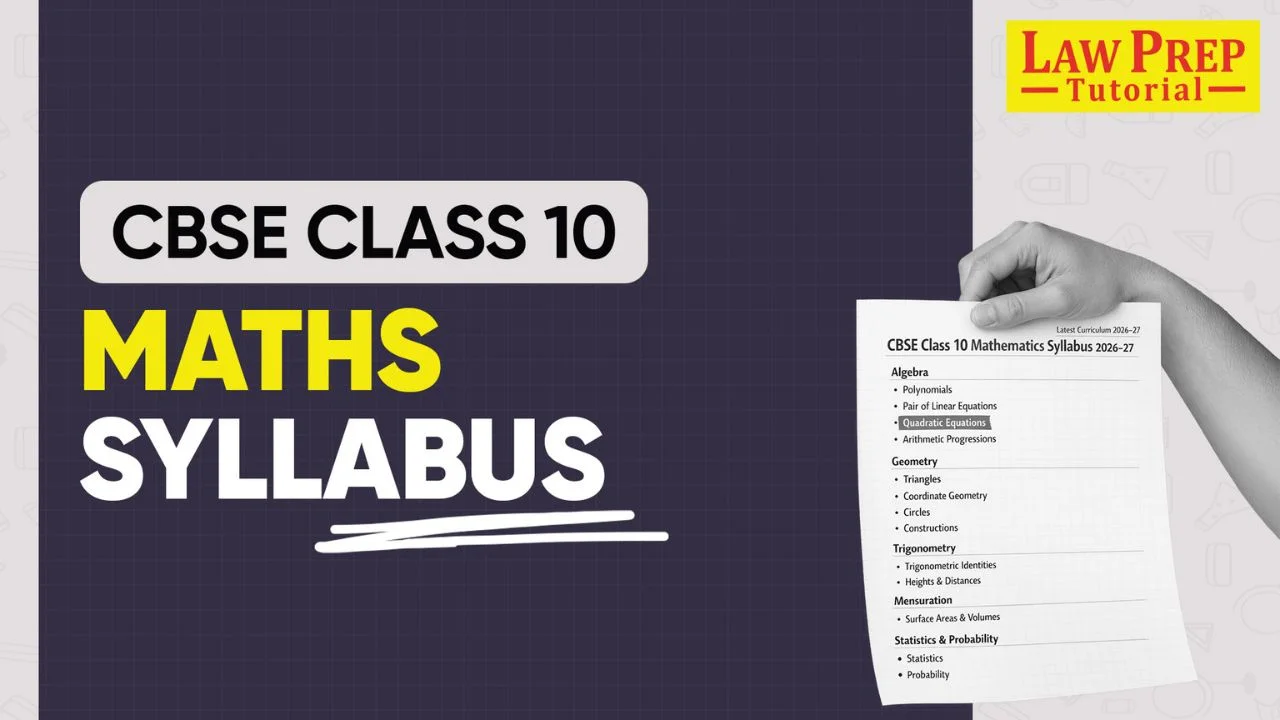
The syllabus is divided into areas like algebra, geometry, trigonometry, mensuration, and statistics. Each unit focuses on problem-solving and application-based questions. You learn how to use formulas, interpret data, and connect concepts across chapters. The CBSE Board exams also follow a structured pattern, where different sections test your understanding, application, and calculation skills. Internal assessment includes periodic tests and activities that support your overall score.
This guide explains each part of the CBSE Class 10 Maths syllabus in a simple and organised way. You will find chapter-wise topics, weightage, important concepts, and exam pattern details aligned with the CBSE Board Class 10 syllabus to help you prepare with clarity and confidence.
Table of Contents
Jump to section- CLAT PG: All About CLAT Postgraduate Exam for LLM
CBSE Board Maths Syllabus for Class 10th
The CBSE Class 10 English syllabus gives you a clear plan for your board exam preparation. It shows what to study, how questions are asked, and which areas need more practice.
The syllabus is divided into three sections: Reading Skills, Writing Skills and Grammar, and Language through Literature. In Reading, you solve two unseen passages with questions on meaning and analysis. In Writing, you practise formats like formal letters and analytical paragraphs. In Literature, you study chapters and poems as part of the CBSE Class 10 syllabus.
The exam follows a fixed structure of 80 marks for theory and 20 marks for internal assessment in the CBSE Class 10 exams. The question paper includes MCQs, short answers, and long answers, so you need both accuracy and clear writing. Internal assessment adds marks through periodic tests, notebook work, and speaking or listening activities.
Below are the major highlights that define the CBSE Class 10 English syllabus assessment.
| CBSE Class 10th Maths Sections | Allotted Marks for Standard Mathematics | Allotted Marks for Basic Mathematics | Description of the Sections |
|---|---|---|---|
| Remembering & Understanding | 43 | 60 | – Recall formulas and concepts – Solve direct questions – Demonstrate basic understanding |
| Applying | 19 | 12 | – Apply formulas in new situations – Solve word problems – Work on case-based questions |
| Analysing, Evaluating & Creating | 18 | 8 | – Solve multi-step problems – Use logical reasoning – Interpret and analyse results |
| Internal Assessment | 20 | 20 | – Periodic Tests and Multiple Assessments – Portfolio Work – Lab Practical Activities |
CBSE Class 10th Maths Syllabus PDF
The CBSE Class 10th Maths syllabus PDF gives you a clear and complete outline of what to study for the board exam. A well-defined syllabus helps you focus on the right topics and avoid spending time on unnecessary content. A clear reference also improves planning and revision.
CBSE has followed a consistent syllabus structure in recent years, so you can rely on the current syllabus for preparation. Chapters, unit-wise weightage, and exam pattern remain aligned across sessions, which allows you to study with clarity and confidence.
The official PDF includes unit-wise topics, chapter details, the marking scheme, and the internal assessment structure. A careful review of the document helps you understand how questions are framed and which areas require more attention.
To access the official syllabus, refer to the link below:
CBSE Class 10th Mathematics Syllabus – Marks Distribution
CBSE Class 10th syllabus of Mathematics gives you a clear structure for board exam preparation. Each unit carries specific marks, so you can decide where to focus more effort. A clear understanding of unit-wise weightage helps you plan study time and improve scoring areas.
The syllabus is divided into units such as Algebra, Geometry, Trigonometry, and Statistics. Each unit focuses on concept clarity and problem-solving. Algebra carries the highest weightage, so regular practice in equations and progressions improves accuracy. Geometry and Trigonometry require step-by-step understanding, while Statistics and Probability offer scoring opportunities with proper practice.
To understand how marks are distributed across these units, refer to the table below:
| Unit | Topic | Marks |
|---|---|---|
| Unit I | Number Systems | 6 |
| Unit II | Algebra | 20 |
| Unit III | Coordinate Geometry | 6 |
| Unit IV | Geometry | 15 |
| Unit V | Trigonometry | 12 |
| Unit VI | Mensuration | 10 |
| Unit VII | Statistics & Probability | 11 |
| Total (Theory) | 80 Marks | |
| Internal Assessment | 20 Marks | |
| Grand Total | 100 Marks |
Units and Marks Distribution
Check the latest CBSE Class 10th syllabus for all subjects below:
CBSE Board Maths Syllabus for Class 10th – Chapter-wise List
CBSE Class 10th Mathematics chapters follow the NCERT textbook structure. Each chapter connects directly with unit-wise topics and exam questions.
To understand how each chapter fits within the unit-wise structure, refer to the table below:
| Class 10th Mathematics Chapters | Unit | Area of Topic |
|---|---|---|
| Real Numbers | Unit I | Number Systems |
| Polynomials | Unit II | Algebra |
| Pair of Linear Equations in Two Variables | Unit II | Algebra |
| Quadratic Equations | Unit II | Algebra |
| Arithmetic Progressions | Unit II | Algebra |
| Coordinate Geometry | Unit III | Coordinate Geometry |
| Triangles | Unit IV | Geometry |
| Circles | Unit IV | Geometry |
| Introduction to Trigonometry | Unit V | Trigonometry |
| TRIGONOMETRIC IDENTITIES | Unit V | Trigonometry |
| Some Applications of Trigonometry (Heights and Distances) | Unit V | Trigonometry |
| Areas Related to Circles | Unit VI | Mensuration |
| Surface Areas and Volumes | Unit VI | Mensuration |
| Statistics | Unit VII | Statistics & Probability |
| Probability | Unit VII | Statistics & Probability |
Check out more important resources for the CBSE Exam here:
| CBSE Class 11th Syllabus | CBSE Class 12th Syllabus |
| CBSE Class 11th: All details | CBSE Class 11th Commerce Subjects |
| CBSE Class 11th Hornbill | CBSE Class 11th Commerce Books |
CBSE Class 10th Maths Detailed Syllabus: Basic vs Standard
CBSE Class 10th Mathematics Basic (Code 241) and Standard (Code 041) follow the same syllabus for the 2025–26 academic session (Board Exam 2026). Both courses include the same chapters and topics taught in school, so your study material and concepts remain unchanged.
The difference appears in the exam pattern and difficulty level of the question paper. Mathematics Standard includes more application-based and analytical questions, while Mathematics Basic focuses more on direct and concept-based questions. Understanding this difference helps you choose the right level based on your comfort with problem-solving and accuracy.
To understand the syllabus in detail, including topics, competencies, and application areas, refer to the unit-wise breakdown below:
| Unit Number and Name for CBSE Class 10th Maths | Name of Topic | Content |
|---|---|---|
| UNIT I: NUMBER SYSTEMS | ||
| 1. | Real Numbers | Fundamental Theorem of Arithmetic |
| Proof of irrational numbers (√2, √3, √5 | ||
| UNIT II: ALGEBRA | ||
| 1. | Polynomials | Zeros of a polynomial |
| Relationship between zeros and coefficients of quadratic polynomial | ||
| 2. | Pair of Linear Equations in Two Variables | Graphical solution |
| Algebraic solution (substitution & elimination) | ||
| 3. | Quadratic Equations | Standard form ax2+bx+c=0ax^2 + bx + c = 0ax2+bx+c=0 |
| Solutions by factorization and quadratic formula | ||
| Discriminant and nature of roots | ||
| 4. | Arithmetic Progressions | nth term of AP |
| Sum of first n terms | ||
| UNIT III: COORDINATE GEOMETRY | ||
| 1. | Coordinate Geometry | Distance formula |
| Section formula | ||
| UNIT IV: GEOMETRY | ||
| 1. | Triangles | Similar triangles and properties |
| Basic Proportionality Theorem | ||
| 2. | Circles | Tangent perpendicular to radius |
| Tangents from external point are equal | ||
| UNIT V: TRIGONOMETRY | ||
| 1. | Introduction to Trigonometry | Trigonometric ratios (sin, cos, tan) |
| Values of ratios for 30°, 45°, 60° | ||
| 2. | Trigonometric Identities | Identity sin2A+cos2A=1sin^2A + cos^2A = 1sin2A+cos2A=1 |
| 3. | Heights and Distances | Angle of elevation & depression |
| UNIT VI: MENSURATION | ||
| 1. | Areas Related to Circles | Area of sectors and segments |
| 2. | Surface Areas and Volumes | Combined solids |
| UNIT VII: STATISTICS AND PROBABILITY | ||
| 1. | Statistics | Mean, Median, Mode (grouped data) |
| 2. | Probability | Classical probability |
Preparing for IPMAT? Learn from the experts with leading Online IPMAT Coaching in India.
Class 10th CBSE Maths Syllabus: Deleted and Added Topics
The CBSE Class 10th Mathematics syllabus for the 2026–27 academic session has not been officially released yet. As of March 2026, the latest available syllabus is for the 2025–26 session (Board Exams 2026). CBSE usually releases the updated curriculum around mid-year, so you can expect official updates later in 2026.
Based on the current syllabus and recent trends, no major additions or deletions have been announced. The syllabus has remained stable since the rationalisation introduced after the pandemic. Most chapters and topics continue without significant changes, and no new topics have been reported for upcoming sessions.
You can continue your preparation using the existing syllabus with confidence. Any official updates, if announced, are usually minor and do not affect the overall structure of the subject.
Class 10th CBSE Maths Syllabus Internal Assessment Structure
Internal assessment plays an important role in your final score, as it contributes 20 marks in both Mathematics Standard and Mathematics Basic. Regular performance in school-based activities helps you secure these marks with consistency.
The assessment structure remains the same for both codes, so your focus should stay on completing tasks on time and maintaining accuracy in all components.
To understand how marks are distributed, refer to the table below:
| Components of Class 10th CBSE Maths Syllabus | Marks | Details of Components |
|---|---|---|
| Pen Paper Test and Multiple Assessment | 10 | – Periodic tests conducted in school – Class assessments and short evaluations |
| Portfolio | 5 | – Notebook work – Assignments and project records |
| Lab Practical | 5 | – Activities based on the prescribed Maths lab manual – Practical application of concepts |
| Total Marks | 20 |
Also check out CBSE Full Form here!
NCERT Books for Class 10th Maths
NCERT books form the base of your preparation for CBSE Class 10th Maths. Board exam questions are directly aligned with NCERT concepts, examples, and exercises. A strong understanding of NCERT helps you solve both basic and application-based questions with accuracy.
The prescribed books cover theory, practice questions, and practical activities. Regular practice from these sources improves concept clarity and builds confidence for the exam.
To understand the complete set of recommended books, refer to the list below:
| S. No. | Book Name | Publisher |
|---|---|---|
| 1 | Mathematics – Textbook for Class IX | NCERT |
| 2 | Mathematics – Textbook for Class X | NCERT |
| 3 | Guidelines for Mathematics Laboratory in Schools (Class IX) | CBSE |
| 4 | Guidelines for Mathematics Laboratory in Schools (Class X) | CBSE |
| 5 | Laboratory Manual – Mathematics (Secondary Stage) | NCERT |
| 6 | Mathematics Exemplar Problems for Class IX | NCERT |
| 7 | Mathematics Exemplar Problems for Class X | NCERT |
CBSE Class 10th Maths syllabus gives you a clear path for board exam preparation when you follow a structured approach. Unit-wise weightage helps you decide where to focus more time, while chapter-wise topics guide daily study. A combination of NCERT practice, regular revision, and sample paper solving improves both speed and accuracy.
Consistent effort across Algebra, Geometry, and Trigonometry builds strong problem-solving skills, while Statistics and Probability offer scoring opportunities with proper practice. Internal assessment also contributes to your final score, so regular performance in tests and practical work remains important.
A focused strategy with clear concepts, regular practice, and proper analysis helps you improve step by step and perform confidently in the exam.
FAQs on CBSE Class 10 Maths Syllabus

SEO Head
Virendra heads SEO & Content at LPT. A writer at heart, he focuses on building exam-focused content that informs, guides, and supports aspirants in their preparation journey.