 Talk to a Counsellor
 Support
CBSE Class 11th: Streams, Subjects, Pattern, All Details
CBSE Class 11th complete guide covering streams, subjects, exam pattern 2026-27, best books, career paths & preparation tips.
Last Updated on 14 Jul 2026

Entering CBSE Class 11th marks a major transition in your academic journey. It’s the stage where you choose a stream, Science, Commerce, or Arts, based on your interests and future career goals.
Unlike previous classes, Class 11 in CBSE introduces in-depth subjects and a more advanced syllabus, setting the foundation for Class 12 and entrance exams.
Whether you’re aiming for JEE, NEET, CLAT, or CUET, the right preparation starts now. This guide will help you understand available streams, subject combinations, syllabus, books, and everything else you need to make informed decisions for success in Class 11 and beyond.
Table of Contents
Jump to sectionCBSE Class 11th Streams
There are three streams in CBSE Class 11:
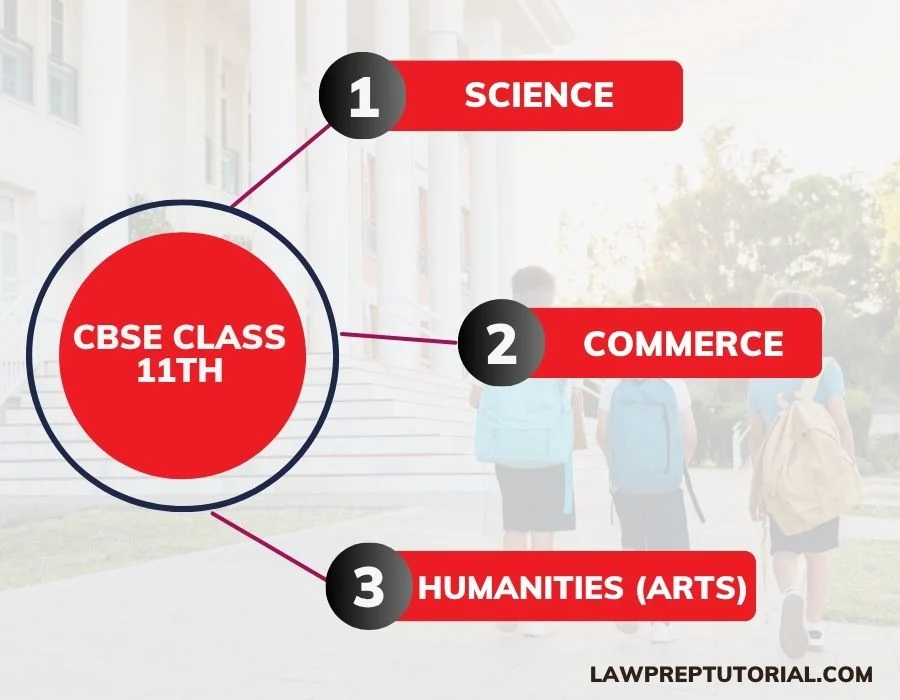
| Stream | Description |
| Science | The Science stream is ideal if you’re interested in subjects like Physics, Chemistry, Biology, and Mathematics. It opens up career paths in engineering, medicine, research, and technology. You can choose between PCM (Physics, Chemistry, Math), PCB (Physics, Chemistry, Biology), or PCMB (all four). |
| Commerce | Commerce focuses on subjects like Accountancy, Business Studies, and Economics. If you’re inclined toward finance, business, management, or entrepreneurship, this stream is a great choice. It also prepares you for exams like CA, CS, and BBA. |
| Arts/Humanities | The Arts or Humanities stream includes subjects like History, Political Science, Sociology, Psychology, and Geography. It’s ideal for students interested in law, journalism, literature, civil services, and social sciences. This stream offers wide flexibility and interdisciplinary options. |
CBSE Class 11 Subjects (Stream-wise)
Below are the CBSE Class 11th subjects:
| Stream | Core Subjects | Optional Subjects | Language Subjects |
| Science | – Physics – Chemistry – Mathematics / Biology |
– Computer Science – Informatics Practices – Physical Education – Psychology |
– English Core – Hindi Core / Elective- Sanskrit (optional) |
| Commerce | – Accountancy – Business Studies – Economics |
– Mathematics – Informatics Practices – Entrepreneurship – Physical Education |
– English Core – Hindi Core / Elective – Other regional languages (optional) |
| Arts / Humanities | – History – Political Science – Sociology – Geography – Economics |
– Psychology – Fine Arts – Legal Studies – Home Science – Physical Education |
– English Core – Hindi Core / Elective – Sanskrit / other languages |
Check full list of CBSE Class 11 Commerce Subjects.
CBSE Class 11 Syllabus 2026
Find the CBSE Class 11th syllabus links:
| S. No | Class 11 Syllabus |
| 1 | CBSE Class 11 Maths Syllabus |
| 2 | CBSE Class 11 Physics Syllabus |
| 3 | CBSE Class 11 Chemistry Syllabus |
| 4 | CBSE Class 11 Biology Syllabus |
| 5 | CBSE Class 11 English Syllabus |
| 6 | CBSE Class 11 Hindi Syllabus |
| 7 | CBSE Class 11 Accountancy Syllabus |
| 8 | CBSE Class 11 Business Studies Syllabus |
| 9 | CBSE Class 11 Economics Syllabus |
| 10 | CBSE Class 11 Political Science Syllabus |
| 11 | CBSE Class 11 Sociology Syllabus |
| 12 | CBSE Class 11 Geography Syllabus |
| 13 | CBSE Class 11 Psychology Syllabus |
| 14 | CBSE Class 11 History Syllabus |
| 15 | CBSE Class 11 Computer Science Syllabus |
| 16 | CBSE Class 11 Informatics Practices Syllabus |
| 17 | CBSE Class 11 Entrepreneurship Syllabus |
| 18 | CBSE Class 11 Legal Studies Syllabus |
| 19 | CBSE Class 11 Physical Education Syllabus |
| 20 | CBSE Class 11 Home Science Syllabus |
| 21 | CBSE Class 11 Fine Arts Syllabus |
| 22 | CBSE Class 11 Sanskrit Syllabus |
CBSE Class 11 Books
| Subject | NCERT Book Title | Popular Reference Books |
| Mathematics | Mathematics Class 11 (Part 1 & 2) | – RD Sharma for Class 11 – ML Aggarwal (for ISC & CBSE) |
| Physics | Physics Class 11 (Part 1 & 2) | – HC Verma Vol 1 – Pradeep’s Fundamental Physics |
| Chemistry | Chemistry Class 11 (Part 1 & 2) | – Pradeep’s Chemistry – Modern’s ABC Chemistry |
| Biology | Biology Class 11 | – Trueman’s Biology – Dinesh Objective Biology |
| English | Hornbill (Main Reader)Snapshots (Supplementary) | – BBC Compacta – Evergreen English |
| Hindi | Antra, Aroh, Vitan, Antral (Depending on course) | – All in One Hindi – Golden Guide Hindi |
| Accountancy | Accountancy: Financial Accounting – I & II | – DK Goel – TS Grewal |
| Business Studies | Business Studies Class 11 | – Subhash Dey – Poonam Gandhi |
| Economics | Indian Economic DevelopmentStatistics for Economics | – Sandeep Garg – TR Jain & VK Ohri |
| Political Science | Indian Constitution at WorkPolitical Theory | – NCERT only (widely preferred) |
| Geography | Fundamentals of Physical GeographyIndia: Physical Environment | – G C Leong (as reference for Physical Geo) |
| History | Themes in World History | – Krishna Reddy’s History Guide |
| Sociology | Introducing SociologyUnderstanding Society | – NCERT only (sufficient for concepts) |
| Psychology | Psychology Class 11 | – NCERT + Psychology by Nicky Hayes (for depth) |
| Computer Science | Computer Science with Python Class 11 | – Sumita Arora (Python) |
| Informatics Practices | Informatics Practices Class 11 | – Sumita Arora |
| Physical Education | Physical Education Class 11 | – Oswaal PE Guide – Together With PE |
| Legal Studies | Legal Studies Class 11 | – Oswaal Legal Studies Guide |
| Home Science | Human Ecology and Family Sciences – Part I & II | – Saraswati Home Science |
| Fine Arts | An Introduction to Indian Art – Part I | – Self-learning + school notes (depends on medium) |
Note: NCERT books for class 11th of CBSE are the primary source and are highly recommended for exam preparation. Reference books help in deeper understanding and competitive exam readiness.
CBSE Class 11 Exam Pattern 2026-27
The CBSE Class 11 exam pattern is designed to assess your understanding through a mix of theory, practicals, and internal assessments. While it follows a school-level structure (not board exams), it prepares you for Class 12 and national-level competitive exams.
| Component | Details |
| Total Marks (Per Subject) | 100 Marks |
| Theory Exam | 80 Marks (for most subjects) |
| Internal Assessment / Practical | 20 Marks (for most subjects) |
| Exam Duration | 3 Hours (for theory papers) |
| Type of Questions | MCQs, Short Answer, Long Answer |
| Passing Marks | Minimum 33% in theory and practical separately (where applicable) |
- Science subjects like Physics, Chemistry, Biology have a practical component of 30 marks and theory of 70 marks.
- Subjects like English, Hindi, History, Political Science generally follow an 80+20 pattern.
- Commerce subjects like Accountancy and Business Studies also follow a similar format, with project work in some cases.
- Internal assessments include class tests, projects, assignments, and attendance.eng
Explore more: CBSE class 11 Commerce Books
Science vs Commerce vs Arts (CBSE Class 11)
Choosing the right stream in CBSE Class 11th is a critical decision that shapes your academic and career path. Here’s a detailed comparison to help you make an informed choice:
| particulars | Science | Commerce | Arts/Humanities |
| Core Subjects | Physics, Chemistry, Maths/Biology | Accountancy, Business Studies, Economics | History, Political Science, Sociology, Geography, Psychology |
| Career Options | Engineering, Medicine, Research, Data Science, Architecture | CA, CS, CMA, B.Com, MBA, Banking, Finance, Entrepreneurship | Law, UPSC, Journalism, Psychology, Teaching, Design, Social Work |
| Entrance Exams | JEE, NEET, CUET (Science), NDA | CUET (Commerce), CA Foundation, CSEET, IPMAT | CUET, CLAT, NID, UPSC, TISS-NET |
| Level of Difficulty | Considered toughest due to complex concepts and practicals | Moderate; focuses on logic, numbers, and business understanding | Flexible; includes theory-heavy but concept-based subjects |
| Who Should Choose? | Students with interest in Maths, Science, problem-solving | Those inclined towards business, numbers, economics | Creative thinkers, writers, aspiring civil servants, lawyers, designers |
| Common Optional Subjects | Computer Science, Physical Education, Hindi | Mathematics, Informatics Practices | Legal Studies, Fine Arts, Home Science, Psychology |
Find detailed questions and answers from all chapters of English Class 11 now:
How to Choose Right Stream in CBSE Class 11th?
Choosing the right stream after Class 10 is one of the most important academic decisions you’ll make. It sets the foundation for your career path and higher education. Here’s how you can choose wisely:
1. Know Your Interests and Strengths
Think about which subjects you genuinely enjoy and perform well in. Do you love solving problems in Maths and Science? Or are you more inclined towards writing, business, or social studies?
2. Understand Each Stream’s Scope
Explore what each stream—Science, Commerce, and Arts—offers in terms of subjects, future studies, and career options. Don’t choose based on what your friends are doing.
3. Set Long-Term Career Goals
Do you see yourself as an engineer, doctor, lawyer, psychologist, entrepreneur, or civil servant? Your career goal should guide your stream selection.
4. Take Stream Aptitude Tests (Optional)
Several online tests or school-guided assessments can help identify which stream suits your personality and skills.
5. Talk to Teachers and Career Counselors
Ask your teachers about your performance in key subjects. Speak to school counselors who can give unbiased advice based on your aptitude and potential.
6. Involve Parents (But Decide for Yourself)
Discuss options with your parents, but remember—it’s your future. Make sure the final decision reflects your interests, not pressure.
7. Explore Flexible Career Paths
Many careers today allow flexibility across streams. For example, law, digital marketing, or design can be pursued from different backgrounds. So choose what you enjoy now; you’ll always find opportunities ahead.
Also check out Hornbill syllabus here!
Career Options After Each Stream (CBSE Class 11)
| Stream | Popular Career Options | Entrance Exams / Courses | Stream Requirement |
| Science (PCM/PCB) | Engineering, Medicine, Architecture, Data Science, Forensic Science | JEE, NEET, NATA, CUET (Science), NDA | Science with Maths/Biology |
| Commerce | CA, CS, CMA, B.Com, Management, Banking, Business Analytics | CA Foundation, CSEET, IPMAT, CUET (Commerce) | Commerce preferred (Math optional for some exams) |
| Arts / Humanities | Law, Journalism, UPSC, Psychology, Teaching, Designing, Foreign Languages | CLAT, CUET (Arts), NID, TISS-NET, B.A. courses | Arts preferred but not mandatory |
| All Streams (Any Background) | Law, Hotel Management, Mass Communication, Civil Services, BBA, BCA, Design, Social Work | CLAT, CUET, IPMAT, NCHMCT-JEE, B.Des., UPSC (after graduation) | No specific stream required |
Read the chapter-wise summaries of Class 11 English here:
CBSE Class 11 Preparation Tips
1. Understand the Syllabus Thoroughly
Start by going through the official CBSE Class 11 syllabus for each subject. Knowing what to study helps you stay focused and avoid unnecessary topics.
2. Stick to NCERT Books First
NCERT textbooks are your primary source. Read them line by line, especially for subjects like Physics, Chemistry, and Biology. They are also important for exams like NEET, JEE, and CUET.
3. Create a Realistic Study Schedule
Divide your time wisely across all subjects, and give extra time to those you find difficult. Balance school studies and self-study with short breaks to avoid burnout.
4. Make Short Notes
While studying, write down formulas, key concepts, and important definitions. These notes will be very helpful during revision time.
5. Practice Regularly
Solve numerical problems, write answers in your own words, and attempt chapter-end questions. For subjects like Maths, Accountancy, and Physics, practice is key.
6. Focus on Conceptual Clarity
Don’t just memorize. Try to understand the “why” behind every concept. Use reference books and online videos if needed.
7. Solve Sample Papers and Previous Year Questions
Practice mock tests, school-level past papers, and CBSE sample papers to get exam-ready. This builds confidence and time management.
8. Don’t Ignore Internal Assessments and Practicals
Subjects like Science, Psychology, PE, and Commerce include project work and practicals. Scoring well in these can boost your overall result.
9. Stay Consistent, Not Perfect
Studying 2 hours every day is better than cramming on weekends. Be regular with your studies and stay committed.
10. Take Help When Needed
If you’re stuck, ask your teachers, join a study group, or look for reliable online resources. Don’t hesitate to clarify doubts.
Find more about: CBSE Class 12th Syllabus
FAQs on CBSE Class 11th

SEO Head
Virendra heads SEO & Content at LPT. A writer at heart, he focuses on building exam-focused content that informs, guides, and supports aspirants in their preparation journey.