Talk to a Counsellor
 Support
CLAT vs LSAT Difference 2027: Full Comparison
Difference between CLAT vs LSAT: The gateway to the best Law colleges is through Law entrance exams, such as the CLAT exam or LSAT exam.
Last Updated on 04 Jul 2026
Download Free CLAT Notes
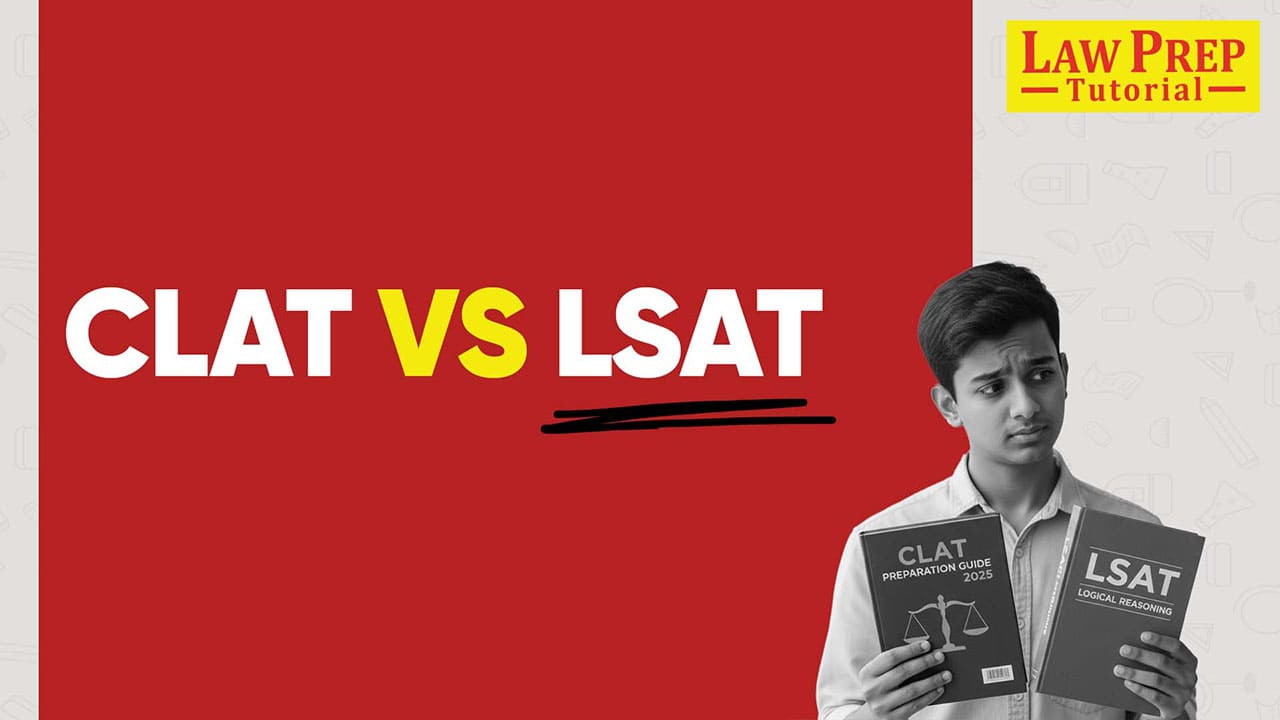
Soon after school, all law aspirants dream about getting into their dream college. The gateway to those best law colleges comes through law entrance exams like CLAT (Common Law Admission Test) or LSAT (Law School Admission Test). With the increasing demand for law programs, aspirants seeking admission to top law institutions appear for various law entrances to land in the top law schools.
It is evident that both CLAT and SLAT land you in good law colleges, but what is the difference between them? This blog will give you a brief idea of the difference between the CLAT and LSAT exams.
Table of Contents
Jump to section- CLAT PG: All About CLAT Postgraduate Exam for LLM
LSAT and CLAT Differences: Highlights
The table below details general highlights between CLAT and LSAT to provide an overview of the essential components of both exams:
| Particulars | CLAT | LSAT |
| Conducting Body | Consortium of NLUs | - LSAC |
| Exam Level | National | - National |
| Courses Offered |
- BA LLB (Hons) |
- BA LLB |
| Courses Duration | - Integrated LLB: 5 years - LLM: 1 year |
- Integrated LLB: 5 years - LLB: 3 years - LLM: 1 year |
| Participating Colleges | 26 NLUs | 16+ LSAT-participating colleges |
| Frequency of Exam | Once a year | Twice a year |
| Sections |
- English Language |
- Reading Comprehension - Analytical Reasoning - Logical Reasoning-1 - Logical Reasoning-2 |
CLAT vs LSAT: Basic Difference
The CLAT is an all-India entrance examination conducted by the Consortium of NLUs in India. It is designed for students seeking admission to undergraduate (LL.B) and postgraduate (LL.M) law programs offered by participating universities.
On the other hand, the LSAT exam is conducted by the Law School Admission Council (LSAC). It is designed for students looking for undergraduate and postgraduate law programs from the LSAT-participating colleges.
Difference Between LSAT and CLAT: Exam Nature and Pattern
Choosing between the CLAT and LSAT exams is a difficult task. Both exams have their importance and are highly prestigious.
| Particular | CLAT | LSAT |
| Exam Mode | Offline | Online |
| Frequency | Once a year | Twice a year |
| Counseling Mode | Online | Offline |
| Test Duration | 2 hours | 2 hours, 20 minutes |
| Type of Questions | Multiple-choice questions | Multiple-choice questions |
| Total no. of Questions | 120 | 92 |
| Marking Scheme | +1 for a correct answer-0.25 for an incorrect answer | +1 for a correct answerNo negative marking |
| Question Areas | CLAT UG English Language, Current Affairs, General Knowledge, Legal Reasoning, Logical Reasoning, Quantitative Techniques CLAT PG Constitutional Law, Other law subjects |
Analytical Reasoning, Logical Reasoning, and Reading Comprehension |
Also Read: Timetable for CLAT Preparation
Difference Between CLAT and LSAT: Application Fees
The difference between LSAT and CLAT application fees is given below:
| CLAT | LSAT |
| For General/ OBC/ PWD/ NRI candidates: INR 4,000/- For SC/ ST/ BPL category candidates: INR 3,500/- |
INR 3999 for all categories. However, discounts can be requested by OBC/ SC/ ST/ EWS category |
CLAT or LSAT: Difficulty Level
| CLAT | LSAT |
| The difficulty level of CLAT is moderate. Moreover, there will be many questions to attempt in less time. The time constraints and negative marking system are challenging for the CLAT aspirants. |
The LSAT question paper difficulty level is high. But an advantage is offered to the candidates as there is no negative marking scheme for any wrong attempt. The students may go for a few guesswork activities. |
Key resources to explore after your CLAT exam:
| CLAT Result | CLAT Answer Key |
| CLAT Counselling | CLAT Admit Card |
| CLAT Marks vs Rank | CLAT Rank Predictor |
| CLAT 2026 Question Paper | CLAT Toppers |
| CLAT College Predictor |
Colleges Accepting CLAT vs LSAT Scores
| CLAT | LSAT |
| 1. National Law School of India University (NLSIU), Bangalore 2. National Law University (NLU), Delhi 3. NALSAR University of Law, Hyderabad 4. West Bengal National University of Juridical Sciences (WBNUJS), Kolkata 5. Gujarat National Law University (GNLU), Gandhinagar 6. National Law University (NLU), Jodhpur 7. National Law Institute University (NLIU), Bhopal 8. Dr. Ram Manohar Lohiya National Law University (RMLNLU), Lucknow 9. Rajiv Gandhi National University of Law (RGNLU), Punjab 10. National Law University (NLUO), Odisha 11. Chanakya National Law University (CNLU), Patna 12. The National University of Advanced Legal Studies (NUALS), Kochi 13. National University of Study and Research in Law (NUSRL), Ranchi 14. Maharashtra National Law University (MNLU), Nagpur 15. Damodaram Sanjivayya National Law University (DSNLU), Visakhapatnam 16. Maharashtra National Law University (MNLU), Mumbai 17. Maharashtra National Law University (MNLU), Aurangabad 18. Himachal Pradesh National Law University (HPNLU), Shimla 19. Dharmashastra National Law University (DNLU), Jabalpur 20. National Law University Tripura (NLUT), Agartala 21. Dr. B. R Ambedkar National Law University (DBRANLU), Haryana 22. Gujarat National Law University (GNLU), Silvassa 23. National Law University and Judicial Academy (NLUJA), Assam 24.Tamil Nadu National Law University (TNNLU), Tiruchirappalli |
1. Alliance University, Bengaluru 2. Asian Law College, Noida 3. BML Munjal University, Gurugram 4. GD Goenka University, Sohna, HaryanaI 5. SBR Law College, Bengaluru 6. Jindal Global Law School, Sonipat, Haryana 7. Lloyd Law College, Noida 8. School of Law and Constitutional Studies Shobhit Institute of Engineering and Technology, Meerut 9. Vinayaka Mission’s Law School, Chennai 10. BITS Law School, Mumbai 11. Chanakya University, Bengaluru 12. CMR University, Bengaluru 13. IILM University, Gurugram 14. Presidency University, Bengaluru 15. University of Petroleum and Energy Studies, New Delhi 16. Vellore Institute of Technology, Chennai |
Conclusion
While the CLAT and LSAT are crucial for law admissions in India, they cater to different preferences and strengths. CLAT is a gateway to national law universities and various law schools in India. In contrast, LSAT India, administered by LSAC, emphasizes analytical and logical skills, making it suitable for numerous law colleges in India. Aspirants should choose based on their career objectives and the specific requirements of their desired law programs.

SEO Head
Virendra heads SEO & Content at LPT. A writer at heart, he focuses on building exam-focused content that informs, guides, and supports aspirants in their preparation journey.
CLAT Trending Blogs