Talk to a Counsellor
 Support
CLAT 2028: Exam Date, Preparation, Registration, New Pattern & Syllabus
CLAT 2028 is expected to be held on 5 December 2027, and registration is likely to start from 2 August 2027. But for you as a CLAT 2028 aspirant, the bigger question is not just the exam date. The real question is whether the CLAT 2028 exam pattern and CLAT 2028 syllabus will change after the Expert Committee Report.
Last Updated on 19 Sep 2026
Download Free CLAT Notes
The Consortium has already said that the committee’s recommendations and public feedback will be considered in preparation for CLAT 2028. This means CLAT 2028 may become more reasoning-based, with possible changes like a three-section UG pattern, removal of GK as a separate section, stronger legal aptitude testing, better question quality, and more analytical Quant.
So, while you should not panic, you should prepare smartly for both the current pattern and possible reforms for CLAT 2028.
Table of Contents
Jump to section- CLAT PG: All About CLAT Postgraduate Exam for LLM
About CLAT 2028
CLAT 2028 is the Common Law Admission Test for students seeking admission to National Law Universities (NLUs) and other participating law schools in India for the academic session 2028.
Through CLAT UG, you can apply for 5-year integrated law courses like BA LLB, BBA LLB, BCom LLB, and similar programs. Through CLAT PG, law graduates can apply for LLM programs. The exam is conducted by the Consortium of National Law Universities and is one of the most important law entrance exams in India.
- CLAT 2028 is for UG and PG law admissions.
- The exam is expected on 5 December 2027.
- Registration is expected from 2 August to 31 October 2027.
- The final pattern and syllabus will be confirmed by the Consortium.
- Expert Committee reforms may be considered for CLAT 2028.
CLAT 2028 Exam Date
The CLAT 2028 exam date is expected to be 5 December 2027. The official notification is expected in July 2027.
| Event | Expected Date / Timeline |
|---|---|
| CLAT 2028 Notification Release | July 2027 |
| CLAT 2028 Registration Start Date | 2 August 2027 |
| CLAT 2028 Registration Last Date | 31 October 2027 |
| CLAT 2028 Application Correction Window | November 2027 |
| CLAT 2028 Admit Card Release Date | Second half of November 2027 |
| CLAT 2028 Exam Date | 5 December 2027 |
| Provisional Answer Key | 8 December 2027 |
| Objection Window | 8-10 December 2027 |
| Final Answer Key | December 2027 |
| CLAT 2028 Result | December 2027 |
| CLAT 2028 Counselling Registration | After result declaration |
CLAT 2028 Registration Date
CLAT 2028 exam registration is expected to start on 2 August 2027 and continue till 31 October 2027. You should complete the form early to avoid last-minute errors.
| Registration Event | Expected Date |
|---|---|
| Application Form Start Date | 2 August 2027 |
| Last Date to Register | 31 October 2027 |
| Last Date to Pay Application Fee | 31 October 2027 |
| Application Correction Window | November 2027 |
How to Fill CLAT 2028 Application Form?
Once the application window is open, you will have to fill the CLAT 2028 form online through the official Consortium portal. Keep your documents, email ID, mobile number, and payment details ready before starting.
- Visit the Official CLAT Website: Go to the official website of the Consortium of NLUs and open the CLAT 2028 registration link when it becomes active.
- Create Your Login Account: Register using your name, mobile number, email ID, and password. Use an active email and phone number for all updates.
- Fill Personal and Academic Details: Enter your personal details, category, address, qualification details, school or college information, and other required information carefully.
- Select UG or PG Program: Choose CLAT UG if you are applying for 5-year law courses, or CLAT PG if you are applying for LLM.
- Upload Required Documents: Upload your photograph, signature, certificates, and other documents in the format and size mentioned in the official instructions.
- Fill NLU Preferences Carefully: Select your NLU preference order wisely because it plays an important role during counselling and seat allotment.
- Pay the Application Fee and Submit: Pay the application fee online, review the full form, submit it, and download the confirmation page for future use.
Documents Required for CLAT 2028 Registration
| Document | Required For | Important Note |
|---|---|---|
| Recent passport-size photograph | All candidates | Use a clear recent photo as per official size guidelines |
| Signature | All candidates | Upload scanned signature in the required format |
| Class 10 marksheet/certificate | UG candidates | Used for basic academic and date-of-birth verification |
| Class 12 marksheet/certificate | UG candidates | Required if already passed Class 12 |
| Class 12 appearing certificate | UG appearing candidates | Needed if you are appearing in Class 12 |
| LLB marksheet/certificate | PG candidates | Required for CLAT PG applicants |
| Final-year certificate | PG appearing candidates | Needed if you are in final year of LLB |
| Category certificate | SC/ST/OBC/EWS candidates | Must be valid and issued by competent authority |
| PwD certificate | PwD candidates | Required to claim PwD reservation or support |
| Domicile certificate | Where applicable | Needed for state domicile-based reservation |
| BPL certificate | BPL candidates | Required to claim fee concession if applicable |
| Valid email ID and mobile number | All candidates | Used for OTP, login, admit card, and updates |
CLAT 2028 Application Form Fees
| Category | Expected Application Fee |
|---|---|
| General / OBC / PwD / NRI / PIO / OCI | ₹4,000 |
| SC / ST / BPL | ₹3,500 |
The final application fee will be confirmed in the official CLAT notification. Additional bank charges may apply during online payment.
Important Resources for CLAT Preparation:
| CLAT Sample Papers | CLAT Selection Process |
| Career Opportunities after Law | Best Newspaper for CLAT Exam |
CLAT 2028: Eligibility Criteria
This is the latest CLAT eligibility criteria:
| Criteria | CLAT UG 2028 | CLAT PG 2028 |
|---|---|---|
| Course | 5-year integrated law courses | LLM programs |
| Required qualification | Class 12 or equivalent | LLB or equivalent law degree |
| Appearing candidates | Class 12 appearing students can apply | Final-year LLB students can apply |
| Minimum marks for General/OBC/PwD/NRI/PIO/OCI | Expected 45% in Class 12 | Expected 50% in LLB |
| Minimum marks for SC/ST | Expected 40% in Class 12 | Expected 45% in LLB |
| CLAT Age limit | No upper age limit | No upper age limit |
| Admission condition | Must clear Class 12 before admission | Must complete LLB before admission |
| Exam purpose | Admission to UG law programs | Admission to PG law programs |
CLAT 2028: Exam Pattern
The final CLAT 2028 exam pattern has not been officially announced yet. However, the CLAT Expert Committee Report has proposed major reforms, and the Consortium has said that the recommendations of the report and public feedback will be considered in preparation for CLAT 2028. This means CLAT 2028 aspirants should understand both the current CLAT pattern and the proposed future model before planning their preparation.
Current CLAT UG Exam Pattern
| Particular | Current CLAT UG Pattern |
|---|---|
| Exam Mode | Offline |
| Exam Duration | 2 hours |
| Type of Questions | Multiple-choice questions |
| Total Questions | 120 |
| Total Marks | 120 |
| Marking Scheme | +1 for correct answer |
| Negative Marking | -0.25 for each wrong answer |
| Unattempted Questions | No marks deducted |
| Number of Sections | 5 sections |
| Sections |
|
Proposed CLAT UG Pattern as per Expert Committee
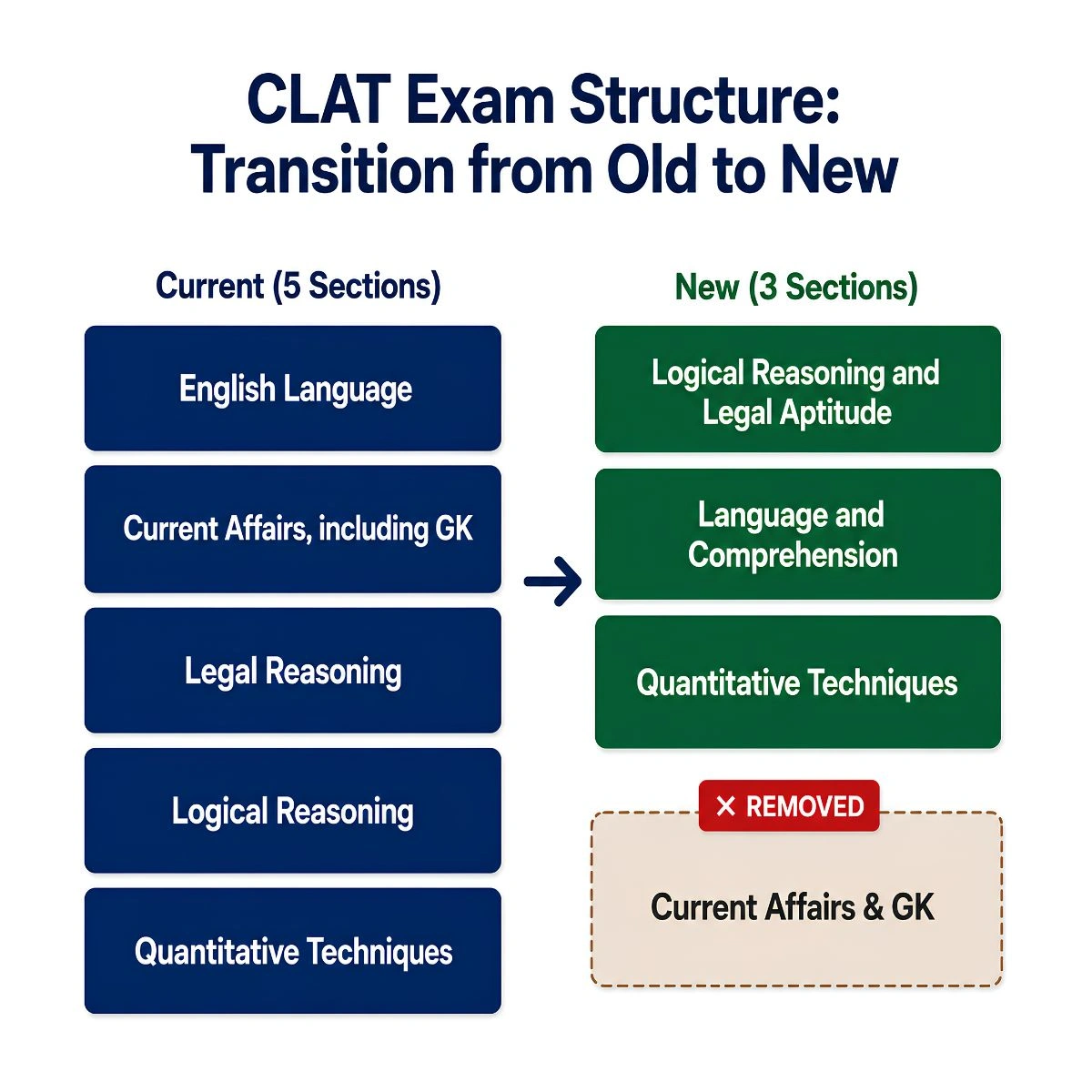
The Expert Committee recommended moving UG CLAT from the current five-section format to a three-section model and removing Current Affairs and GK as a separate section under the proposed framework.
| Proposed Section | What It May Test |
|---|---|
| Logical Reasoning and Legal Aptitude | Rule application, rule derivation, deductive reasoning, inductive reasoning, legal aptitude, and application of facts |
| Language and Comprehension | Reading ability, inference, tone, contextual meaning, interpretation, and argument evaluation |
| Quantitative Techniques | Data sufficiency, conceptual numeracy, quantitative reasoning, and representational logic |
| Total Time | 2 hours |
| Current Affairs & GK | Recommended to be removed as a separate section |
| Essay Section | Not recommended immediately for UG CLAT |
Explore CLAT Section-Wise Practice Questions:
| CLAT GK Questions | CLAT English Questions |
| CLAT Quantitative Techniques Questions | CLAT Logical Reasoning Questions |
| CLAT Legal Reasoning Questions |
Will CLAT 2028 Pattern Change?
The CLAT 2028 pattern is highly likely to change, but nothing is final yet. The Expert Committee has proposed major reforms, and the Consortium has said these recommendations and public feedback will be considered for CLAT 2028. So, prepare for the current pattern, but also build skills for the proposed changes.
Is GK Removed From CLAT 2028?
GK has not been officially removed from CLAT 2028 yet. However, the Expert Committee has recommended removing Current Affairs and GK as a separate section in the proposed future UG CLAT model. So, CLAT 2028 aspirants should not stop GK preparation until the Consortium releases the final pattern.
Practical advice for you:
- Continue GK and current affairs preparation until the final CLAT 2028 pattern is officially announced.
- Focus more on understanding issues, not only memorising facts, dates, names, and events.
- Track legal, national, international, economic, and policy developments because these can still help in reading, reasoning, and legal aptitude.
Will CLAT 2028 Have an Essay Section?
CLAT 2028 is not confirmed to have an essay section. The Expert Committee considered an essay component for UG CLAT but did not recommend its immediate introduction due to evaluation, objectivity, and large-scale assessment challenges. It suggested that the idea may be revisited after three years.
CLAT 2028 Syllabus
CLAT syllabus is one of the most important things to track because it is highly likely to be reviewed before the final notification. The Consortium has not announced the final CLAT 2028 syllabus yet, but the Expert Committee Report has suggested a clear shift from memory-heavy preparation to reasoning, comprehension, legal aptitude, and analytical thinking.
Current CLAT UG Syllabus
| Section | Current Syllabus Focus |
|---|---|
| English Language | Reading comprehension, vocabulary in context, inference, tone, main idea, summary, and passage-based questions |
| Current Affairs including GK | National events, international affairs, legal developments, economy, awards, sports, important personalities, and static GK linked to current issues |
| Legal Reasoning | Legal principles, legal current affairs, rule application, legal awareness, and passage-based legal reasoning |
| Logical Reasoning | Arguments, assumptions, conclusions, strengthening and weakening arguments, inference, analogy, and critical reasoning |
| Quantitative Techniques | Data interpretation, ratios, percentages, averages, profit and loss, basic arithmetic, charts, graphs, and tables |
Proposed CLAT UG Syllabus as per Expert Committee
| Proposed Section | Proposed Syllabus Focus |
|---|---|
| Logical Reasoning and Legal Aptitude | Rule application, rule derivation, legal aptitude, deductive reasoning, inductive reasoning, facts-based analysis, and hypothetical legal reasoning |
| Language and Comprehension | Deep reading, meaning-making, inference, tone, context, argument structure, strengthening and weakening arguments, and interpretation |
| Quantitative Techniques | Data sufficiency, conceptual numeracy, quantitative reasoning, analytical problem-solving, patterns, and representational logic |
| Current Affairs & GK | Recommended to be removed |
| Essay Component | Not recommended immediately |
CLAT 2028 Marking Scheme
The CLAT 2028 marking scheme has not been officially announced yet. Until the Consortium confirms any change, students should understand the current marking scheme.
| Response Type | Marks |
|---|---|
| Correct Answer | +1 mark |
| Wrong Answer | -0.25 mark |
| Unattempted Question | 0 mark |
| Question Type | Multiple-choice questions |
| Total Marks | Currently 120 marks |
If the CLAT 2028 pattern changes, the final marking scheme will be confirmed in the official CLAT notification.
Key resources to explore after CLAT exam:
| CLAT Result | CLAT Answer Key |
| CLAT Marks vs Rank | CLAT Rank Predictor |
| CLAT Cut-Off | CLAT Toppers |
| CLAT College Predictor | CLAT Counselling |
What Did the Expert Committee Recommend for CLAT 2028?
1. Shift From Five Sections to Three Sections
The committee recommended replacing the current five-section UG paper with three broader sections focused on reasoning, comprehension, and quantitative ability.
2. Remove GK as a Separate Section
Current Affairs and GK may be removed as a separate section because the report criticised memory-based and trivia-heavy testing.
3. Merge Legal Reasoning and Logical Reasoning
The report proposed one combined section called Logical Reasoning and Legal Aptitude to test rule application and reasoning.
4. Make Legal Aptitude More Application-Based
Future legal aptitude questions may focus on applying given rules to facts instead of testing prior legal knowledge.
5. Make Language Testing More Comprehension-Based
The English section may become Language and Comprehension, focusing on inference, tone, argument structure, and contextual meaning.
6. Make Quant More Analytical
Quantitative Techniques may test data sufficiency, conceptual numeracy, and representational logic instead of repetitive arithmetic questions.
7. Reduce the Role of Rote Learning
The committee wants CLAT to reward aptitude, thoughtfulness, application, and depth rather than memorisation, speed, coaching, or luck.
8. Improve Question Quality
The report strongly recommends clearer, better-framed, less ambiguous, and more reliable questions to reduce answer-key disputes.
9. Professionalise Paper Setting
The committee recommended external expert paper setters or internal expertise, along with stronger review systems and institutional checks.
10. No Immediate UG Essay Section
The committee considered an essay section but did not recommend it immediately due to scale, objectivity, and evaluation challenges.
CLAT 2028 Preparation Strategy
If you are planning for CLAT 2028, remember that it is the next major CLAT attempt where the Expert Committee recommendations may be seriously considered. The final pattern is not out yet, so your preparation should not depend only on rumours. Right now, your time should go into skills that will not change much even if the paper changes: reading, reasoning, legal aptitude, analytical thinking, current affairs understanding, and mock analysis.
The proposed reforms clearly indicate one thing: CLAT may move closer to testing aptitude, depth, and application instead of memory, speed, and guesswork. So your CLAT preparation should become broader and smarter from the beginning.
1. Build Strong Reading Skills First
Reading will remain central to CLAT, whether the current pattern continues or the proposed pattern is accepted. Read editorials, legal explainers, policy articles, court-related news, and long-form analysis daily.
Focus on understanding tone, argument, assumptions, conclusion, and hidden meaning. Do not just read fast; read with purpose.
2. Prepare Legal Aptitude Through Rule Application
The Expert Committee has proposed stronger focus on legal aptitude without prior legal knowledge. So, instead of memorising laws, practise applying given principles to facts. Learn how one small change in facts can change the answer. This will help you in both the current Legal Reasoning section and any future reformed pattern.
3. Continue Current Affairs Until Final Pattern Is Clear
Do not stop GK or Current Affairs preparation just because the committee recommended removing it as a separate section. That change is not final for CLAT 2028 yet. Prepare CLAT current affairs, but focus more on understanding the background of issues, legal impact, national importance, international context, and policy angle.
4. Practise Logical Reasoning at a Deeper Level
The proposed pattern may merge Legal Reasoning and Logical Reasoning in CLAT into one broader aptitude section. This means you should practise arguments, assumptions, conclusions, strengthening, weakening, inference, analogy, rule derivation, and LSAT/LNAT-style reasoning. Your goal should be accuracy with reasoning, not shortcut-based solving.
5. Make Quant More Conceptual
Quant may become more reasoning-based if the proposed reforms are considered. So, prepare basic arithmetic, percentages, ratios, averages, and DI, but also practise data sufficiency, patterns, conceptual numeracy, and logic-based data questions.
You do not need advanced maths, but you need comfort with numbers and structured data.
6. Start Mocks Early, But Analyse Them Properly
Do not wait for the final CLAT 2028 notification to start mocks. Begin with sectional tests, then move to full-length CLAT mocks. After every mock, check why you lost marks: concept gap, reading mistake, time pressure, poor option elimination, or over-attempting. Mock analysis will matter more than mock count.
Best Books and Resources for CLAT 2028
| Resource Type | Best Use for CLAT 2028 Preparation |
| Newspapers and Editorials | Build reading speed, issue awareness, argument understanding, and vocabulary in context. Recommended newspapers include The Hindu and Indian Express. |
| CLAT Previous Year Papers | Understand the current pattern, question style, difficulty level, and section-wise expectations. Recommended PYQs include from CLAT 2020 to CLAT 2026. |
| CLAT Mock Tests | Improve time management, accuracy, question selection, and exam temperament. |
| CLAT Sectional Tests | Strengthen English, GK, Legal Reasoning, Logical Reasoning, and Quant separately. |
| Current Affairs Magazines | Revise monthly events, legal developments, national news, international affairs, and policy updates. Recommended magazine include CLAT Express. |
| Legal Reasoning Practice Material | Practise principle-fact application, legal awareness, and rule-based reasoning. |
| Logical Reasoning Books/Practice Sets | Build argument analysis, inference, assumption, strengthening, weakening, and critical reasoning. |
| LNAT Practice Questions | Prepare for deeper reasoning, rule application, complex passages, and possible future reforms. |
| Quantitative Aptitude Basics | Cover percentages, ratios, averages, profit-loss, DI, and reasoning-based numerical questions. |
| Law Prep Tutorial CLAT Study Material | Get structured preparation, updated mocks, mentor guidance, current affairs, and exam-focused practice. Use Game Changer Kit. |
Explore related resources for CLAT preparation:
| Best Books for CLAT Preparation | The Hindu Daily Analysis for CLAT |
| How to Read Newspaper for CLAT | Editorials for CLAT |
Common Mistakes CLAT 2028 Aspirants Should Avoid
- Waiting for the final CLAT 2028 pattern before starting preparation.
- Reading only short news summaries and avoiding long passages.
- Taking mocks without analysing mistakes properly.
- Preparing only for speed and ignoring accuracy.
- Ignoring Quant because it has fewer questions.
- Not tracking official updates from the Consortium.
- Avoiding difficult reasoning questions.
- Ignoring LSAT/LNAT-style practice completely.
- Changing preparation strategy after every rumour.
- Not building a daily reading habit.
- Starting full-length mocks too late.
- Not revising monthly CLAT current affairs regularly.
- Spending too much time on one section and ignoring balance.
- Treating CLAT as a memory-based exam.
- Not taking mentor feedback.
- Preparing without a monthly plan.
Should You Join Coaching for CLAT 2028?
Yes, structured coaching helps if you want guided preparation, updated study material, mocks, doubt support, and mentor-led strategy. Since CLAT 2028 may see proposed reforms, coaching helps you prepare for both the current pattern and possible changes without confusion, panic, or wasted effort.
Join:
Law Prep Tutorial’s Guidance for CLAT 2028 Aspirants
Do not wait for the final pattern to begin. Start with the skills that will matter in every possible version of CLAT: reading, reasoning, legal aptitude, and analytical thinking.
The Expert Committee Report clearly points toward a future where CLAT may become more reasoning-based, less memory-driven, and more focused on application. The report recommends moving UG CLAT from five sections to three sections, removing GK as a separate section in the proposed model, merging Legal and Logical Reasoning, and making Quant more analytical.
Our CLAT 2028 preparation will keep students ready for both possibilities: the current CLAT pattern and the proposed reform-based direction. Students will practise regular CLAT mocks, section-wise tests, legal reasoning, current affairs, LSAT/LNAT-style questions, and analytical Quant. With mentor support, performance tracking, and AI-powered LMS analysis, you can identify weak areas early and improve with a clear plan.
Checkout the Best Law Universities in India:
| NLSIU Bangalore | RMNLU Lucknow |
| NLU Shimla | MNLU Nagpur |
| NALSAR Hyderabad | NLU Prayagraj |
| NLU Jodhpur | NLU Delhi |
| NUJS Kolkata | NLIU Bhopal |
| GNLU Gandhinagar | IIULER Goa |
| NLU Ranchi |
FAQs About CLAT 2028

Senior Academic Mentor – Law Entrance Exams
Richa Bais is an experienced law entrance educator who has mentored CLAT and other law entrance exam aspirants for over a decade. Her expertise includes CLAT preparation strategy, curriculum planning, academic content development, and student mentorship. At Law Prep Tutorial, she has helped students understand complex concepts, build effective preparation plans, and improve their exam performance through structured guidance, practical learning methods, and personalized academic support.
CLAT Trending Blogs