Talk to a Counsellor
 Support
CLAT 2027 Expert Committee Report (Out): Major Reforms Proposed
The CLAT 2027 Expert Committee Report is finally out, and the biggest update for aspirants is clear: there will be no change in the CLAT 2027 syllabus, pattern, or sections for both UG and PG papers. This means CLAT 2027 aspirants can continue their preparation as per the existing exam structure without panic.
Last Updated on 22 Jul 2026
Download Free CLAT Notes
The CLAT expert committee report has proposed major reforms for the future, including changes in question quality, paper structure, section design, and the overall way CLAT tests legal aptitude. The Consortium has also stated that the CLAT 2027 paper setters may consider the committee’s suggestions on question format and quality wherever feasible. So, while the pattern remains the same for CLAT 2027, students should prepare for better-designed, more reasoning-based, and more analytical questions.
Table of Contents
Jump to sectionKey Highlights of CLAT Expert Committee Report
- CLAT UG may shift from five sections to three sections in future.
- No immediate essay section recommended for UG CLAT due to evaluation challenges.
- Current Affairs and GK may not remain separate sections in future CLAT.
- Past CLAT papers were criticised for ambiguity, errors, and weak question quality.
- Future CLAT should test reasoning and aptitude over rote learning.
- Legal Reasoning and Logical Reasoning may merge into one aptitude-based section.
- Quantitative Techniques may become more reasoning-based, with less repetitive arithmetic.
- CLAT PG may include Legal Knowledge and constructed-response problem questions.
- Professional paper-setting, review systems, and exam governance reforms were strongly recommended.
- The committee urged quick public release for transparency, trust, and public discussion.
Major Changes Proposed by CLAT Expert Committee
1. CLAT UG May Move From 5 Sections to 3 Sections
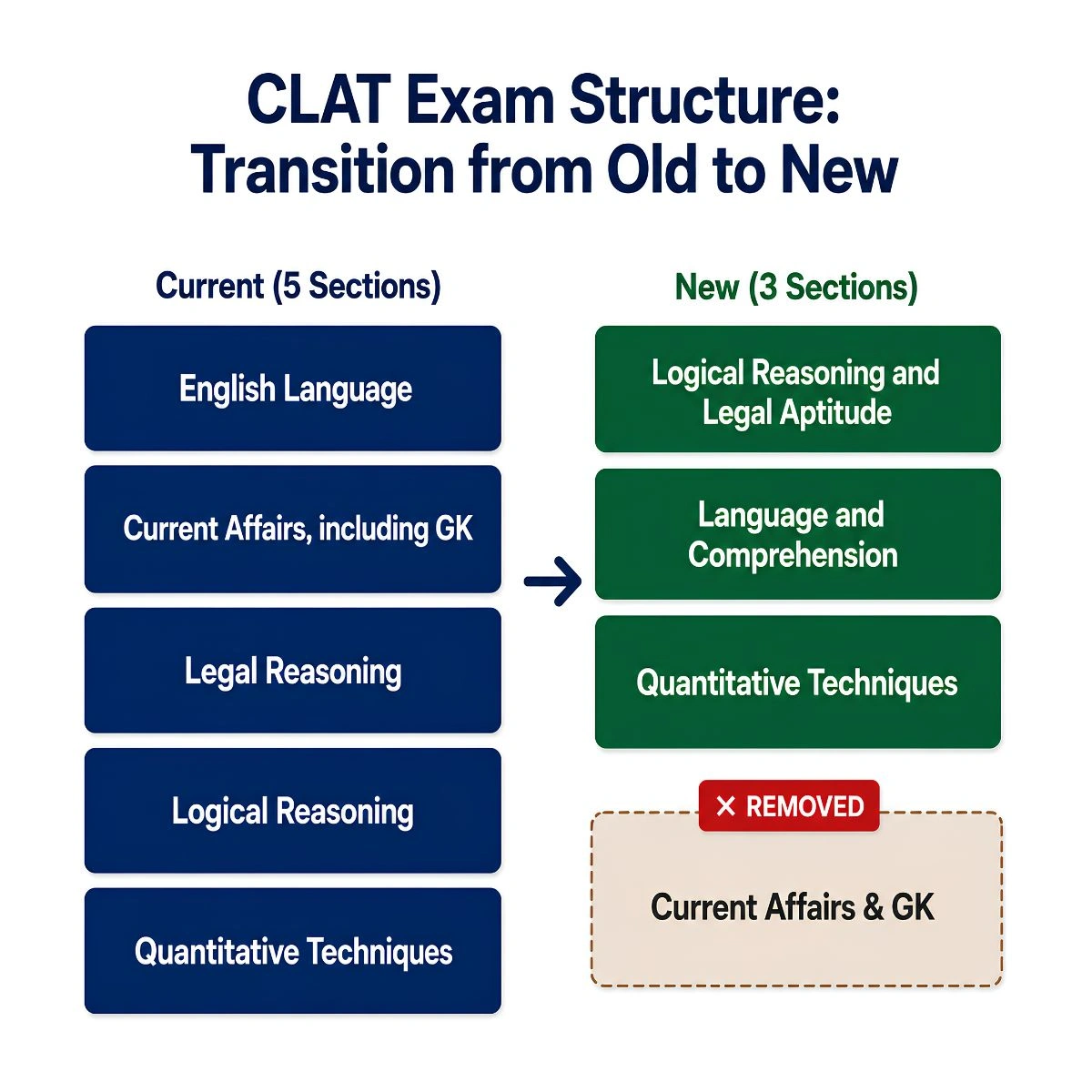
The biggest recommendation in the CLAT Expert Committee Report is the proposed restructuring of the UG paper. At present, CLAT UG has five sections: English Language, CLAT Current Affairs including GK, Legal Reasoning, Logical Reasoning, and Quantitative Techniques.
The committee recommends moving to a three-section model: CLAT Logical Reasoning and Legal Aptitude, Language and Comprehension, and Quantitative Techniques.
This would make the exam more skill-based and reduce overlap between sections. However, students must remember that this is not applicable to CLAT 2027, as the official press release says there will be no change in syllabus, pattern, or sections for CLAT 2027.
2. Current Affairs and GK May Be Removed as a Separate Section
The CLAT Expert Committee report clearly recommends removing Current Affairs and General Knowledge as a separate section in the proposed future UG CLAT model. The committee has raised concerns that the current GK section rewards memory, news-cycle trivia, and obscure factual recall instead of real aptitude.
In many cases, the section either tests facts directly or becomes another passage-comprehension section. For future reforms, the committee appears to prefer a model where reasoning, comprehension, and legal aptitude are tested more directly. But for CLAT 2027 aspirants, GK is still part of the exam because the Consortium has confirmed no change in syllabus or sections for CLAT 2027.
3. Legal Reasoning and Logical Reasoning May Be Merged
The report recommends merging CLAT Legal Reasoning and Logical Reasoning into one section called Logical Reasoning and Legal Aptitude. This is important because the CLAT Expert committee feels that legal aptitude should not depend on prior legal knowledge. Instead, students should be tested on their ability to apply rules to facts, derive rules from examples, identify relevant words in a rule, and understand how facts change the result.
This means future CLAT may move closer to LSAT-style reasoning and rule-based legal aptitude. For students, this signals that simply memorising legal maxims, laws, or current legal topics may not be enough in future exams.
This section may test:
- Rule application
- Rule derivation
- Deductive reasoning
- Inductive reasoning
- Legal aptitude without prior legal knowledge
- Ability to apply facts carefully
- Ability to handle modified factual situations
4. Language and Comprehension May Replace English Language
The CLAT expert committee report recommends that the current English Language section should be absorbed into a broader Language and Comprehension section. The purpose is not to test English grammar, vocabulary, or polished language for its own sake. Instead, the section should test how well a student reads, understands, interprets, and reasons with text.
This is an important shift because it focuses on functional literacy, not ornamental English. The report also says that questions should test inference, tone, meaning, context, and argument structure. For aspirants, this means reading practice should go beyond finding answers directly in the passage.
|
Current Focus |
Proposed Focus |
|
English Language |
Language and Comprehension |
|
Vocabulary and surface-level reading |
Meaning, inference, tone, and argument |
|
Direct passage-based answers |
Deeper interpretation |
|
Grammar-style preparation |
Reading and reasoning with text |
5. Quantitative Techniques May Become More Reasoning-Based
The CLAT 2027 Expert Committee report notes that CLAT Quantitative Techniques is generally the most consistent and least error-prone section. However, it also says that the section currently lacks variety and often tests a narrow range of arithmetic skills such as ratios, percentages, and proportions.
The committee recommends making Quant more reasoning-based, with focus on data sufficiency, conceptual numeracy, quantitative reasoning, and representational logic. This means future Quant may not become tougher in terms of advanced maths, but it may become more analytical. Students may need to understand what data is required, how numbers connect, and how to reason through a problem logically.
|
Current Quant Issue |
Suggested Direction |
|
Repetitive arithmetic |
More varied question types |
|
Ratios, percentages, proportions repeated often |
Data sufficiency and conceptual numeracy |
|
Direct calculations |
Reasoning with numbers |
|
Limited skill range |
Analytical and representational logic |
6. No Immediate Essay Section for UG CLAT
The committee considered whether an essay component should be added to UG CLAT. It agreed that essay writing can test a student’s ability to structure arguments clearly, express ideas, and respond to the other side. However, it did not recommend immediate introduction of an essay section because of practical challenges.
The biggest problems are objectivity and scale. Since tens of thousands of students appear for CLAT, evaluating essays fairly and consistently would require a strong assessment system. The report suggests that an essay component may be revisited after three years, once the system has more experience with constructed-response evaluation.
7. CLAT Should Test Aptitude, Not Rote Learning
The report of CLAT 2027 Expert Committee strongly says that an error-free paper is only the minimum requirement. CLAT must also test the right skills. According to the committee, the current system often rewards legal and general knowledge, speed, breadth, rote learning, prior coaching, stylistic fluency, and even luck.
The proposed framework should instead reward logical and legal aptitude, thoughtfulness, application, depth, functional literacy, and genuine ability. This is one of the most important philosophical shifts in the report. It means the exam should become less about who has memorised more and more about who can read, reason, apply, and think clearly.
|
Current Framework Rewards |
Proposed Framework Should Reward |
|
Legal and general knowledge |
Logical and legal aptitude |
|
Speed |
Thoughtfulness and application |
|
Breadth |
Depth |
|
Rote learning and coaching advantage |
Intellectual ability |
|
Stylistic fluency |
Functional literacy |
|
Luck |
Genuine ability |
8. CLAT PG May Get a Major Redesign
The report also gives important recommendations for CLAT PG. It says the PG exam should retain the three foundational sections recommended for UG: Logical Reasoning and Legal Aptitude, Language and Comprehension, and Quantitative Techniques, but with reduced overall weightage. Along with this, it recommends a Legal Knowledge section and a constructed-response problem question.
This would be a major shift from a purely MCQ-based test toward a model that also checks structured legal reasoning and written articulation. For PG aspirants, the future exam may require deeper legal understanding, not just recall of judgments, provisions, and legal facts.
|
Proposed CLAT PG Component |
What It Would Test |
|
Logical Reasoning and Legal Aptitude |
Foundational reasoning |
|
Language and Comprehension |
Legal reading and interpretation |
|
Quantitative Techniques |
Analytical use of numbers/data |
|
Legal Knowledge |
Key concepts and recent legal developments |
|
Problem Question |
Structured legal reasoning and writing |
9. Professional Paper-Setting is a Major Recommendation
One of the strongest recommendations in the CLAT Expert Committee report is to professionalise paper-setting. The committee says that CLAT is an aptitude test, and such tests require specialised expertise in test design, review, validity, reliability, bias control, and fairness. It suggests two possible routes: hiring an external paper-setting agency with relevant standardised test experience or developing internal expertise inside the CLAT Secretariat.
It also recommends stronger institutional systems such as an exam board, standard operating procedures, fixed timelines, better review, stakeholder communication, grievance redressal, confidentiality systems, and institutional memory. This is meant to reduce errors, ambiguity, answer-key disputes, and repeated litigation.
Recommended reforms include:
- External paper setter or internal expert team
- CLAT Exam Board
- Two-stage paper review
- SOPs for every process
- Strict timelines
- Better communication with students and parents
- Quick grievance redressal
- Preservation of institutional memory
- Confidentiality during paper-setting and review
10. The Report Itself Asked for Quick Public Release
A very important part of the report is the committee’s own request that the report be published in the public domain at the earliest. The committee submitted the final report on February 2, 2026 and gave three reasons for quick publication: stakeholder investment, informed public discourse, and legitimacy/credibility.
This matters because students, parents, teachers, and institutions had already participated in the feedback process and were waiting for clarity. The committee itself recognised that reforms of this scale need transparency. Eventually, the report was published with public feedback invited till August 31, 2026.
Explore Key Resources for the CLAT Exam:
| CLAT Exam Notification | CLAT Registration Form |
| CLAT Eligibility Criteria | Important Topics for CLAT Exam |
CLAT 2027: The Ultimate Last-Months Preparation Roadmap
What Has the Consortium Finalized for CLAT 2027?
The Consortium of National Law Universities has now clarified the position for CLAT 2027 through its official press release dated July 21, 2026. The most important update is that there will be no change in the syllabus, exam pattern, or sections of UG and PG CLAT 2027.
This gives direct relief to students who were worried that the Expert Committee recommendations may immediately change the structure of the exam.
At the same time, the Consortium has not completely ignored the Expert Committee Report. It has said that the CLAT 2027 Convenor and paper setters will consider and adopt suggestions related to question format and question quality wherever feasible. This means students should not expect a new pattern, but they may expect better-framed, more reasoning-based, and higher-quality questions.
Consortium’s Final Decision for CLAT 2027:
|
Point |
What the Consortium Has Said |
|
No change in pattern/sections of UG and PG papers. |
|
|
No change in syllabus for UG and PG papers. |
|
|
UG CLAT Sections |
Existing sections will continue. |
|
PG CLAT Structure |
No change in PG syllabus or pattern/sections. |
|
Question Format & Quality |
Paper setters may adopt Expert Committee suggestions in a feasible manner. |
|
Expert Committee Report |
Report will be published for public feedback. |
|
Feedback Deadline |
Feedback can be submitted till August 31, 2026. |
|
Future Reforms |
Recommendations and feedback will be considered for CLAT 2028. |
FAQs About CLAT 2027 Expert Committee Report

SEO Head
Virendra heads SEO & Content at LPT. A writer at heart, he focuses on building exam-focused content that informs, guides, and supports aspirants in their preparation journey.
CLAT Trending Blogs
Other Related Blogs