Talk to a Counsellor
 Support
CLAT Syllabus 2027/28 (Latest & Detailed Section-Wise PDF)
Download the latest CLAT 2027/28 syllabus PDF with section-wise topics, marks distribution, and expert prep tips.
Last Updated on 08 Jul 2026
Download Free CLAT Notes
The CLAT 2027 syllabus includes five sections: English Language, Current Affairs including GK, Legal Reasoning, Logical Reasoning, and Quantitative Techniques. English covers reading comprehension, vocabulary, tone, inference, and arguments. Current Affairs includes national and international events, legal developments, polity, economy, awards, reports, and important personalities.
Legal Reasoning tests legal principles, facts, rights, duties, judgments, and public policy issues. Logical Reasoning focuses on arguments, assumptions, conclusions, patterns, and critical thinking. Quantitative Techniques covers data interpretation, percentages, ratios, averages, profit-loss, and basic arithmetic.
The latest CLAT syllabus mainly demands reading speed, accuracy, reasoning ability, and awareness. Below, we have covered the detailed syllabus of CLAT exam with PDF.
Table of Contents
Jump to section- CLAT PG: All About CLAT Postgraduate Exam for LLM
Sections in CLAT Syllabus
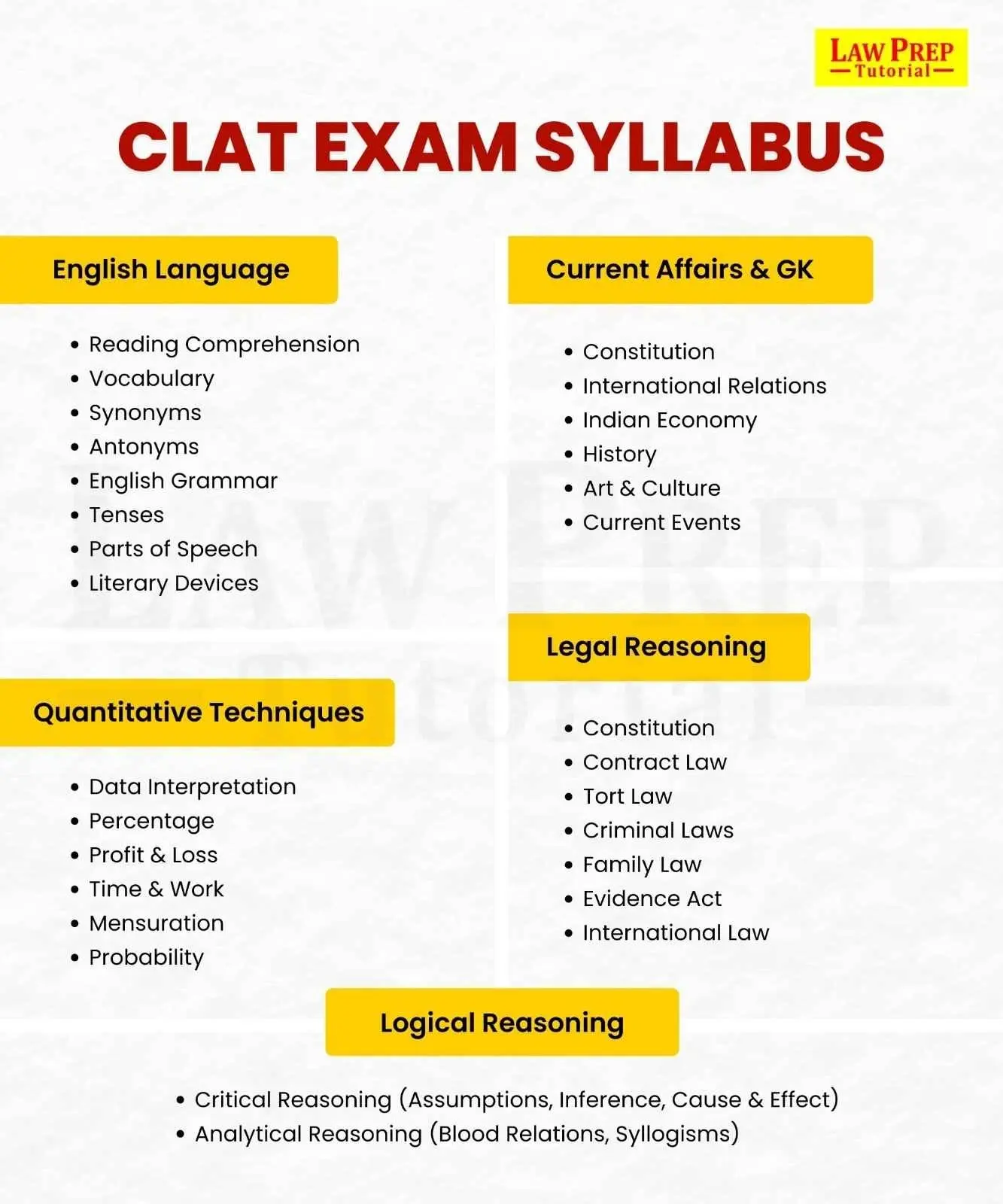
The CLAT syllabus consists of the following 5 sections:
- English Language
- Current Affairs, including General Knowledge
- Legal Reasoning
- Logical Reasoning
- Quantitative Techniques
Download CLAT 2027 Syllabus PDF
Get the comprehensive CLAT syllabus PDF to kickstart your preparation. This free download includes detailed topics for all sections, helping you plan effectively and focus on high-scoring areas.
Benefits of Having the Detailed CLAT Syllabus PDF:
- Comprehensive Coverage
- Offline Accessibility
- Efficient Preparation
- Saves Time
- Exam-Ready Format
- Supports Revision
CLAT 2027 Syllabus: Overview
This is the new syllabus for CLAT 2027 preparation:
| Section | Key Topics |
| English Language |
|
| Current Affairs, including GK |
|
| Legal Reasoning |
|
| Logical Reasoning |
|
| Quantitative Techniques |
|
Download Complete Syllabus PDF
CLAT 2027 Syllabus for English Language
The CLAT English syllabus tests a candidate’s proficiency in comprehension, grammar, and vocabulary. With 22-26 questions in this section, it accounts for 20% of the exam.
Mastery of English is critical as it enhances understanding of other sections, particularly Legal Reasoning and Logical Reasoning. From identifying the tone of passages to solving para jumbles, strong English skills are indispensable for improving accuracy and time management.
| Topic | Key Areas Covered |
| Reading Comprehension | Passages of ~450 words, main idea, tone, viewpoints, inferences, and summary questions |
| Vocabulary |
|
| English Grammar |
|
| Paragraph-Based Questions |
|
| Literary Devices | Common literary terms and their applications |
1. Reading Comprehension
Reading comprehension in CLAT involves analyzing passages (~450 words) to identify the main idea, tone, viewpoints, and inferences. Focuses on evaluating comprehension and summarization skills essential for both this section and understanding complex legal texts.
2. Vocabulary
Vocabulary for CLAT covers synonyms, antonyms, root words, homophones, idioms, and one-word substitutions.
It tests a candidate’s understanding of word meanings and contextual usage, helping improve comprehension and precision in written communication.
3. Grammar
CLAT English Grammar focuses on parts of speech, tenses, modals, conditionals, and phrasal verbs. It enhances clarity in sentence construction and ensures grammatical accuracy, which is critical for answering language-based questions.
4. Paragraph-Based Questions
Includes para jumbles, para completion, and para summaries. Tests logical coherence and sequencing abilities, vital for presenting clear arguments and analyzing textual structures.
5. Literary Devices
Explores common literary terms like metaphors, similes, and personifications. Strengthens interpretative skills and helps in understanding nuanced expressions in reading passages.
Recommended Preparation Resources:
CLAT 2027 Syllabus for Current Affairs and GK
The syllabus of CLAT Current Affairs and GK focuses on assessing a candidate’s awareness of national and international events, history, and general knowledge.
This section comprises 28-32 questions (25% of the exam), making it a high-weightage area. Staying updated with daily events and understanding key topics in history, economics, and the constitution are essential for scoring well.
| Topic | Key Areas Covered |
| Constitution of India |
|
| Basics of International Relations |
|
| Basics of Economics |
|
| Important Current Events |
|
| History |
|
| Art and Culture |
|
1. Constitution of India
The Indian Constitution covers key provisions, governance structure, and judiciary, essential for understanding legal systems.
2. Basics of International Relations
Focuses on India’s foreign policies, relations with neighbors, and international organizations like the UN.
3. Basics of Economics
Includes inflation, banking, and economic terms, offering insights into financial systems and policies.
4. Important Current Events
Focuses on recent developments in science, politics, environment, and schemes, critical for staying updated.
5. History
Explores freedom struggles, significant figures, and key historical milestones shaping modern India.
6. Art and Culture
Highlights India’s rich heritage in art, literature, and architecture, fostering cultural awareness.
Recommended Preparation Resources:
CLAT 2027 Syllabus for Legal Reasoning
The CLAT Legal Reasoning syllabus tests a candidate’s ability to understand legal principles and their application. With 28-32 questions (25% of the exam), it is one of the most crucial sections.
It not only evaluates your legal aptitude but also enhances your understanding of fundamental legal concepts like constitutional rights, contracts, and criminal law.
Scoring well in this section boosts your chances of securing admission to top NLUs, making it essential for aspirants.
| Topic | Key Areas Covered |
| Constitution |
|
| Contract Law | Types of contracts, offer, acceptance, consideration, capacity to contract, breach, and remedies. |
| Tort Law | Nature of torts, negligence, vicarious liability, defamation, nuisance, and trespass. |
| Criminal Law | Offenses like murder, theft, culpable homicide, sexual offenses, and defenses in criminal law. |
| Family Law |
|
| Evidence Act |
|
| International Law Basics |
|
| Other Law Basics |
|
1. Constitution
Covers fundamental rights, emergency provisions, and governance structure, building knowledge of India’s legal framework.
2. Contract Law
Focuses on agreements, offer and acceptance, breach, and remedies, essential for understanding legal transactions.
3. Tort Law
Explores negligence, liability, and defamation, highlighting accountability in civil wrongs.
4. Criminal Law
Includes major offenses like murder and theft, emphasizing intent, defenses, and criminal liabilities.
5. Family Law
Discusses marriage, divorce, and inheritance laws, introducing personal legal matters.
6. Evidence Act
Covers burden of proof, estoppel, and dying declarations, testing evidence-based reasoning.
7. International Law Basics
Focuses on treaties, state recognition, and refugee laws, fostering global legal awareness.
8. Other Law Basics
Includes intellectual property rights, arbitration, and data protection laws, addressing current legal issues.
Recommended Preparation Resources:
- CLAT Legal Reasoning: All details
- CLAT Legal Reasoning Passages
- CLAT Legal Reasoning Sectional Tests
- CLAT Legal Reasoning Questions
Syllabus of CLAT Logical Reasoning
The CLAT Logical Reasoning syllabus evaluates a candidate’s ability to think critically and solve problems logically. This section, comprising 22-26 questions (20% of the exam), is pivotal for interpreting and analyzing arguments, patterns, and logical sequences.
It strengthens problem-solving skills, essential not just for CLAT but also for a successful legal career. Mastering this section helps in improving accuracy and time management during the exam.
| Topic | Key Areas Covered |
| Critical Reasoning |
|
| Analytical Reasoning |
|
| Course of Action | Logical decision-making based on given scenarios. |
| Flaw in Reasoning | Identification of logical fallacies in arguments. |
| Parallel Reasoning | Drawing analogies and recognizing similar logical structures. |
1. Critical Reasoning
Tests argument evaluation, inferences, and assumptions, focusing on identifying and strengthening logical arguments.
2. Analytical Reasoning
Includes problem-solving in patterns like blood relations, seating arrangements, and coding-decoding to assess logical structure understanding.
3. Course of Action
Involves logical decision-making based on hypothetical scenarios, emphasizing practicality and reason.
4. Flaw in Reasoning
Identifies fallacies in arguments, sharpening skills to spot inconsistencies or errors in logic.
5. Parallel Reasoning
Tests analogy-based reasoning by identifying similar patterns or logical structures in arguments.
Recommended Preparation Resources:
- CLAT Logical Reasoning Sectional Tests
- CLAT Logical Reasoning Questions
- Blood Relations Reasoning Questions for CLAT
CLAT Syllabus for Quantitative Techniques
The CLAT Quantitative Techniques syllabus evaluates mathematical aptitude and data interpretation skills. With 10-14 questions (10% of the exam), this section focuses on Class 10-level mathematics and application-based problem-solving.
Practice is key to mastering this section and ensuring accuracy within the limited time.
| Topic | Key Areas Covered |
| Basic Calculations |
|
| Percentage and Ratios |
|
| Profit and Loss | Calculating profit, loss, and discounts. |
| Interest Calculations |
|
| Time and Work | Work efficiency, pipes and cistern problems. |
| Time, Speed, and Distance | Problems on trains, boats, and streams. |
| Mensuration |
|
| Data Interpretation |
|
| Probability |
|
1. Basic Calculations
Covers foundational skills like squares, cubes, and divisibility rules, crucial for quick and accurate computations.
2. Percentage and Ratios
Focuses on calculating percentages, ratios, and averages, essential for analyzing quantitative scenarios.
3. Profit and Loss
Tests the ability to calculate profit, loss, and discounts, relevant in financial problem-solving.
4. Interest Calculations
Includes simple and compound interest, emphasizing financial literacy and logical application.
5. Time and Work
Assesses efficiency and problem-solving with work-related scenarios like pipes and cisterns.
6. Time, Speed, and Distance
Explores concepts of motion and relative speed in scenarios like trains and boats.
7. Mensuration
Focuses on calculating area, volume, and surface area of geometric figures, essential for spatial reasoning.
8. Data Interpretation
Involves analyzing tables, charts, and graphs to draw logical conclusions from numerical data.
9. Probability
Tests understanding of probability and permutations, helping assess outcomes in uncertain situations.
Recommended Resources for You:
- CLAT Quantitative Techniques Questions
- Math Calculation Tips for CLAT
- Profit-Loss Questions for CLAT
- Venn Diagram Questions for CLAT
CLAT 2027: The Ultimate Last-Months Preparation Roadmap
CLAT Syllabus for PG
The CLAT PG syllabus is designed to evaluate candidates’ comprehension abilities, legal reasoning, and knowledge of core legal subjects. The exam focuses on analyzing primary legal materials, judgments, and statutes, testing advanced understanding of the law.
| Section | Key Areas Covered |
| Constitutional Law |
|
| Jurisprudence |
|
| Administrative Law |
|
| Law of Contract |
|
| Law of Torts | Negligence, nuisance, defamation, vicarious liability, and strict liability principles. |
| Family Law | Marriage, divorce, inheritance, adoption, and maintenance laws. |
| Criminal Law | Offenses, general defenses, culpable homicide, murder, and criminal liability principles. |
| Property Law | Transfer of property, easements, leases, and sales. |
| Company Law | Incorporation, corporate governance, winding up, and directors’ duties. |
| Public International Law | Sovereignty, treaties, state recognition, and international human rights law. |
| Tax Law | Direct and indirect taxes, GST, income tax provisions, and related case laws. |
| Environmental Law | Principles like sustainable development, environmental protection acts, and landmark judgments. |
| Labour and Industrial Law | Trade unions, industrial disputes, employee benefits, and wage-related laws. |
Previous Year Papers of CLAT:
| CLAT 2026 Question Paper | CLAT 2025 Question Paper |
| CLAT 2024 Question Paper | CLAT 2023 Question Paper |
| CLAT 2021 Question Paper | CLAT 2020 Question Paper |
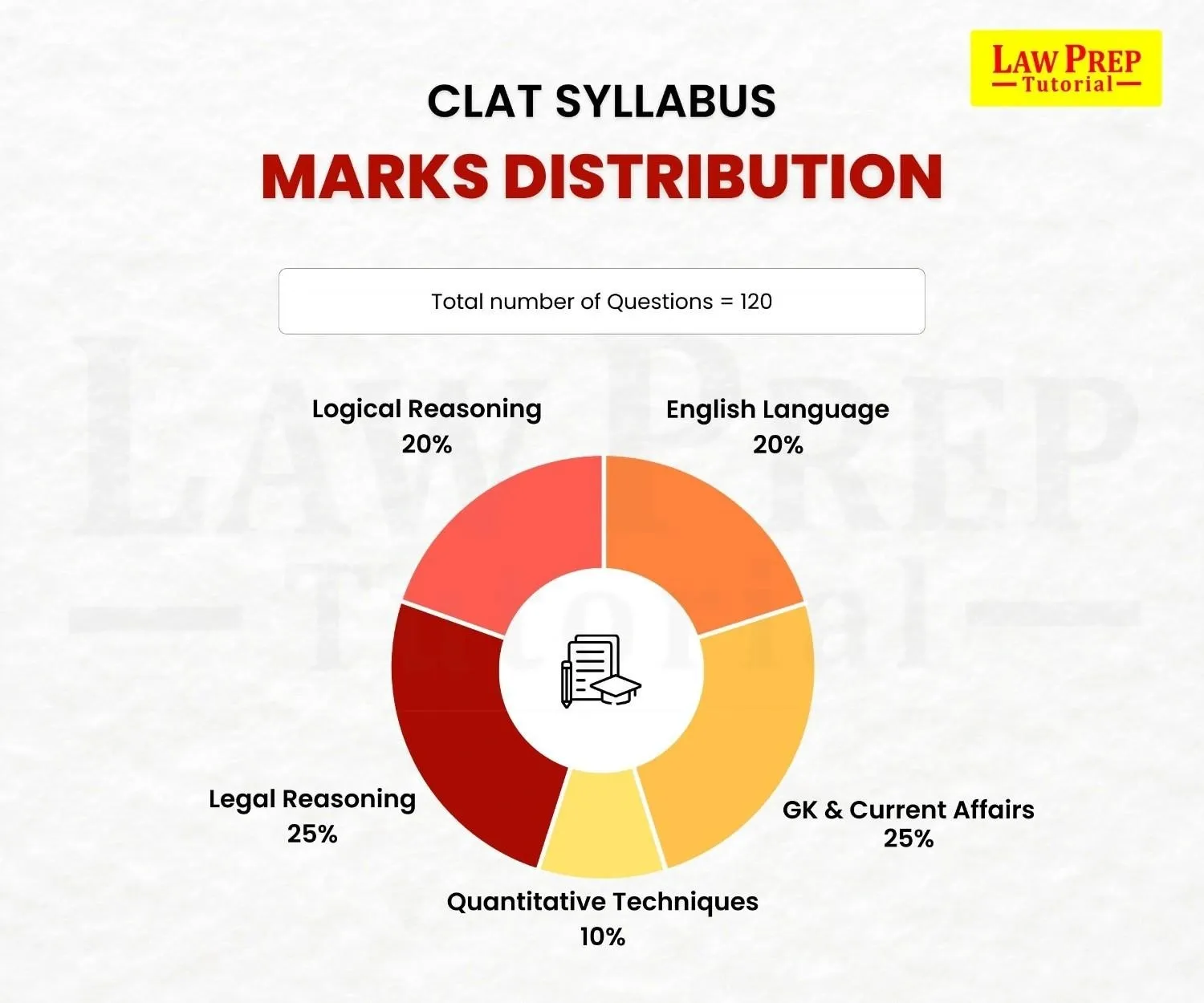
CLAT Syllabus 2027: Marks Distribution
| Subjects in CLAT | No. of Questions | Weightage |
| English Language | 22-26 | 20% |
| Current Affairs (including GK) | 28-32 | 25% |
| Legal Reasoning | 28-32 | 25% |
| Logical Reasoning | 22-26 | 20% |
| Quantitative Techniques | 10-14 | 10% |
Best Books for CLAT Syllabus 2027
Experts and toppers highly recommend the following CLAT preparation books to help aspirants prepare for each section effectively.
| Subject | Book Name | Author/Publisher |
| English | Word Power Made Easy | Norman Lewis |
| 30 Days to a More Powerful Vocabulary | Norman Lewis | |
| High School English Grammar and Composition | Wren & Martin | |
| English is Easy | Chetan Anand Singh | |
| Current Affairs and GK | Pratiyogita Darpan | – |
| Manorama Year Book | – | |
| Pearson’s Concise GK Manual | – | |
| Lucent’s General Knowledge | – | |
| Competition Review Yearbook | – | |
| CLAT Express | Law Prep Tutorial | |
| Quantitative Techniques | Quantitative Aptitude for Competitive Examinations | RS Aggarwal |
| Data Interpretation | BSC Publications | |
| Magical Book on Quicker Maths | M. Tyra | |
| Quantitative Aptitude for Competitive Examinations | Pearson | |
| Logical Reasoning | Modern Approach to Verbal and Non-Verbal Reasoning | R.S. Aggarwal |
| GMAT Official Guide | – | |
| Legal Reasoning | Legal Awareness and Legal Reasoning | Pearson |
| Important Judgments That Transformed India | Alex Andrews George | |
| The Pearson Guide to the CLAT | Harsh Gagrani |
Importance of Knowing Syllabus of CLAT 2027
Understanding the syllabus of CLAT exam is essential for effective preparation and achieving your dream of securing admission to a top NLU:
- Helps You Prioritize Key Areas The CLAT examination syllabus outlines the topics that hold the highest weightage, allowing you to focus on what’s most important.
- Creates a Structured Study Plan: A clear understanding of the syllabus of CLAT exam helps in creating a targeted timetable that covers all sections effectively.
- Avoids Wasting Time on Irrelevant Topics: By sticking to the CLAT entrance test syllabus, you can prevent wasting time on topics not included in the exam.
- Boosts Confidence in Preparation: Knowing what to expect in each section of the CLAT syllabus builds confidence as you prepare systematically.
- Aligns Practice with Exam Requirements: Familiarity with the syllabus ensures your CLAT mock tests and practice sessions are aligned with the actual exam.
- Improves Time Management: Understanding the scope of each section helps in managing your time wisely during both preparation and the exam itself.
- Enhances Your Ability to Score High: A thorough grasp of the CLAT entrance test syllabus equips you to tackle high-scoring areas and secure a better rank.
- Makes Revision More Efficient: When you know the syllabus, you can focus your revision for CLAT on the most crucial topics, ensuring comprehensive preparation.
How to Prepare for CLAT Syllabus 2027?
By breaking down the CLAT exam syllabus into manageable parts and adopting specific preparation methods for each, you can maximize your chances of scoring well.
Below is the complete strategy:
1. Understand CLAT Exam Syllabus Thoroughly
Begin by downloading and reviewing the CLAT syllabus PDF in detail. Familiarize yourself with the weightage of each section.
Understanding what topics are included in the syllabus for CLAT 2027 helps you prioritize high-scoring areas and avoid wasting time on irrelevant topics. Create a checklist for each section to track your preparation.
2. Focus on Reading Comprehension for English
The English section of the CLAT UG syllabus tests reading comprehension, vocabulary, and grammar.
To prepare:
- Read newspapers, editorials, and fiction daily to improve reading speed and comprehension.
- Practice answering questions based on passages, focusing on tone, main idea, and inferences.
- Revise grammar basics like tenses, parts of speech, and modifiers.
- Enhance your vocabulary by learning synonyms, antonyms, idioms, and one-word substitutions.
- Set aside time for CLAT mock tests to simulate exam conditions and analyze your performance to improve accuracy.
3. Stay Updated for Current Affairs and GK
The syllabus of CLAT entrance exam emphasizes awareness of national and international events.
Strategies include:
- Follow daily news through newspapers for CLAT, like The Hindu or Indian Express.
- Use monthly current affairs magazines like CLAT Express and yearbooks to stay updated on topics like constitutional amendments, international relations, and government schemes.
- Focus on topics mentioned in the CLAT syllabus, such as history, art and culture, and economics, to prepare comprehensively.
- Practice previous year papers of CLAT to familiarize yourself with question patterns and boost retention.
4. Develop Logical Thinking for Logical Reasoning
The Logical Reasoning section in the syllabus for CLAT tests critical and analytical reasoning skills.
Here’s how to prepare:
- Practice solving puzzles, blood relations, seating arrangements, and syllogisms to improve problem-solving speed.
- Learn to analyze arguments by identifying assumptions, inferences, and flaws in reasoning.
- Attempt sample questions and CLAT-specific reasoning books to sharpen your logical thinking.
- Focus on understanding patterns in questions and identifying the most logical solutions.
5. Master Legal Concepts for Legal Reasoning
Legal Reasoning, a high-weightage section in the CLAT exam syllabus 2027, requires understanding legal principles and their application.
Tips include:
- Familiarize yourself with constitutional basics, contract law, criminal law, torts, and family law.
- Read case studies to understand how legal principles are applied in real scenarios.
- Practice questions that involve applying legal concepts to hypothetical situations.
- Review current legal issues to stay updated on relevant legal developments.
6. Strengthen Basics for Quantitative Techniques
The Quantitative Techniques section of the CLAT UG syllabus tests numerical ability and data interpretation.
Steps to excel include:
- Brush up on Class 10-level math topics like percentages, ratios, time and work, and mensuration.
- Focus on improving calculation speed using shortcuts and easy math tricks.
- Solve data interpretation problems involving graphs, tables, and charts.
- Practice extensively from past papers and mock tests to increase confidence and accuracy.
7. Practice Mock Tests and Analyze Performance
Regularly attempting mock tests is crucial for mastering the syllabus of CLAT entrance exam:
- Simulate exam conditions to improve time management.
- Analyze CLAT mock test to identify strengths and weaknesses.
- Revise frequently missed topics and adapt your study strategy accordingly.
- Mock tests help familiarize yourself with the CLAT Exam Pattern and improve accuracy under pressure.
8. Revise Regularly for Long-Term Retention
Revision is essential for ensuring that topics from the syllabus for CLAT stay fresh in your memory:
- Create concise notes for quick revision of important concepts.
- Dedicate the last month to revisiting key topics across all sections.
- Use flashcards or digital apps to revise vocabulary and current affairs.
9. Manage Time Effectively During Preparation and Exam
Balancing time is critical to cover the CLAT exam syllabus effectively:
- Allocate specific hours to each section daily and stick to the schedule.
- During the exam, start with your strongest section to build confidence and save time for challenging parts.
FAQs About CLAT Syllabus

SEO Head
Virendra heads SEO & Content at LPT. A writer at heart, he focuses on building exam-focused content that informs, guides, and supports aspirants in their preparation journey.
CLAT Trending Blogs