Talk to a Counsellor
 Support
Delhi Judiciary Exam Pattern 2026 (DJS Pre & Mains Pattern)
Learn the latest Delhi Judiciary Exam Pattern 2026 including prelims mains interview stages detailed syllabus question types and preparation techniques.
Last Updated on 20 Jul 2026

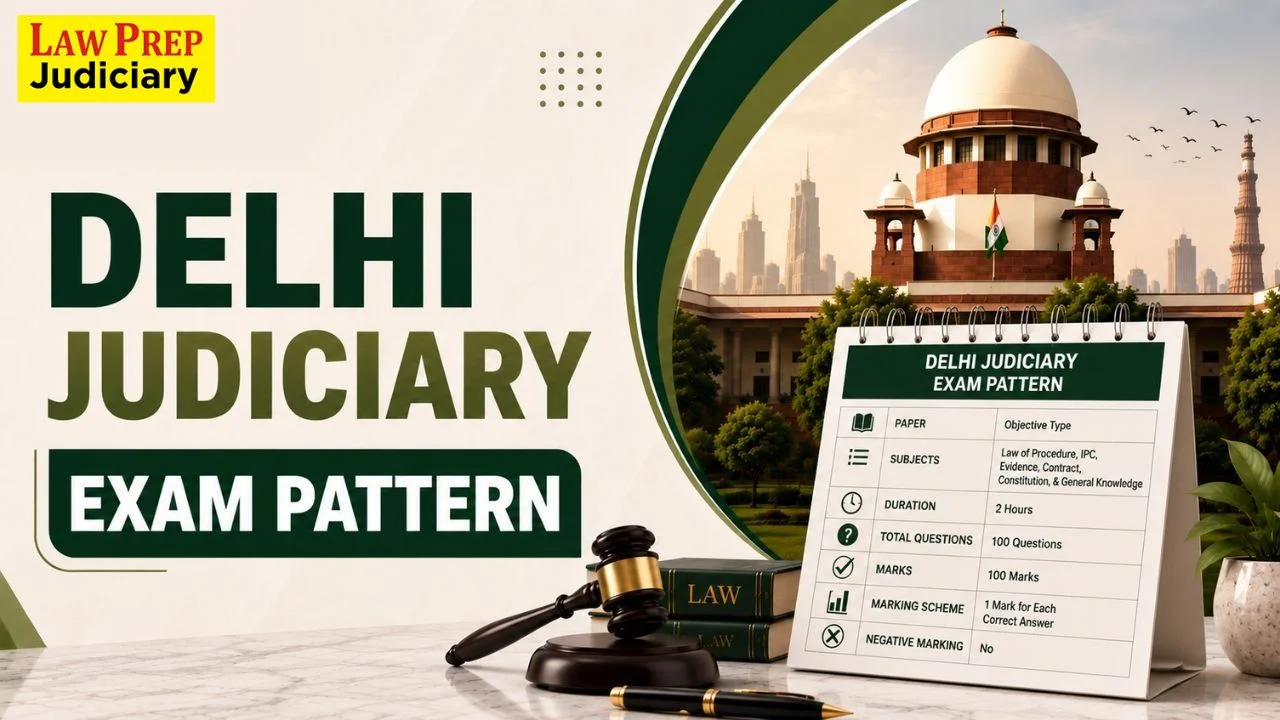
The Delhi Judicial Service Examination (DJS) is one of India’s most competitive and prestigious judicial recruitment exams. Understanding the Delhi Judiciary exam pattern 2026 is essential for structured preparation.
This blog explains the expected exam pattern based on previous cycles to help you prepare confidently before the official announcement.
Table of Contents
Jump to section- CLAT PG: All About CLAT Postgraduate Exam for LLM
Delhi Judiciary Exam Pattern: Stages
The Delhi Judiciary exam pattern follows the traditional three-stage structure:
- Preliminary Examination (Objective)
- Mains Examination (Descriptive)
- Viva Voce (Interview)
| Stage | Nature of Exam | Purpose | Qualifying Criteria |
| Prelims | Objective (MCQs) | Screening Test | 40% (General) 35% (SC/ST/OBC) |
| Mains | Descriptive | Evaluation of legal writing & interpretation | 50% aggregate required for Mains qualification |
| Viva Voce | Personal Interview | Assessment of personality & judicial temperament | Final Merit List based on Mains + Interview (1000 Marks Total) |
Delhi Judiciary Exam Pattern for Prelims
The preliminary examination is expected to be an objective-type screening test. Its purpose is to shortlist candidates for the mains exam. This stage evaluates fundamentals in law, analytical skills, and language proficiency.
| Component | Details |
| Exam Type | Objective (MCQs) |
| Total Marks | 200 |
| Duration | 2.5 hours |
| Qualifying Marks | 60% |
| Marking Scheme | +1 for correct answer, -0.25 for incorrect |
| Subjects Covered | 12 subjects (Legal Knowledge, GK, Aptitude, Language) |
Section-wise Marks Distribution
| Subject | Number of Questions |
| Code of Criminal Procedure | 30 |
| Code of Civil Procedure | 30 |
| Indian Penal Code | 25 |
| Indian Evidence Act | 18 |
| Arbitration and Conciliation Act | 16 |
| Constitution | 12 |
| Limitation Act | 10 |
| Commercial Courts Act | 10 |
| Indian Contracts Act | 8 |
| Specific Relief Act | 5 |
| POCSO | 5 |
| LLP | 3 |
| Legal Maxims | 2 |
| Rent Control Act | 1 |
| English | 15 |
| Legal GK | 10 |
DJS Prelims Preparation Tips
The preliminary exam tests speed, accuracy, and conceptual clarity. To score well in this objective-stage screening test, candidates must adopt a sharp, practice-driven approach.
- Focus on Extensive MCQ Practice: Regularly solve previous years’ questions, mock tests, and topic-wise MCQs. This helps improve accuracy, enhances familiarity with question patterns, and boosts time management skills.
- Strengthen General Knowledge and English: Prelims typically include GK, Current Affairs, and English comprehension. Make it a habit to read newspapers, follow monthly current affairs digests, and revise vocabulary and grammar rules to improve overall performance.
- Revise Bare Acts Consistently: Bare acts form the backbone of Prelims preparation. Memorize important sections, illustrations, provisos, and definitions from core laws like CPC, CrPC, IPC, Evidence Act, and the Constitution. Prioritize short, daily revision sessions.
Explore important resources for Delhi Judiciary preparation here:
| Delhi Judiciary Admit Card | Delhi Judiciary Eligibility Criteria |
| Delhi Judiciary Vacancy Notification | Delhi Judiciary Exam Date |
| Online Delhi Judiciary Coaching |
Delhi Judiciary Exam Pattern for Mains
The mains exam is the most crucial stage of the selection process. It evaluates a candidate’s in-depth legal understanding, analytical thinking, and the ability to present complex ideas coherently.
| Paper | Marks | Details |
| General Knowledge & Language | 250 | Section I: GK & Legal Awareness (100 marks) Section II: Essay, Precis, Translation (150 marks) |
| Civil Law – I | 200 | Substantive Civil Laws |
| Civil Law – II | 200 | Procedural Civil Laws |
| Criminal Law | 200 | Substantive & Procedural Criminal Laws |
Mains Preparation Tips
The mains examination is descriptive and requires clarity of thought, structured writing, and in-depth legal understanding. A disciplined approach to answering writing questions can significantly boost scores.
- Practice Descriptive Answers Regularly: Write answers for previous years’ questions and mock tests to improve speed, structure, and articulation. Focus on presenting logical reasoning and clear legal arguments.
- Use Case Laws Strategically and Smartly: Incorporating landmark judgments strengthens answers, but avoid overloading responses with unnecessary citations. Use concise, relevant case laws that enhance the quality of your explanation.
- Improve Legal Writing Style and Clarity: The mains answers must be crisp, coherent, and legally sound. Work on paragraph structuring, use headings or subheadings where appropriate, and maintain precision in legal terminology.
Delhi Civil Judge Exam Pattern for Interview
The final stage of the selection process is the viva voce or interview. Candidates who clear the mains are called for a 150-mark viva voce. This stage assesses personality, communication skills, ethics, judicial temperament, and overall suitability for the judiciary.
| Component | Details |
| Total Marks | 150 |
| Qualifying Marks | 50% (General) 45% (SC/ST/PwD) |
| Evaluation Criteria | • Confidence • Communication • Ethics & integrity • Judicial temperament • Awareness of current legal issues |
Viva Voce Preparation Tips
The viva voce tests personality, legal awareness, and judicial temperament.
- Build Confidence and Communication Skills: Practice speaking clearly and confidently. Participate in mock interviews, group discussions, or even record yourself to identify areas for improvement.
- Stay Updated With Current Legal Developments: Interviewers often ask questions about recent judgments, amendments, and socially relevant legal issues. Reading legal news portals, blogs, and Supreme Court updates daily is essential.
- Practice Mock Interviews Regularly: Mock sessions help simulate the interview environment. They enhance composure, polish communication skills, and reduce anxiety. Seek feedback from mentors or seniors to refine your responses and body language.
Delhi Judicial Services Exam Pattern: Question Types
Understanding how each stage differs helps in structuring a targeted preparation plan.
| Stage | What It Tests | Type of Questions |
| Prelims | Speed, accuracy, and conceptual clarity | MCQs |
| Mains | Analytical ability, legal depth, writing skills | Descriptive answers |
| Viva | Personality, communication, temperament | Oral responses |
Syllabus for Delhi Judiciary Exam 2026
Find the overview of Delhi judiciary syllabus:
Prelims Syllabus
| Subject Area | Topics Covered |
| General Knowledge & Aptitude | Current affairs, static GK, logical reasoning, analytical ability |
| English Language | Grammar, comprehension, vocabulary, and expression |
| Objective Legal Knowledge | MCQs based on the key laws listed below |
| Core Legal Subjects | • Constitution of India • Code of Civil Procedure, 1908 • Code of Criminal Procedure, 1973 • Indian Penal Code • Indian Contract Act, 1872 • Limited Liability Partnership Act, 2008 • Arbitration & Conciliation Act, 1996 • Indian Evidence Act, 1872 • Specific Relief Act, 1963 • Limitation Act, 1963 • Protection of Children from Sexual Offences (POCSO) Act, 2012 • Commercial Courts Act, 2015 |
Mains Syllabus
Paper 1 – General Legal Knowledge & Language (250 marks)
| Section | Details |
| Section I: General Legal Knowledge | Tests awareness of current legal affairs, important judgments, and general knowledge. |
| Section II: Language (Essay, Translation & Precis) | Essay writing, precise use of English, translation from English to Hindi (Devnagri) and Hindi to English, and precis writing. Emphasis on clarity, accuracy, and grammar. |
Paper 2 – Civil Law–I (200 marks)
| Indian Contract Act, 1872 | Sale of Goods Act, 1930 |
| Transfer of Property Act, 1882 | Specific Relief Act, 1963 |
| Hindu Law | Mohammedan Law |
| Delhi Rent Control Act, 1958 | Law of Torts |
| New Delhi Municipal Council Act, 1994 | Delhi Municipal Corporation Act, 1957 |
| Commercial Courts Act, 2015 | – |
Paper 3 – Civil Law–II (200 marks)
| Code of Civil Procedure, 1908 | Indian Evidence Act, 1872 |
| Limitation Act, 1963 | Registration Act, 1908 |
| Arbitration & Conciliation Act, 1996 | Trade Marks Act, 1999 |
| Copyright Act, 1957 | – |
Paper 4 – Criminal Law (200 marks)
| Code of Criminal Procedure, 1973 | Indian Evidence Act, 1872 |
| Indian Penal Code | Protection of Women from Domestic Violence Act, 2005 |
| Negotiable Instruments Act, 1881 | Sexual Harassment of Women at Workplace Act, 2013 |
| Juvenile Justice (Care & Protection of Children) Act, 2015 | – |
How to Prepare As Per Delhi Judiciary Paper Pattern
Find the Delhi judiciary preparation tips:
1. Cover the syllabus well
- Challenge: The syllabus is extensive and covers numerous laws.
- Solution: Break it into smaller sections, create a structured study plan, and focus on understanding concepts rather than memorizing.
2. Time Management
- Challenge: Balancing prelims, mains, interview prep, and personal commitments is tough.
- Solution: Prioritize high-weightage topics, schedule your study hours, and keep time for revision.
3. High Competition
- Challenge: Limited vacancies increase the competition.
- Solution: Improve accuracy and speed for Prelims; practice clear, well-structured answers for Mains.
4. Stress and Pressure
- Challenge: Performance pressure often leads to stress.
- Solution: Maintain a healthy routine, sleep well, and practice mindfulness. Stay connected with mentors and supportive peers.
5. Difficulty Understanding Complex Laws
- Challenge: Some legal provisions are hard to grasp.
- Solution: Use diverse study resources and seek guidance from teachers or coaching if needed.
6. Staying Updated with Current Affairs
- Challenge: Constant updates in law and current events require regular tracking.
- Solution: Read newspapers, follow legal blogs, and make brief notes for quick revision.
7. Language Proficiency
- Challenge: Mains tests writing skills in both English and Hindi.
- Solution: Practice essays and long answers, read regularly, and work on improving fluency.
8. Self-Doubt and Low Motivation
- Challenge: Long preparation periods can reduce confidence.
- Solution: Set small goals, celebrate progress, and stay connected with fellow aspirants. Remind yourself of your long-term goal to keep motivated.
FAQs on Delhi Judiciary Exam Pattern

SEO Head
Virendra heads SEO & Content at LPT. A writer at heart, he focuses on building exam-focused content that informs, guides, and supports aspirants in their preparation journey.
Delhi Judiciary Trending Blogs
Other Related Blogs