Talk to a Counsellor
 Support
Delhi Judiciary Syllabus 2026: Pre & Mains Syllabus PDF
Discover the complete Delhi Judiciary Syllabus 2026! Explore subject-wise topics, exam patterns, prep tips, and essential books for success.
Last Updated on 20 Jul 2026

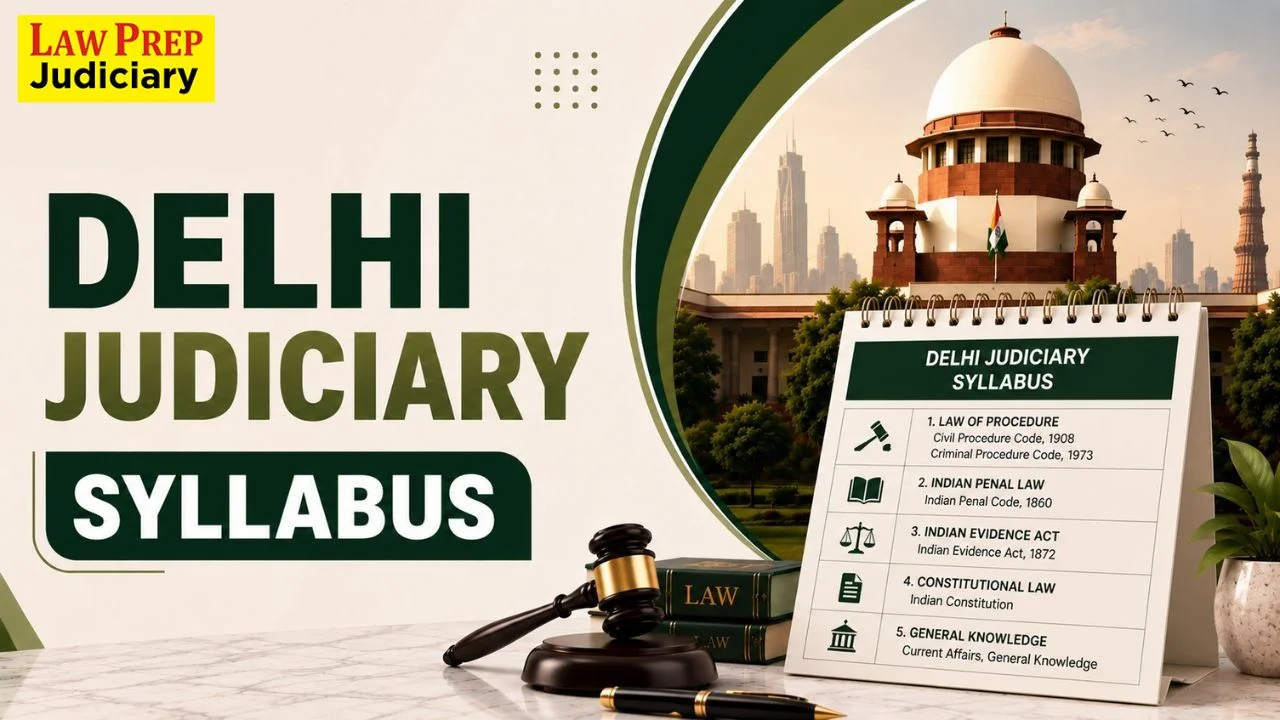
The Delhi Judiciary Exam syllabus covers major laws like the Constitution, CPC, CrPC, IPC, Evidence Act, Contract, TPA, Family Laws, Torts, and key Delhi-specific laws, along with essays, précis, and language skills.
DJS consists of Prelims (objective), Mains (descriptive), and Viva Voce. Prelims tests GK, aptitude, English, and legal MCQs, while Mains evaluates detailed legal understanding across four law papers.
This guide gives a concise, well-organised overview of the Delhi judiciary syllabus, exam pattern, and preparation strategy.
Table of Contents
Jump to section- CLAT PG: All About CLAT Postgraduate Exam for LLM
Delhi Judiciary Syllabus 2026: Subject-wise Topics
These are the primary topics in syllabus of Delhi judiciary exam:
- Constitutional Law: Fundamental Rights, Directive Principles, distribution of powers, writs, basic structure.
- Code of Civil Procedure (CPC): Jurisdiction, suits, pleadings, interim orders, execution, appeals, review, restitution.
- Indian Contract Act & Specific Relief: Contract formation, performance, breach, remedies, specific performance, and reliefs.
- Transfer of Property Act: Properties, mortgages, leases, sales, and creation of interests.
- Hindu Law & Mohammedan (Muslim) Law: Succession, marriage, maintenance, custody, and statutory updates.
- Law of Torts & Consumer Protection: Fundamentals, negligence, strict liability, remedies, and consumer protection statutes.
- Indian Penal Code (IPC): Substantive offences, general exceptions, sentencing principles.
- Code of Criminal Procedure (CrPC): Investigation, charge, trial, bail, appeals, and procedural safeguards.
- Indian Evidence Act: Relevancy, burden of proof, admissibility, documentary & oral evidence.
- Juvenile Justice, POCSO, Domestic Violence, and Negotiable Instruments Act: Key special statutes often tested.
- Local Laws Specific to Delhi: Delhi Rent Control Act, NDMC/DMC statutes, local municipal laws, and allied state rules (important for marks).
- General Legal Knowledge, Current Legal Affairs & Language Skills: Essay, Precis, Translation, and Drafting ability.
Stages in Delhi Judiciary Syllabus 2026
The Delhi judicial exam is conducted in three stages:
DJS Prelims / Screening Paper
Broadly covers the same range as Papers I–III of Mains (objective form) to test legal awareness, expression, and objective legal problem-solving.
DJS Mains Paper Breakdown
- Paper I: General Legal Knowledge & Language (essay, précis, translation, comprehension).
- Paper II: Civil Law I (Contracts, Specific Relief, Transfer of Property, Torts, Local Laws).
- Paper III: Civil Law II / Procedure (CPC, Civil remedies, local municipal laws).
- Paper IV: Criminal Law (IPC, CrPC, Evidence, special criminal statutes).
Delhi Judiciary Exam Pattern
Following is the Delhi judiciary exam pattern:
Preliminary Examination
| Component | Details |
| Exam Type | Objective (MCQs) |
| Total Marks | 200 |
| Duration | 2.5 hours |
| Qualifying Marks | 60% |
| Marking Scheme | +1 for correct answer, -0.25 for incorrect |
| Subjects Covered | 12 subjects (Legal Knowledge, GK, Aptitude, Language) |
Mains Examination
| Paper | Marks | Details |
| General Knowledge & Language | 250 | Section I: GK & Legal Awareness (100 marks) Section II: Essay, Precis, Translation (150 marks) |
| Civil Law – I | 200 | Substantive Civil Laws |
| Civil Law – II | 200 | Procedural Civil Laws |
| Criminal Law | 200 | Substantive & Procedural Criminal Laws |
Viva Voce (Interview)
| Component | Details |
| Total Marks | 150 |
| Qualifying Marks | 50% (General) 45% (SC/ST/PwD) |
| Evaluation Criteria | Personality, communication, confidence, and judicial aptitude |
Explore important resources for Delhi Judiciary preparation here:
| Delhi Judiciary Admit Card | Delhi Judiciary Eligibility Criteria |
| Online Delhi Judiciary Coaching | Delhi Judiciary Exam Date |
Delhi Judiciary Syllabus for Prelims
Find the Delhi judiciary prelims syllabus:
| Subject Area | Topics Covered |
| General Knowledge & Aptitude | Current affairs, static GK, logical reasoning, analytical ability |
| English Language | Grammar, comprehension, vocabulary, and expression |
| Objective Legal Knowledge | MCQs based on the key laws listed below |
| Core Legal Subjects | – Constitution of India – Code of Civil Procedure, 1908 – Code of Criminal Procedure, 1973 – Indian Penal Code – Indian Contract Act, 1872 – Limited Liability Partnership Act, 2008 – Arbitration & Conciliation Act, 1996 – Indian Evidence Act, 1872 – Specific Relief Act, 1963 – Limitation Act, 1963 – Protection of Children from Sexual Offences (POCSO) Act, 2012 – Commercial Courts Act, 2015 |
Tips to Prepare for DJS Prelims
1. Build Strong GK & Aptitude
- Stay updated with current affairs.
- Revise important static GK topics.
- Practice reasoning and analytical questions regularly.
2. Improve English Skills
- Work on grammar and vocabulary.
- Read daily to strengthen comprehension.
- Solve previous English-based questions for familiarity.
3. Focus on Legal MCQs
- Practice objective questions from all core laws.
- Revise important definitions, sections, and case laws.
- Take short quizzes to test speed and accuracy.
4. Cover All Major Legal Subjects
- Thoroughly revise bare acts and essential provisions.
- Concentrate on commonly tested areas across subjects.
- Review fundamental concepts and key chapters.
5. Revise Smartly
- Create short notes, charts, and summaries.
- Revisit important provisions multiple times.
- Use quick revision techniques to retain information.
6. Attempt Mock Tests
- Practice full-length tests under exam conditions.
- Review mistakes to strengthen weak areas.
- Track your progress regularly for improvement.
Delhi Judiciary Syllabus for Mains
Below is the Delhi judiciary mains exam syllabus:
Paper 1 – General Legal Knowledge & Language (250 marks)
| Section | Details |
| Section I: General Legal Knowledge | Tests awareness of current legal affairs, important judgments, and general knowledge. |
| Section II: Language (Essay, Translation & Precis) | Essay writing, precise use of English, translation from English to Hindi (Devnagri) and Hindi to English, and precis writing. Emphasis on clarity, accuracy, and grammar. |
Paper 2 – Civil Law–I (200 marks)
| Indian Contract Act, 1872 | Sale of Goods Act, 1930 |
| Transfer of Property Act, 1882 | Specific Relief Act, 1963 |
| Hindu Law | Mohammedan Law |
| Delhi Rent Control Act, 1958 | Law of Torts |
| New Delhi Municipal Council Act, 1994 | Delhi Municipal Corporation Act, 1957 |
| Commercial Courts Act, 2015 | – |
Paper 3 – Civil Law–II (200 marks)
| Code of Civil Procedure, 1908 | Indian Evidence Act, 1872 |
| Limitation Act, 1963 | Registration Act, 1908 |
| Arbitration & Conciliation Act, 1996 | Trade Marks Act, 1999 |
| Copyright Act, 1957 | – |
Paper 4 – Criminal Law (200 marks)
| Code of Criminal Procedure, 1973 | Indian Evidence Act, 1872 |
| Indian Penal Code | Protection of Women from Domestic Violence Act, 2005 |
| Negotiable Instruments Act, 1881 | Sexual Harassment of Women at Workplace Act, 2013 |
| Juvenile Justice (Care & Protection of Children) Act, 2015 | – |
Tips to Prepare for DJS Mains
1. Build Strong Legal Awareness
- Follow current legal developments and important judgments.
- Maintain brief notes on major updates and amendments.
2. Improve Writing & Language Skills
- Practice essays, precis, and answer writing regularly.
- Work on translation (English ↔ Hindi) and strengthen grammar/vocabulary.
3. Prepare Civil Law–I Effectively
- Focus on Contract, TPA, Specific Relief, Hindu/Mohammedan Law.
- Revise Delhi-specific laws and important case laws.
- Use charts and notes for quick revision.
4. Master Civil Law–II
- Understand CPC sections/orders and Evidence Act concepts deeply.
- Learn key limitation periods and essential IP law provisions.
- Practice problem-based questions.
5. Strengthen Criminal Law
- Revise CrPC procedures, IPC offences, and important case laws.
- Cover special Acts such as the DV Act, JJ Act, NI Act, and POSH Act thoroughly.
6. Practice Answer Writing
- Write structured, clear, and case-law-supported answers.
- Develop speed and accuracy through regular mocks.
7. Use Bare Acts Smartly
- Read Bare Acts multiple times.
- Highlight key sections and prepare compact notes.
8. Revise Regularly
- Follow a fixed revision schedule.
- Keep concise notes for last-minute preparation.
How to Prepare for Delhi Judiciary Exam Syllabus?
Stage 1: Foundation (8–12 weeks)
- Read bare acts thoroughly (word-for-word). Bare acts are the backbone of questions, and judgments often track statutory language.
- Simultaneously, create a subject map (list major chapters/sections to cover for each law). Use the official syllabus to prioritize topics.
Stage 2: Consolidation (8–12 weeks)
- Study one core subject at a time (CPC / IPC / CrPC / Evidence / Contracts). After reading the bare act, consult one standard commentary for depth.
- Practice writing daily time yourself for 30–40 mark answers and learn to cite relevant sections/case law concisely. (Mains is about accurate, structured answers.)
Stage 3: Application & Revision (6–8 weeks)
- Take full-length Mains mock papers and Prelims MCQ tests. Review errors and maintain an error log.
- Focus on local laws & recent legislative amendments and leading Supreme Court and Delhi High Court decisions.
Ongoing
- Daily current affairs: legal developments, Supreme Court / Delhi High Court landmark rulings.
- Vocabulary & language drills: essay practice, precis, translation, and reading judgments for legal drafting style.
Best Books for Delhi Judiciary Syllabus
Use these books for Delhi judiciary preparation:
| Book Name | Author/Publisher | Book Description |
| Constitutional Law of India | JN Pandey | A comprehensive book to study after the Bare Act; covers landmark judgments and explains concepts in detail. |
| Indian Constitution Law | MP Jain | Provides an in-depth and analytical understanding of the Constitution; ideal for advanced conceptual clarity. |
| The Code of Civil Procedure, 1908 | C.K. Takwani | Explains CPC provisions with illustrations and simple case-law summaries, making it helpful for understanding complex procedural concepts. |
| The Indian Evidence Bare Act | – | – |
| The Evidence Act, 1872| | Batuklal | Simple, student-friendly explanations with case briefs covering all key provisions of the Evidence Act. |
| The Indian Penal Code, 1860 | T. Bhattacharya | Detailed explanations with case law and illustrations; best used after mastering the Bare Act. |
| The Code of Criminal Procedure, 1973 | Ratanlal & Dhirajlal | Reliable and detailed commentary on CrPC (and IPC references); essential for clarity on procedural aspects. |
| Contract and Specific Relief | Avtar Singh | Covers important sections, concepts, and case laws clearly; great companion to the Bare Acts. |
| Law of Tort | R.K. Bangia | Thorough and straightforward coverage of tort principles, including leading foreign judgments. |
| Family Law in India | Paras Diwan | Clear explanations and illustrations; helpful in tackling tricky questions in family law. |
| The Arbitration and Conciliation Act, 1996 | N.V. Paranjape | Comprehensive coverage with easy case law illustrations; simplifies complex provisions. |
Common Mistakes to Avoid in Delhi Judiciary Syllabus
- Skipping Bare Acts: Relying only on commentaries or notes.
- Poor Answer Format: Long paragraphs, no headings, weak legal structure. Mains reward concise, sectional answers.
- Ignoring Local Delhi Laws: Municipal and rent-control statutes are frequently asked.
- Neglecting Negative Marking Strategy for Prelims: random guessing can hurt scores.
- Not Practicing Past Papers or Mock Interviews: Both are crucial to gauge readiness.
FAQs on Delhi Judiciary Syllabus

SEO Head
Virendra heads SEO & Content at LPT. A writer at heart, he focuses on building exam-focused content that informs, guides, and supports aspirants in their preparation journey.
Delhi Judiciary Trending Blogs
Other Related Blogs