Talk to a Counsellor
 Support
CLAT English Language: Notes, Syllabus, Important Topics 2027
Master the CLAT English Language section with free notes, syllabus breakdown, key concepts, and preparation tips. Download CLAT 2027 English notes now.
Last Updated on 18 Jul 2026

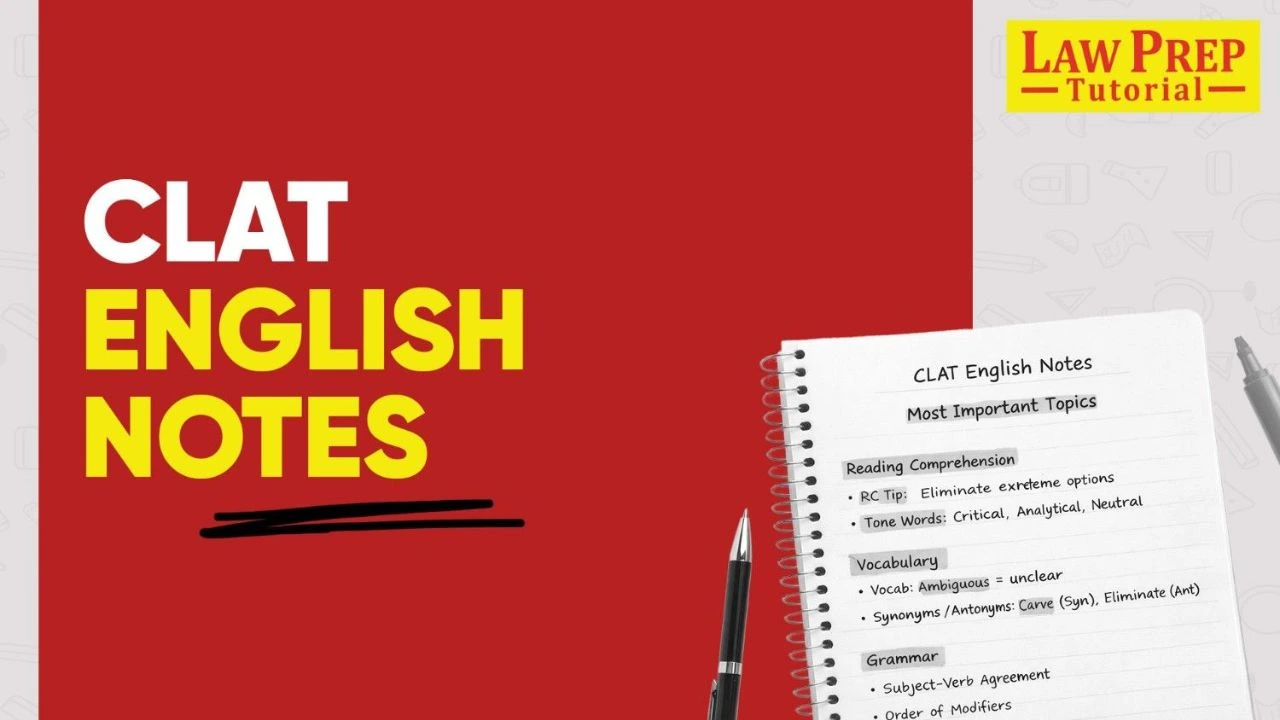
Strong command over English can directly impact your CLAT rank, as this section contributes around 20% of the paper and tests your real reading ability. Instead of focusing on rote grammar, the exam demands clarity in comprehension, vocabulary in context, and logical interpretation of passages.
To help you prepare the right way, we at Law Prep Tutorial are sharing expert-curated CLAT English notes designed by our senior faculty members and subject matter experts.
These notes are structured exactly as per the latest CLAT Paper pattern, covering every important area in a simplified and practical manner. If you are preparing seriously, these English language notes for CLAT 2027 will help you build accuracy, improve speed, and strengthen your overall approach to the section.
Table of Contents
Jump to sectionDownload CLAT English Notes (Free PDF)
Get structured CLAT English language notes prepared by senior faculties and SMEs.
What is English Language Section in CLAT?
The English section in CLAT is designed to test your ability to read, understand, and interpret passages, not just your knowledge of grammar rules. Instead of direct questions, you are given passages followed by questions that check how well you can grasp the author’s idea, identify arguments, and apply vocabulary in context.
The focus is on comprehension, logical thinking, and language application. A strong performance in this section depends on consistent reading practice, clarity of concepts, and the ability to analyze passages quickly and accurately.
CLAT English Language – Key Details
| Feature | Details |
|---|---|
| Number of Questions | 22–26 questions |
| Weightage | ~20% of total paper |
| Format | Passage-based questions |
| Passage Length | ~450 words each |
| Difficulty Level | Class 12 standard |
| Reading Time per Passage | 5–7 minutes |
| Skills Tested | Comprehension, inference, vocabulary in context |
| Sources of Passages | Fiction & non-fiction (contemporary/historical) |
| Negative Marking | -0.25 for each wrong answer |
Important CLAT Questions for Practice:
| CLAT Legal Reasoning Questions | CLAT Logical Reasoning Questions |
| CLAT GK Questions |
Structure of CLAT English Section
The entire section is built around reading passages, and each passage is followed by multiple questions. You will typically encounter:
Passage-Based Questions
- 4–5 passages in the exam
- Each passage contains 4–6 questions
- Topics may include social issues, law, philosophy, history, or current affairs
Types of Questions Asked
- Main idea or central theme of the passage
- Author’s tone, attitude, or viewpoint
- Inference-based questions (reading between the lines)
- Summary-based questions
- Vocabulary in context (meaning of words/phrases)
- Compare and contrast viewpoints within the passage
Core Concepts You Must Know for CLAT English
1. Reading Comprehension Skills
This is the backbone of the entire section. You must learn how to quickly identify the main idea, supporting arguments, and author’s intent within a passage. Instead of reading line by line slowly, develop the ability to scan effectively, pick key points, and eliminate irrelevant details. Regular practice with diverse passages improves both speed and accuracy.
2. Vocabulary in Context
CLAT does not test isolated word meanings. Instead, you are expected to understand how words function within the passage context. This includes synonyms, antonyms, idioms, and phrases, but always linked to the passage meaning. Building vocabulary through reading editorials and noting word usage is far more effective than memorizing word lists.
3. Grammar Fundamentals (Application-Based)
While direct grammar questions are rare, a strong understanding of CLAT English grammar helps in better comprehension and sentence interpretation. Concepts like parts of speech, tenses, modals, and sentence structure help you understand relationships between ideas in a passage and avoid confusion while answering CLAT English questions.
4. Inference & Logical Interpretation
Many questions require you to go beyond what is directly written. You must be able to draw logical conclusions, identify implied meanings, and connect ideas across the passage. This skill improves with practice and is crucial for scoring high, as inference questions often differentiate CLAT toppers from average scorers.
5. Para-Based Question Handling
You should be comfortable with paragraph-based concepts like para jumbles, para completion, and summaries. Even though they appear within passages, understanding how ideas flow logically from one sentence to another helps in identifying correct answers and improves overall comprehension ability.
6. Understanding Author’s Tone & Viewpoint
Recognizing the author’s tone—such as critical, supportive, neutral, or analytical—is essential for many questions. You must focus on word choice, argument style, and conclusion to identify the author’s stance. This helps in answering tone-based and opinion-based questions accurately.
Important Resources After CLAT Exam:
| CLAT Result | CLAT Question Paper |
| CLAT Answer Key | CLAT Allotment List |
| CLAT Cut Off | CLAT Rank Predictor |
| CLAT Marks vs Rank | CLAT College Predictor |
| CLAT Counselling |
CLAT English Syllabus
Below is the syllabus of CLAT English Language section:
| Topic | Key Areas Covered |
| Reading Comprehension | Passages of ~450 words, main idea, tone, viewpoints, inference-based questions, and summary-based questions |
| Vocabulary | Synonyms Antonyms Root Words Homophones Idioms & Phrases Analogies One-word Substitutions |
| English Grammar | Parts of Speech Tenses Modals Conditionals Phrasal Verbs Determiners |
| Paragraph-Based Questions | Para Jumbles Para Completion Para Summary |
| Literary Devices | Common literary terms and their practical applications |
The CLAT English syllabus is not divided into isolated topics in the exam. All these areas are tested within passages, which means your preparation should focus on understanding concepts and applying them while reading.
Most Important English Topics for CLAT 2027
| Topic | Why It Matters for CLAT |
| Reading Comprehension | Core of the section; almost every question is based on passages |
| Inference | Helps in answering questions that require logical conclusions beyond direct statements |
| Tones | Identifying the author’s tone is key to solving viewpoint-based questions |
| Vocabulary | Important for understanding words in context within passages |
| Literary Devices | Helps interpret deeper meanings, especially in descriptive passages |
| Summarizing | Required to identify the main idea and concise meaning of the passage |
| Paraphrasing | Helps in understanding reworded statements and tricky answer options |
| Idioms & Phrases | Often tested through contextual meaning within passages |
| Grammar | Supports clarity in comprehension and sentence interpretation |
| Central Idea | Most questions revolve around identifying the core message of the passage |
Free CLAT Study Material for You:
| CLAT Previous Year Papers PDF | CLAT Sample Papers |
| CLAT Videos | CLAT Current Affairs |
How to Read English Passage for CLAT?
Step 1: Skim the Passage First
Start by quickly reading the passage to understand the overall theme. Don’t focus on every word initially. This step helps you build a mental framework, which is essential when using CLAT 2027 English notes effectively during practice.
Step 2: Identify the Central Idea
While reading, focus on what the passage is mainly about. Usually, the central idea is reflected in the introduction and conclusion. This helps eliminate confusing options and is a key skill developed through strong English notes for CLAT.
Step 3: Track the Author’s Tone and Intent
Pay attention to how the author presents arguments—supportive, critical, neutral, or analytical. Words and phrases often reveal tone. Understanding this improves accuracy in opinion-based questions and avoids common mistakes.
Step 4: Break the Passage into Parts
Divide the passage into small logical sections. Understand what each paragraph is trying to convey. This makes it easier to locate answers and improves speed, especially when dealing with lengthy CLAT passages.
Step 5: Focus on Keywords and Connectors
Look for keywords like “however,” “therefore,” “moreover,” and “in contrast.” These indicate shifts in arguments or conclusions. Recognizing these connectors helps in solving inference and logic-based questions more accurately.
Step 6: Read the Questions Carefully
Before marking answers, understand exactly what is being asked. Many mistakes happen due to misreading questions. Use elimination technique and relate each option directly to the passage for better accuracy.
Step 7: Avoid Overthinking
CLAT passages are designed to test comprehension, not assumptions. Stick to what is given in the passage. Avoid adding personal opinions or external knowledge while answering questions.
Mistakes to Avoid in CLAT English Preparation
- Reading Passages Too Slowly: Spending too much time on one passage reduces overall attempts. CLAT is a time-bound exam, so speed with understanding is crucial.
- Ignoring the Context of Words: Many aspirants rely on memorized meanings. In CLAT, vocabulary is tested within context, so ignoring usage leads to wrong answers.
- Overthinking Inference Questions: Adding personal assumptions instead of sticking to the passage often results in errors. Always base your answer strictly on the given text.
- Skipping Tone-Based Questions: Students often underestimate tone-based questions, but they are scoring if approached correctly by identifying the author’s attitude.
- Not Practicing Diverse Passages: Limiting practice to one type of content (only editorials or only fiction) reduces adaptability in the exam.
- Weak Elimination Technique: Instead of eliminating wrong options, many aspirants try to directly find the right answer, increasing confusion and mistakes.
- Ignoring Regular Revision: Concepts like vocabulary, idioms, and literary devices need consistent revision. Without it, retention and application suffer during the exam.
Download CLAT 2027 English Notes!
Strong ranks begin with clear concepts. Download our English notes for CLAT 2027 and pair them with regular practice to stay consistent across mocks and the final exam.
How to Use English Notes for CLAT Preparation?
1. Start with Concept Clarity
Begin by understanding each topic from your CLAT English notes instead of rushing into practice. Clear concepts help you apply knowledge effectively while solving passage-based questions.
2. Combine Notes with Daily Reading
Use your CLAT 2027 English notes alongside newspaper reading. Apply concepts like tone, inference, and vocabulary directly while reading editorials to build real exam skills.
Know about the best newspaper for CLAT.
3. Practice After Every Topic
After completing a topic from your notes, immediately solve related questions. This strengthens retention and helps you understand how concepts are applied in actual CLAT passages.
4. Revise Vocabulary Regularly
Keep revisiting CLAT English vocabulary, idioms, and phrases from your notes. Regular revision ensures better recall and improves your ability to understand words in context during the exam.
5. Focus on Weak Areas
Identify topics where you struggle, such as inference or tone, and revise those sections more frequently using your notes to improve accuracy over time.
6. Use Notes for Quick Revision Before Mocks
Before attempting mocks, go through your CLAT English notes for quick revision. This refreshes key concepts and improves performance in full-length tests.
7. Track Your Progress
After practicing, analyze mistakes and update your notes accordingly. This makes your CLAT 2027 English notes more personalized and effective for revision.
What These CLAT English Notes Cover?
Our expert-curated CLAT English notes are designed to match the exact demand of the CLAT exam, focusing on application-based learning instead of theoretical overload. Created by senior faculty and subject matter experts, these notes help you build strong fundamentals and apply them directly in passage-based questions.
Below is what you will get:
1. Complete Reading Comprehension Coverage
Detailed explanation of how to approach passages, identify central ideas, track arguments, and improve reading speed with accuracy. This forms the core of your CLAT English preparation.
2. Inference & Logical Interpretation
Step-by-step guidance to understand implied meanings, draw logical conclusions, and avoid common traps in inference-based questions.
3. Vocabulary in Context
Focused coverage of synonyms, antonyms, idioms, and phrases with real usage examples so you can understand words as they appear in passages.
4. Tone & Author’s Perspective
Clear methods to identify the author’s tone and viewpoint, helping you solve opinion-based questions with confidence.
5. Summarizing & Paraphrasing Techniques
Learn how to condense passages into key points and understand rephrased statements—skills that are crucial for accuracy in tricky questions.
6. Grammar for Better Comprehension
Application-based grammar concepts like parts of speech, tenses, and sentence structure to support better understanding of complex sentences.
7. Paragraph-Based Question Practice
Coverage of para jumbles, para completion, and summary-based questions to strengthen your logical flow and comprehension skills.
8. Literary Devices
Easy explanation of commonly used literary devices and how they appear in passages, helping you interpret deeper meanings.
9. Practice-Oriented Approach
These CLAT 2027 English notes are structured to help you directly apply concepts while solving questions, ensuring better retention and exam readiness.
How These CLAT English Notes Are Different from Regular Notes?
1. Built on Actual CLAT Pattern
These CLAT English notes are designed strictly around passage-based questions. Instead of isolated grammar rules, they train you to apply concepts directly while solving comprehension questions.
2. Created by Senior Faculty & SMEs
The content is curated by experienced mentors who have trained toppers. Every concept is explained with clarity, keeping in mind the exact challenges aspirants face during CLAT preparation.
3. Focus on Application, Not Memorization
Regular notes often push rote learning. These notes emphasize understanding—how to identify tone, draw inferences, and interpret passages, which is what CLAT actually tests.
4. Integrated Concept + Practice Approach
Each topic is linked with practical usage. You don’t just learn vocabulary or grammar—you understand how they appear in real passages and questions.
5. Structured for Quick Revision
The notes are concise and organized, making them ideal for last-minute revision before mocks or the actual exam without overwhelming you.
6. Aligned for CLAT 2027 Preparation
These CLAT 2027 English notes are updated as per the latest exam trend, ensuring you prepare with relevant content instead of outdated patterns.
7. Designed to Improve Accuracy & Speed
The notes focus on building a strong approach—helping you read faster, eliminate wrong options, and attempt more questions with better accuracy.
How Often Should You Revise English Notes for CLAT?
Revision is what turns concepts into accuracy in CLAT English. You need consistency and the right cycle.
1. Daily Quick Revision (15–20 minutes)
Revise key concepts like vocabulary, tone, and inference from your CLAT English notes. This keeps your mind aligned with passage-solving skills.
2. Weekly Deep Revision (1–2 sessions)
Revisit all major topics and practice questions. Use your CLAT 2027 English notes to strengthen weak areas and reinforce concepts.
3. Before Every Mock Test
Do a quick scan of important concepts like central idea, tone, and vocabulary. This improves your accuracy and reduces silly mistakes in mocks.
Attempt a free CLAT mock test.
4. After Mock Analysis
Update and revise notes based on mistakes. This makes your notes more personalized and improves retention over time.
Learn how to analyze a CLAT mock test.
5. Monthly Full Revision
Go through all topics once to ensure nothing is left behind. This helps in long-term retention and better performance closer to the exam.
Who Should Use These CLAT English Notes?
These notes are designed for every serious aspirant who wants to improve accuracy and confidence in the English section.
1. Beginners Starting CLAT Preparation
If you are new to CLAT, these notes help you build a strong foundation in comprehension, vocabulary, and passage-solving approach.
2. CLAT 2027 Aspirants
Students preparing seriously for the upcoming exam can use these CLAT 2027 English notes to align their preparation with the latest pattern.
3. Students Struggling with Reading Speed
If passages take too long or feel confusing, these notes provide a structured method to improve reading and understanding.
4. Aspirants Making Mistakes in Inference & Tone Questions
These notes help you understand how to approach tricky questions logically instead of guessing.
5. Droppers Aiming for Rank Improvement
For repeat aspirants, these notes help refine strategy, eliminate mistakes, and boost overall accuracy in the English section.
FAQs on CLAT English Language

SEO Head
Virendra heads SEO & Content at LPT. A writer at heart, he focuses on building exam-focused content that informs, guides, and supports aspirants in their preparation journey.
CLAT Trending Blogs
Other Related Blogs