Talk to a Counsellor
 Support
How to Crack CLAT in First Attempt? Strategy from Toppers Who Did It
To crack CLAT in first attempt, you need to focus on these areas: building section-wise basics, practising passage-based questions and improving accuracy through mocks and PYQs.
Last Updated on 12 Oct 2026
Download Free CLAT Notes
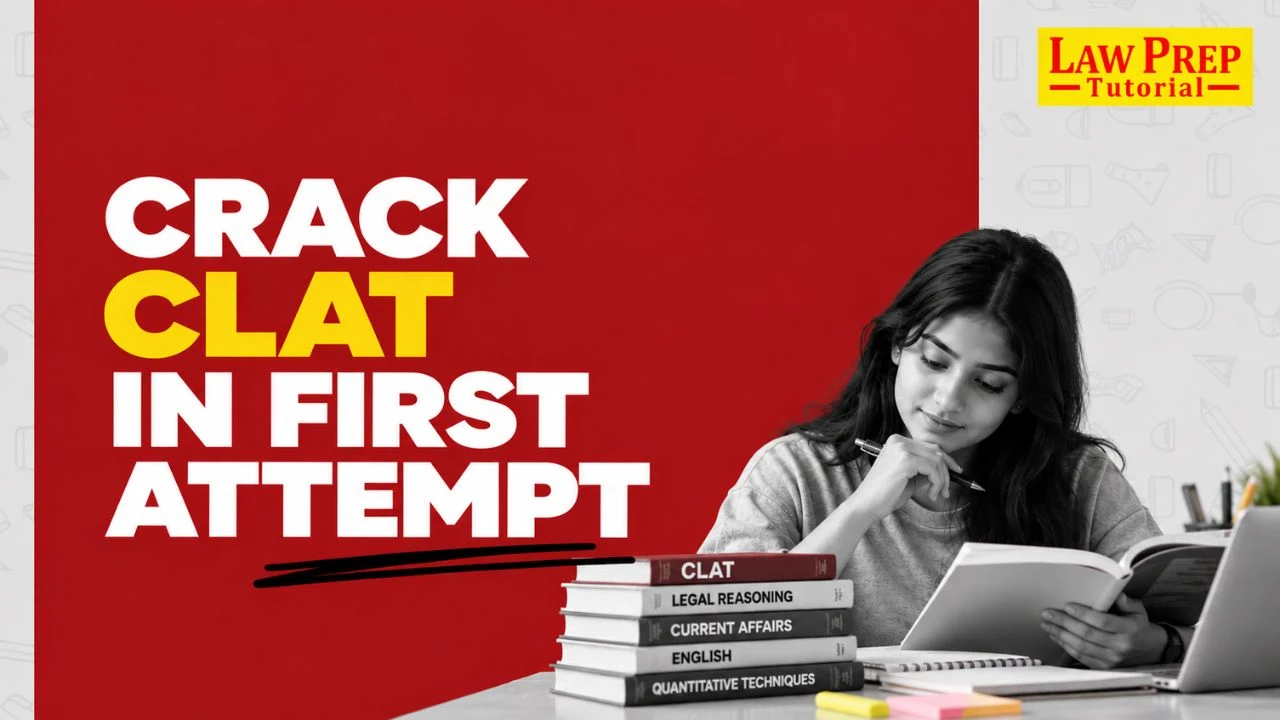
You must refine your approach based on your preparation level. Beginners should first build fundamentals, while droppers should identify and fix gaps from previous preparation.
This guide covers the preparation Strategy, study plan, subject-wise, books, and other details to help you crack CLAT exam in first attempt.
Table of Contents
Jump to section- CLAT PG: All About CLAT Postgraduate Exam for LLM
Understand the CLAT Exam Pattern:
The CLAT UG paper has five sections. Current Affairs (including General Knowledge) and Legal Reasoning carry the highest approximate share, while Quantitative Techniques has the fewest questions.
| Section | Approx. Questions | Approx. Weightage |
| English Language | 22-26 | 20% |
| Current Affairs & General Knowledge | 28-32 | 25% |
| Legal Reasoning | 28-32 | 25% |
| Logical Reasoning | 22-26 | 20% |
| Quantitative Techniques | 10-14 | 10% |
| Total | 120 | 100% |
The paper has 120 MCQs, with each question carrying one mark. The total test duration is two hours, and 0.25 marks are deducted for every wrong answer.
This distribution should influence your CLAT preparation strategy. Spend more time on the sections that make up a larger portion of the paper. But don't ignore the smaller Quantitative Techniques section, because even a limited number of correct answers can still increase your overall score.
How Should Beginners Start Preparation to Crack CLAT in 1st Attempt?
A beginner should not start preparation by immediately attempting full-length CLAT mocks. First, understand the five sections and identify the types of questions asked in each.
Start with a simple three-step process:
1. Understand the section: Read the syllabus and solve a few basic questions to see where you stand.
2. Build the basics: Work on reading, vocabulary, reasoning, legal principles, current affairs and Class 10-level mathematics.
3. Move towards timed practice: Once the basic concepts are familiar, introduce sectional tests and short timed sets.
Beginners should build a reading habit from the beginning. CLAT is passage-focused, so reading only practice papers is not sufficient. Read editorials, reliable news reports, essays and other well-written non-fiction to improve comprehension and speed.
For the first few weeks, focus more on understanding why an answer is correct. A beginner can divide the day into four broad study blocks:
- Current Affairs/GK: Daily news and revision
- English + Logical Reasoning: Reading and solving passages
- Legal Reasoning: Principle-based questions and legal awareness
- Quantitative Techniques: Concepts followed by numerical practice
How to Crack CLAT in First Attempt? Step-by-Step Approach
Your CLAT preparation strategy should move from understanding to application and finally to exam simulation.
Step 1: Analyse the syllabus and format
Know how many questions each section comprises. This helps you decide where to spend your preparation time.
Step 2: Establish your starting level
Take a diagnostic sectional test or one manageable mock. Do not worry about the score. Use it to find weak areas.
Step 3: Build section-wise basics
Strengthen basic grammar, comprehension, reasoning concepts, legal principles and Class 10-level mathematics before increasing question volume.
Step 4: Read daily current affairs
You can't cover Current Affairs and GK by studying everything together at the end. Follow a daily system and revise regularly.
Step 5: Begin sectional tests
Once the basics are reasonably clear, solve timed sectional tests for CLAT. This will show whether you can apply what you have studied under pressure.
Step 6: Introduce full-length mocks
Use mocks to practise the complete two-hour paper. Focus on decision-making, section order and time allocation along with the score.
Step 7: Analyse every mock
The CLAT mock analysis should take longer than simply checking the score. Mark questions as correct and confident, correct but guessed, incorrect with valid reason or unattempted.
Step 8: Revise Regularly
As the exam approaches, reduce new resources. Revise notes, CLAT current affairs, mistakes, important concepts and previously attempted questions.
Sectional Strategy to Follow to Crack CLAT Exam in First Attempt
The five sections require different preparation methods. Reading-heavy sections need comprehension and interpretation, while Quantitative Techniques requires calculation-based practice.
English Language
The English section is likely to have around 22-26 questions. Its passages may be drawn from fiction and non-fiction and can test comprehension, inference, viewpoints, comparison and contextual vocabulary.
Focus on the following areas:
- Reading comprehension
- Main idea and tone
- Inference-based questions
- Vocabulary in context
- Synonyms and antonyms
- Root words
- Idioms and phrases
- Grammar
- Para jumbles
- Para completion
- Para summaries
- Common literary devices
Don't treat vocabulary as a list to memorise once. Learn unfamiliar words while reading and revise them periodically. For comprehension, read the passage for its central argument before looking at the options. This reduces the chance of selecting an answer simply because it contains words similar to those in the passage.
Current Affairs and GK
Current Affairs and GK account for around 28-32 questions. This makes it one of the largest sections.
Your preparation should cover the following topics:
- Major national events
- International developments
- Government schemes
- Science and technology
- Environment
- Economy
- Important reports
- International organisations
- History
- Art and culture
- Constitutional and governance topics
- Major events of continuing historical importance
The Constitution deserves regular revision because questions may involve institutions, governance and important constitutional developments. For current affairs, avoid collecting too many sources.
Follow a manageable daily routine and revise older material every week. Monthly revision is equally important for retaining concepts over a longer period.
Legal Reasoning
Legal Reasoning is expected to contribute around 28-32 questions.
The section evaluates whether you know legal principles or propositions and can apply them to a given situation. Prior knowledge of law is not necessary for solving the passage-based questions. However, awareness of legal and public-policy developments can be useful.
Prepare areas such as:
- Constitutional principles
- Contracts
- Torts
- Criminal law
- Family law
- Evidence
- International law basics
- Intellectual property
- Arbitration
- Data protection
- Contemporary legal issues
The most important skill is application. Do not give all the time memorising legal terms and definitions. Read the principle carefully, identify the relevant facts and then apply the rule.
When practising, also change one fact in a question and ask how the answer would change. This develops the flexibility needed for principle-based questions.
Logical Reasoning
Logical Reasoning is expected to have around 22-26 questions.
The section focuses on arguments, premises, conclusions, assumptions, inferences and the effect of changing supporting facts.
Practise the following topics:
- Critical reasoning
- Assumptions
- Inferences
- Strengthen and weaken questions
- Cause and effect
- Analytical reasoning
- Blood relations
- Direction sense
- Syllogisms
- Seating arrangements
- Coding-decoding
- Course of action
- Flaws in reasoning
- Parallel reasoning
Do not solve logical questions mechanically. For critical reasoning, identify the conclusion first and then check which statement supports or challenges it.
For analytical questions, draw diagrams or short tables whenever they make the relationships easier to see.
Quantitative Techniques
Quantitative Techniques is expected to comprise approximately 10-14 questions and is based on Class 10-level mathematical operations and numerical data.
Key areas include:
- Basic calculations
- Fractions
- Divisibility
- Percentages
- Ratio and proportion
- Averages
- Profit and loss
- Simple and compound interest
- Time and work
- Time, speed and distance
- Mensuration
- Data interpretation
- Probability
- Permutation and combination
The section may present numerical information through short sets, tables, charts or other representations. Therefore, knowing formulas alone is not enough.
Practise calculating quickly without compromising accuracy. Keep a record of recurring calculation errors and revise the relevant concept.
Useful Preparation Resources for CLAT Exam
| CLAT Quantitative Techniques Questions | CLAT English Questions |
| CLAT Logical Reasoning Questions | CLAT Legal Reasoning Questions |
Books to Use for CLAT Preparation
The right CLAT preparation books should support both concept building and practice. Beginners should avoid collecting too many books because completing several resources halfway is less useful than working through a smaller set.
A useful book should help you understand the topic, practise CLAT-level questions and identify your weak areas. Section-wise material can help you build strong basics.
Law Prep Tutorial offers separate book sets for the major CLAT sections. Use them to make your subject-wise preparation more focused.
| Book Name | Description | Link |
| CLAT Quantitative Techniques Books Set | 5 Modules for Maths, Data Interpretation & Practice Exercises | This five-module set covers mathematics fundamentals, Quantitative Techniques, previous-year practice and exercises. It can help beginners build calculation speed and improve accuracy through structured practice. | Click Here |
| CLAT GK Books Set | 2 Modules for Static General Knowledge & Indian Constitution | This two-module set focuses on static GK and the Indian Constitution. It can help aspirants strengthen their base in general knowledge and constitutional topics alongside current affairs preparation. | Click Here |
| CLAT English Language Books Set | 10 Modules for Word List, Grammar, Verbal Ability, Reading Comprehension, Editorial Practice | This 10-module set covers vocabulary, grammar, verbal ability, reading comprehension, editorial and fiction-based passages, PYQs and additional exercises. It is designed for regular reading and language practice. | Click Here |
| CLAT Logical Reasoning Books Set | 10 Modules for Analytical Reasoning, Critical Reasoning, Puzzles & Practice Exercises | The 10-module set includes analytical and critical reasoning, puzzles, passage-based questions, previous-year questions and practice exercises. It can provide structured practice across different reasoning formats. | Click Here |
| CLAT Legal Reasoning Books Set | 12 Modules for Legal Aptitude, Legal Reasoning, Torts, Contract, Crime, Constitution & Practice Exercises | This 12-module set covers legal aptitude, constitutional topics, torts, contracts, criminal law, practice questions and topic-wise exercises. Use it to build concepts and then progress to application-based practice. | Click Here |
How to Use Mock Tests and PYQs to Crack CLAT in 1st Attempt
Mocks and previous-year questions should be a part of your preparation.
CLAT PYQs help you understand the exam format and the nature of the questions. They can show how passages are framed, what type of reasoning is expected and where you are likely to make mistakes.
Mocks help you understand the actual exam conditions. They test your ability to manage 120 questions in two hours while dealing with negative marking.
Do not start taking full mocks every day from day 1. Initially, use sectional and topic-wise tests. Increase mock frequency as your preparation progresses.
After every mock, calculate more than your total score. Track the following aspects:
| Metric | What It Shows |
| Attempts | Whether you are attempting a sufficient number of questions |
| Accuracy | How consistently you are choosing the correct answers |
| Time per Section | Which sections are taking more time than planned |
| Unattempted Easy Questions | Potential marks lost on questions you could have solved |
| Guesswork | May lose marks due to negative marking |
| Repeated Errors | Concepts or question types that need further revision |
LPT also provides several free CLAT preparation resources that can be included in a regular study routine, including Daily Current Affairs for CLAT, Monthly Current Affairs/GK Compendium, Daily Legal Updates, CLAT Current Affairs Quiz, free CLAT notes and PDFs, and free CLAT preparation videos.
For students looking for a larger preparation package, LPT's CLAT study material includes options such as the Champions Toolkit (CTK), CLAT Game Changer Kit, CLAT Express + Legal Express Combo and CLAT Express monthly GK and Current Affairs magazine.
Common Mistakes to Avoid While Preparing for CLAT
Some common mistakes you must avoid while preparing for CLAT are as follows:
Studying without a timetable
A long list of topics is not a study plan. Assign subjects and tasks to specific study blocks so you can track progress.
Ignoring Current Affairs until the final month
Current Affairs has one of the highest weightages. Leaving it for the end creates a large revision burden.
Taking mocks without analysing them
A mock score tells you where your preparation stands. The analysis highlights your strengths and weak areas.
Using too many resources
Switching between multiple books, PDFs, videos, and test series can create fragmented preparation. Finish useful material before moving to another source.
Avoiding Quantitative Techniques
This section has fewer questions, but skipping it completely can cost marks that may matter in a competitive exam.
Focusing only on speed
Fast solving is helpful only when your responses are accurate. With negative marking, uncontrolled guessing can reduce the benefit of serious attempts.
Repeating easy questions
Preparation should gradually move from basic questions to CLAT-level passage sets and timed practice. Solving only familiar questions can create a false sense of readiness.
Not revising mistakes
Unreviewed mistakes can reappear in the next mock. Maintain an error log and revisit it every few days.
How to Clear CLAT Exam in First Attempt?
To clear CLAT in the first attempt, focus on accuracy, consistency, and exam decision-making rather than simply counting study hours.
First, understand how the 120 marks are distributed. Current Affairs, including GK and Legal Reasoning, together account for roughly half of the paper, while English and Logical Reasoning contribute another substantial share.
Quantitative Techniques has fewer questions but still requires daily practice. For a beginner, the priority should be building fundamentals before increasing test volume. A dropper should spend more time correcting previous mistakes and improving weak areas.
With the December 6 exam approaching, the remaining preparation period should have a clear progression: Learn, Practise, Analyse, Revise and Repeat.
A strong first-attempt preparation plan should therefore include daily current affairs, regular reading, subject-wise practice, PYQs, sectional tests, full-length mocks and revision of mistakes.
Most importantly, do not track preparation only by the percentage of syllabus covered. Measure it by how accurately and confidently you can solve questions under a two-hour limit. That is the skill you need on CLAT exam day.
Check our other blogs:
| CLAT Eligibility Criteria | CLAT Sample Papers |
| CLAT Notification | Time Management Tips for CLAT Preparation |
| How to Read Newspaper for CLAT Exam | CLAT Admit Card |
FAQs About Cracking CLAT in First Attempt

SEO Head
Virendra heads SEO & Content at LPT. A writer at heart, he focuses on building exam-focused content that informs, guides, and supports aspirants in their preparation journey.
CLAT Trending Blogs
Other Related Blogs