Talk to a Counsellor
 Support
CLAT 2015 Question Paper: Download Free PDF with Answers
The CLAT 2015 question paper covered five sections. The paper was moderate in Legal Aptitude, General Knowledge and Current Affairs, and English. Logical Reasoning and Mathematics were tough. The overall difficulty level was moderate to difficult.
Last Updated on 29 Oct 2026

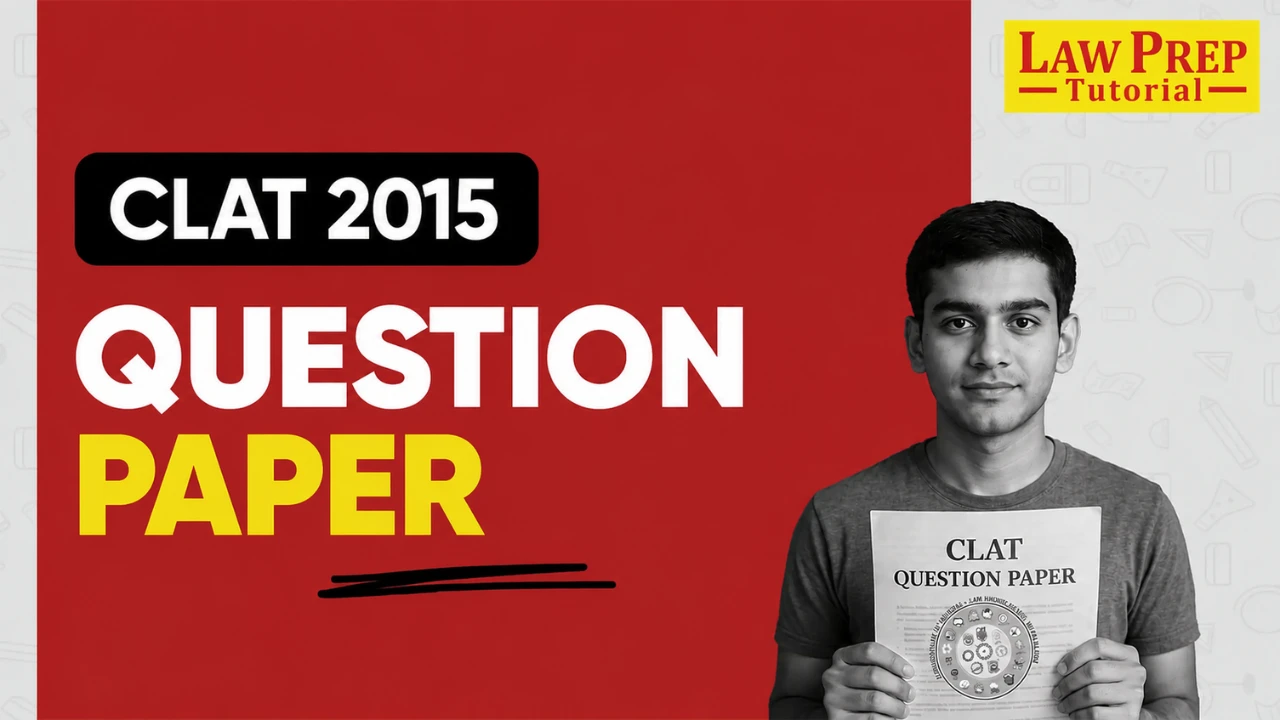
Reviewing the paper helps candidates understand the types of questions asked across these sections and identify the topics that need more practice. Read ahead to access the CLAT question paper 2015 PDF download link for focused practice.
Table of Contents
Jump to sectionCLAT 2015 Question Paper PDF
The CLAT 2015 paper with answers helps you practise questions from all five sections. Candidates can use the answer key to check their responses, review mistakes, and identify recurring topics that require additional preparation.
Candidates looking for a CLAT 2015 question paper PDF download should use the paper and answer key together for practice. Checking answers after attempting the questions makes it easier to separate conceptual mistakes from errors.
Benefits of Solving the CLAT 2015 Question Paper PDF
Solving an older paper lets candidates test their preparation with questions from different areas of the CLAT syllabus. The following benefits make it useful for revision.
- Identify weak topics: Reviewing incorrect answers helps candidates find areas that need more attention, such as syllogisms, arrangements, or probability.
- Practise different question types: The paper includes comprehension-based questions, legal aptitude questions, reasoning problems, and mathematical calculations.
- Improve logical accuracy: Questions on blood relations, coding, puzzles, and arrangements help candidates practise drawing conclusions from given information.
- Strengthen English skills: Reading comprehension, sentence correction, contextual synonyms, and inference-based questions help candidates assess their language and comprehension skills.
- Review subject knowledge: Static GK and current affairs questions assess general knowledge, while legal GK questions help candidates check their legal awareness.
How to Use the CLAT 2015 Question Paper for Practice
A structured practice session can help candidates gain more value from the paper. Follow these steps to review the questions and analyse your performance.
Step 1: Attempt questions independently
Solve the questions before checking the answers. This helps you identify which topics you can handle without assistance and where you face difficulty.
Step 2: Review the answer key
Compare your responses with the answers. Mark incorrect answers and questions you guessed, even if your guess was correct.
Step 3: Group mistakes by topic
Classify errors according to their topics. For example, you can review mistakes in syllogisms, coding, and arrangements under Logical Reasoning, while errors in number systems and probability can be grouped under Mathematics.
Step 4: Revisit difficult questions
Work through each incorrect question again. Check whether you misunderstood the question, applied the wrong method, or made a calculation error.
Step 5: Practise the weak areas
Revise the concepts behind your mistakes and solve additional questions from the same topics. This turns paper analysis into a focused revision plan.
CLAT 2015 Paper Difficulty Level
The paper had three moderate sections and two tough ones. Check the CLAT 2015 exam difficulty level below:
| Section | Difficulty Level |
| Legal Aptitude | Moderate |
| General Knowledge and Current Affairs | Moderate |
| English | Moderate |
| Logical Reasoning | Tough |
| Mathematics | Tough |
| Overall | Moderate to Difficult |
CLAT 2015 Exam Section-Wise Analysis
The section-wise analysis highlights the topics covered in each subject. Candidates can use this breakdown to organise revision and identify which question types need further practice.
English
The English section carried 40 marks and was of moderate level. Its topics covered reading comprehension, vocabulary, sentence structure, and interpretation.
| Topic | Practice Focus |
| Reading Comprehension | Understanding passages and identifying relevant information |
| Cloze Test | Selecting suitable words to complete a passage |
| Sentence Correction/Completion | Checking sentence structure and choosing appropriate completions |
| Contextual Synonyms | Identifying word meanings according to context |
| Commonly Confusing Words | Distinguishing between words with similar spellings or meanings |
| Phrasal Verbs | Understanding the meanings of verb phrases |
| Inference-Based Questions | Drawing conclusions from the given text |
Logical Reasoning
Logical Reasoning carried 40 marks and was rated tough. The section included several types of reasoning problems that require candidates to identify patterns, relationships, and valid conclusions.
| Topic | Practice Focus |
| Syllogism | Checking whether conclusions follow from statements |
| Blood Relations | Establishing relationships between family members |
| Series | Identifying number or pattern sequences |
| Coding | Understanding coding patterns and applying the given rules |
| Puzzles | Organising information and solving connected conditions |
| Arrangements | Placing people or items according to stated conditions |
Legal Aptitude
Legal Aptitude carried 50 marks and was of moderate level. The listed topics included assertion reasoning, fill-in-the-blanks, legal GK, and fact-based questions with or without principles.
| Topic | Practice Focus |
| Assertion Reasoning | Evaluating the relationship between an assertion and its reasoning |
| Legal GK | Revising legal general knowledge |
| Fact-Based Questions With/Without Principle | Analysing facts and applying the relevant principle when given |
Mathematics
Mathematics carried 20 marks and was rated tough. The section covered calculation-based topics, including number systems, speed-related problems, clocks, chart calculations, permutations, and probability.
| Topic | Practice Focus |
| Number System | Solving problems involving numbers and their properties |
| Time, Speed, and Distance | Applying the relationship between time, speed, and distance |
| Clocks | Working through clock-based problems |
| Chart Calculations | Extracting information from charts and performing calculations |
| Permutation | Solving problems involving possible arrangements |
| Probability | Calculating the likelihood of an event |
General Knowledge and Current Affairs
General Knowledge and Current Affairs carried 50 marks and had a moderate level. The section covered two broad areas.
| Topic | Practice Focus |
| Static GK | Revising general knowledge that does not depend on recent developments |
| Current Affairs | Reviewing questions related to current events |
More Previous Year Papers of CLAT
Below are the PDFs of previous year question papers of CLAT with answers, which you can download for FREE:
| Year | PDF Link |
| CLAT 2027 Question Paper | To be updated |
| CLAT 2026 Question Paper | Download PDF |
| CLAT 2025 Question Paper | Download PDF |
| CLAT 2024 Question Paper | Download PDF |
| CLAT 2023 Question Paper | Download PDF |
| CLAT 2022 Question Paper | Download PDF |
| CLAT 2021 Question Paper | Download PDF |
| CLAT 2020 Question Paper | Download PDF |
| CLAT 2019 Question Paper | Download PDF |
| CLAT 2018 Question Paper | Download PDF |
| CLAT 2017 Question Paper | Download PDF |
| CLAT 2016 Question Paper | Download PDF |
| CLAT 2015 Question Paper | Download PDF |
| CLAT 2014 Question Paper | Download PDF |
| CLAT 2013 Question Paper | Download PDF |
| CLAT 2012 Question Paper | Download PDF |
| CLAT 2011 Question Paper | Download PDF |
| CLAT 2010 Question Paper | Download PDF |
| CLAT 2009 Question Paper | Download PDF |
| CLAT 2008 Question Paper | Download PDF |
FAQs on CLAT 2015 Question Paper

SEO Head
Virendra heads SEO & Content at LPT. A writer at heart, he focuses on building exam-focused content that informs, guides, and supports aspirants in their preparation journey.
CLAT Trending Blogs
Other Related Blogs