Talk to a Counsellor
 Support
Fundamental Duties Are Taken/Borrowed From Which Country?
Discover the origin of Fundamental Duties in India, their connection to the USSR, reasons for inclusion, and important legal developments.
Last Updated on 05 Jul 2026

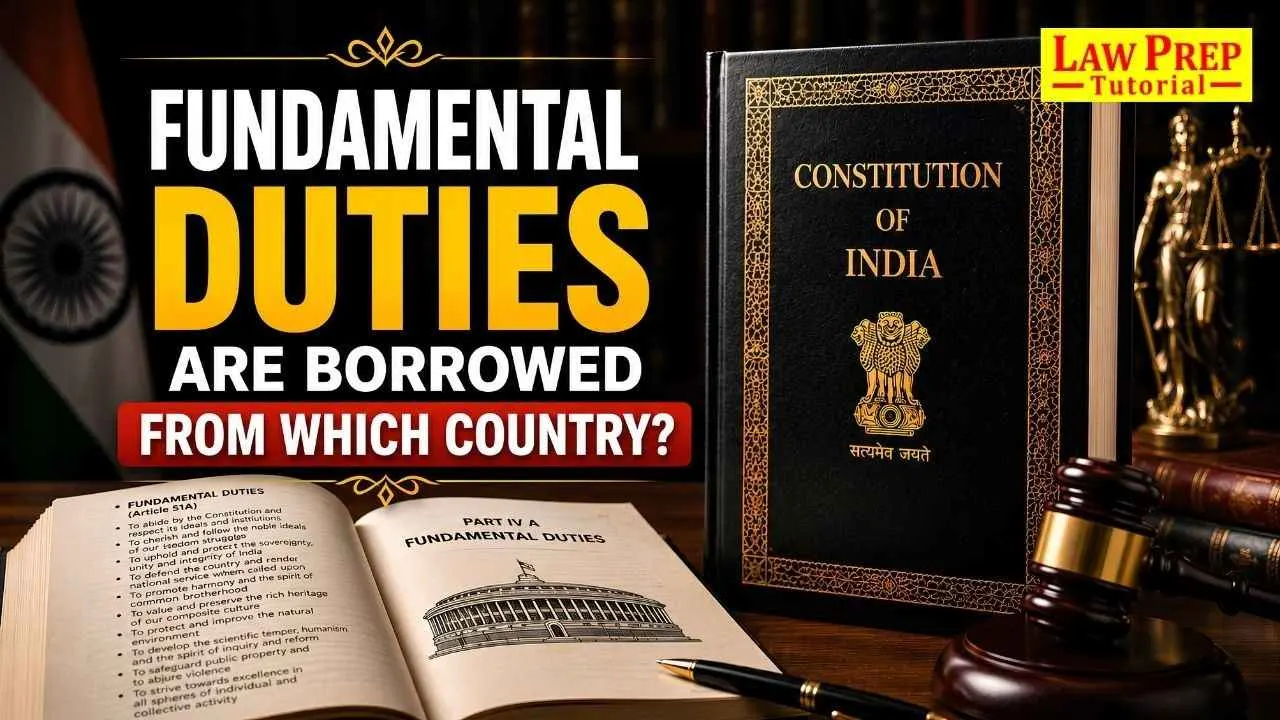
The Fundamental Duties of Indian Constitution are taken from the Soviet Constitution, also known as the USSR Constitution. However, India did not copy them blindly. The idea was adapted according to India’s democratic values and social needs. Fundamental Duties were not part of the original Constitution.
They were added later by the 42nd Constitutional Amendment Act, 1976, on the recommendation of the Swaran Singh Committee. These duties remind citizens to respect the Constitution, protect national unity, preserve culture, safeguard public property, and care for the environment.
Table of Contents
Jump to section- CLAT PG: All About CLAT Postgraduate Exam for LLM
Fundamental Duties are Taken From Which Country?
Fundamental Duties are taken from the Soviet Constitution / USSR. They were added to the Indian Constitution by the 42nd Constitutional Amendment Act, 1976 under Part IVA, Article 51A. Originally, 10 Fundamental Duties were added. Later, the 11th Fundamental Duty was added by the 86th Constitutional Amendment Act, 2002, making education a duty of parents or guardians for children aged 6 to 14 years.
Explore the Sources of Indian Constitution in detail!
What Are Fundamental Duties?
Fundamental Duties are the moral and civic responsibilities of Indian citizens mentioned in Article 51A of the Indian Constitution. These duties guide citizens to respect the Constitution, National Flag, National Anthem, public property, environment, culture, and unity of India. They also encourage citizens to develop scientific thinking, protect natural resources, and work towards excellence.
List of Fundamental Duties in Indian Constitution:
| No. | Fundamental Duty Under Article 51A | Meaning |
| 1 | To abide by the Constitution and respect its ideals, institutions, National Flag and National Anthem | Respect the Constitution and national symbols |
| 2 | To cherish and follow the noble ideals of the freedom struggle | Remember and follow the values of India’s freedom movement |
| 3 | To uphold and protect the sovereignty, unity and integrity of India | Protect India’s independence and unity |
| 4 | To defend the country and render national service when called upon | Serve the nation when needed |
| 5 | To promote harmony and brotherhood among all people of India | Maintain unity beyond religion, language, region, or caste |
| 6 | To value and preserve the rich heritage of India’s composite culture | Respect and protect India’s cultural heritage |
| 7 | To protect and improve the natural environment, including forests, lakes, rivers and wildlife | Take care of nature and the environment |
| 8 | To develop scientific temper, humanism and the spirit of inquiry and reform | Think logically and support learning, questioning, and reform |
| 9 | To safeguard public property and avoid violence | Do not damage public property and avoid violent actions |
| 10 | To strive towards excellence in all spheres of individual and collective activity | Work towards personal and national progress |
| 11 | To provide opportunities for education to children aged 6 to 14 years | Parents or guardians must support children’s education |
Check out other important Indian Constitution topics here:
| Preamble of Indian Constitution | Schedules of Indian Constitution |
| Salient Features of Indian Constitution | Facts About Indian Constitution |
| Constitution Day of India | Parts of Indian Constitution |
Reasons Why Fundamental Duties Were Added to the Constitution
1. To Balance Rights With Responsibilities
The Indian Constitution gives citizens important Fundamental Rights, but rights work better when citizens also follow their duties. Fundamental Duties were added to remind people that they should not only claim freedoms but also act responsibly towards society, the nation, and the Constitution.
2. To Promote Respect for the Constitution
India needed citizens to respect the Constitution, National Flag, National Anthem, and constitutional institutions. Fundamental Duties help build constitutional discipline and remind citizens that national symbols and democratic institutions must be treated with dignity.
3. To Strengthen National Unity
India is a diverse country with many languages, religions, cultures, and regions. Fundamental Duties encourage citizens to protect the sovereignty, unity, and integrity of India. They also promote harmony and brotherhood among all people.
4. To Protect Public Property
Damage to public property affects everyone because public resources are created through public money. Fundamental Duties remind citizens to safeguard public property and avoid violence, especially during protests, public movements, or social conflicts.
5. To Protect the Environment
The Constitution expects citizens to protect forests, rivers, lakes, wildlife, and the natural environment. This duty is important because environmental protection cannot depend only on the government. Citizens also have a role in keeping nature safe.
6. To Encourage Scientific Thinking
Fundamental Duties ask citizens to develop scientific temper, humanism, and the spirit of inquiry. This means people should think rationally, question blindly accepted ideas, support reform, and help build a progressive society.
7. To Support Education
The 11th Fundamental Duty was added to make parents or guardians responsible for providing education to children aged 6 to 14 years. This duty supports the larger goal of making education accessible and meaningful for every child.
Explore important Legal Education resources here:
| Articles of Indian Constitution | Article 14 of Indian Constitution |
| Article 343 of Indian Constitution | Article 15 of Indian Constitution |
Fundamental Duties Borrowed From USSR: How India Adapted Them?
Fundamental Duties were borrowed from the Soviet Constitution / USSR, where duties were treated as an important part of citizenship. The Soviet model focused on the idea that citizens must contribute to the nation and society, not just enjoy rights. India accepted this idea, but adapted it according to its democratic system.
In India, Fundamental Duties do not take away Fundamental Rights. They work as guiding responsibilities for citizens. They remind people to respect the Constitution, protect unity, preserve culture, care for the environment, safeguard public property, and develop scientific thinking. They are also mostly non-justiciable, which means a citizen cannot usually be punished only for not following a Fundamental Duty unless a separate law supports it.
So, India borrowed the idea from the USSR, but gave it an Indian form based on democracy, unity, social harmony, and responsible citizenship.
Important Supreme Court Cases on Fundamental Duties
| Case | Year | Importance |
| M.C. Mehta v. Union of India | 1988 | The Supreme Court linked environmental protection with constitutional duties and stressed the need to protect nature, rivers, forests, and public health. |
| Rural Litigation and Entitlement Kendra v. State of Uttar Pradesh | 1985 | The Court supported environmental protection and sustainable use of natural resources, which connects with the duty to protect the environment. |
| Bijoe Emmanuel v. State of Kerala | 1986 | The Court balanced respect for the National Anthem with freedom of conscience and religious belief. |
| AIIMS Students’ Union v. AIIMS | 2001 | The Court observed that Fundamental Duties are important for citizens and should be treated as a guide for responsible conduct. |
| Javed v. State of Haryana | 2003 | The Court referred to duties and social responsibility while upholding a law related to population control for local body elections. |
| In Re: Noise Pollution Case | 2005 | The Court connected responsible citizenship with control of noise pollution and protection of public health. |
| Ramlila Maidan Incident v. Home Secretary, Union of India | 2012 | The Court discussed constitutional values, citizen responsibility, and peaceful public conduct in a democracy. |
Fundamental Duties PDF Download
This PDF will help you quickly revise the source of Fundamental Duties, Article 51A, complete list of duties, amendments, Supreme Court cases, and exam-focused facts.
Check out more Law-Related Topics here:
FAQs on Fundamental Duties Are Taken From Which Country

SEO Head
Virendra heads SEO & Content at LPT. A writer at heart, he focuses on building exam-focused content that informs, guides, and supports aspirants in their preparation journey.
Constitution of India Trending Blogs
Other Related Blogs