Talk to a Counsellor
 Support
5+ Easy Tricks to Remember Articles of Indian Constitution
Add 4, add 89 and add 90 are three simple number patterns that can help you remember many important Articles of the Indian Constitution without learning every Article as a separate fact.
Last Updated on 17 Oct 2026

For example, the three major Emergency provisions follow an easy pattern: Article 352, Article 356 and Article 360. You simply add 4 to move from one to the next. Similarly, several provisions relating to the Centre and States have corresponding Article numbers that differ by 89 or 90.
These tricks to remember Articles of Indian Constitution are especially useful when you already understand the provision but keep forgetting its Article number. In this guide, we will use number patterns, topic groups and Centre-State comparisons to make important constitutional Articles easier to revise.
Table of Contents
Jump to sectionHow Many Articles Are There in the Indian Constitution?
The Constitution of India originally contained 395 Articles when it came into force on January 26, 1950.
Since then, several Constitutional Amendments have added new Articles, while some provisions have been amended, repealed or omitted. This is why simply looking at the highest Article number does not tell you how many operative Articles exist today.
For competitive exams, trying to memorise every Article number separately is not practical. A better approach is to learn the most important Articles in groups and number patterns.
For example:
- Articles 14–18 deal with the Right to Equality.
- Articles 19–22 cover freedoms and protections.
- Articles 25–28 deal with Freedom of Religion.
- Articles 352, 356 and 360 cover Emergency provisions.
- Several Centre-State corresponding Articles can be recalled by adding 89 or 90.
Important Articles of Indian Constitution: At a Glance
| Article | Provision |
| Article 14 | Equality before law and equal protection of laws |
| Article 19 | Protection of certain freedoms |
| Article 21 | Protection of life and personal liberty |
| Article 21A | Right to Education |
| Article 32 | Constitutional Remedies |
| Article 44 | Uniform Civil Code |
| Article 51A | Fundamental Duties |
| Article 72 | Pardoning power of President |
| Article 123 | Ordinance-making power of President |
| Article 124 | Establishment and constitution of Supreme Court |
| Article 161 | Pardoning power of Governor |
| Article 213 | Ordinance-making power of Governor |
| Article 214 | High Courts for States |
| Article 324 | Election Commission |
| Article 352 | National Emergency |
| Article 356 | Failure of constitutional machinery in a State |
| Article 360 | Financial Emergency |
| Article 368 | Amendment of Constitution |
Tricks to Remember Articles of Indian Constitution
The three most useful tricks to remember articles of Constitution of India are:
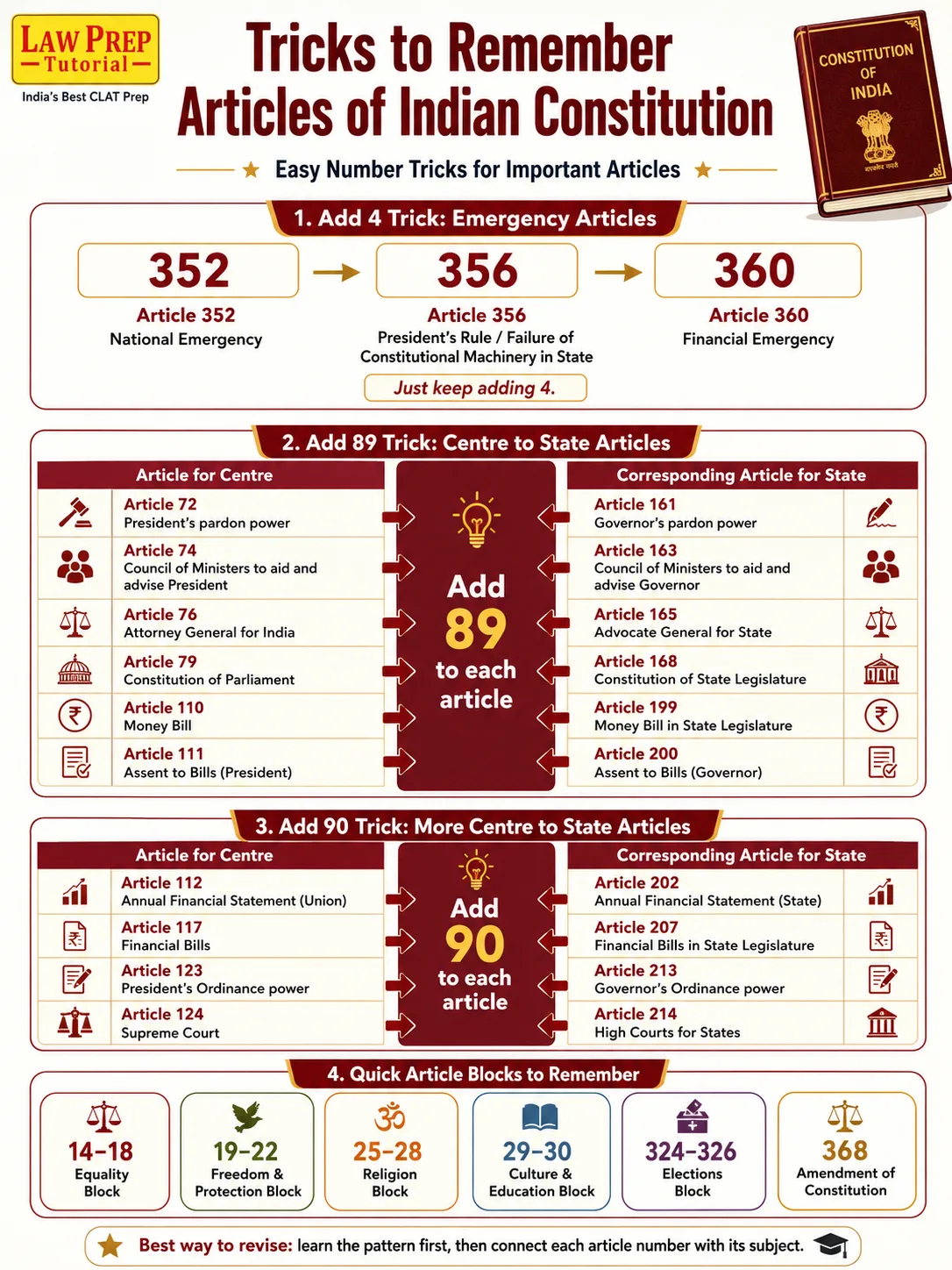
1. Add 4 for Emergency Articles
Emergency provisions are among the easiest constitutional Articles to remember because they follow a clean numerical pattern.
Article 352: National Emergency
Article 352 deals with the proclamation of Emergency in circumstances specified by the Constitution.
Remember:
352 = National Emergency
Now add 4.
Article 356: Failure of Constitutional Machinery in a State
352 + 4 = 356
Article 356 deals with a situation where the constitutional machinery of a State fails. It is commonly associated with the President's Rule.
Now add another 4.
Article 360: Financial Emergency
356 + 4 = 360
Article 360 deals with Financial Emergency.
So, the full trick is:
352 → +4 → 356 → +4 → 360
| Article | Provision | Memory Trick |
| 352 | National Emergency | Start |
| 356 | President's Rule | 352 + 4 |
| 360 | Financial Emergency | 356 + 4 |
2. Add 89 for Many Centre-State Corresponding Articles
One of the most useful tricks to remember Articles of Indian Constitution is to compare similar provisions for the Union and the States.
For several important provisions, the corresponding State Article is:
Centre Article + 89 = State Article
This pattern works across a surprisingly useful set of Articles.
| Centre | Provision | State | Provision |
| 72 | President's pardon | 161 | Governor's pardon |
| 74 | Council of Ministers | 163 | Council of Ministers |
| 75 | Union Ministers | 164 | State Ministers |
| 76 | Attorney General | 165 | Advocate General |
| 77 | Union business | 166 | State business |
| 78 | PM's duties | 167 | CM's duties |
| 79 | Parliament | 168 | State Legislature |
| 85 | Sessions of Parliament | 174 | Sessions of State Legislature |
| 86 | President addresses Houses | 175 | Governor addresses Legislature |
| 88 | Ministers/AG in Houses | 177 | Ministers/Advocate General |
| 100 | Voting in Parliament | 189 | Voting in State Legislature |
| 102 | Disqualification | 191 | Disqualification |
| 105 | Parliamentary privileges | 194 | State Legislature privileges |
| 110 | Money Bill | 199 | State Money Bill |
| 111 | President's assent | 200 | Governor's assent |
Article 72 and Article 161: Pardoning Powers
72 + 89 = 161
- Article 72: Pardoning power of the President
- Article 161: Pardoning power of the Governor
So if you remember Article 72 for the President, adding 89 gives you Article 161 for the Governor.
Article 74 and Article 163: Council of Ministers
74 + 89 = 163
- Article 74: Council of Ministers to aid and advise the President
- Article 163: Council of Ministers to aid and advise the Governor
Article 75 and Article 164: Ministers
75 + 89 = 164
- Article 75: Other provisions relating to Union Ministers
- Article 164: Other provisions relating to State Ministers
Article 76 and Article 165: Attorney General and Advocate General
76 + 89 = 165
- Article 76: Attorney General for India
- Article 165: Advocate General for the State
This pair is particularly easy to remember because both are the highest law officers at their respective levels.
Article 77 and Article 166: Conduct of Government Business
77 + 89 = 166
- Article 77: Conduct of business of the Government of India
- Article 166: Conduct of business of the Government of a State
Article 78 and Article 167: Duties of PM and CM
78 + 89 = 167
- Article 78: Duties of the Prime Minister regarding furnishing information to the President
- Article 167: Duties of the Chief Minister regarding furnishing information to the Governor
Article 79 and Article 168: Parliament and State Legislature
79 + 89 = 168
- Article 79: Constitution of Parliament
- Article 168: Constitution of Legislatures in States
Article 85 and Article 174: Sessions of Legislatures
85 + 89 = 174
- Article 85: Sessions, prorogation and dissolution relating to Parliament
- Article 174: Sessions, prorogation and dissolution relating to State Legislature
Article 86 and Article 175: Right to Address the Houses
86 + 89 = 175
- Article 86: Right of the President to address and send messages to Houses
- Article 175: Right of the Governor to address and send messages to the State Legislature
Article 88 and Article 177: Rights of Ministers and Law Officers
88 + 89 = 177
- Article 88: Rights of Ministers and Attorney General in relation to Parliament
- Article 177: Rights of Ministers and Advocate General in relation to State Legislature
Article 100 and Article 189: Voting in Houses
100 + 89 = 189
- Article 100: Voting in Houses of Parliament
- Article 189: Voting in Houses of State Legislature
Article 102 and Article 191: Disqualification
102 + 89 = 191
- Article 102: Disqualification for membership of Parliament
- Article 191: Disqualification for membership of State Legislature
Article 105 and Article 194: Powers and Privileges
105 + 89 = 194
- Article 105: Powers and privileges of Parliament and its members
- Article 194: Powers and privileges of State Legislatures and their members
Article 110 and Article 199: Money Bills
110 + 89 = 199
- Article 110: Definition of Money Bill for Parliament
- Article 199: Definition of Money Bill for State Legislature
Article 111 and Article 200: Assent to Bills
111 + 89 = 200
- Article 111: Assent to Bills by the President
- Article 200: Assent to Bills by the Governor
3. Add 90 for Another Centre-State Article Block
Another group becomes easier when you use:
Centre Article + 90 = State Article
This pattern is especially useful for financial procedure and legislative provisions.
| Centre Article | Provision | State Article | Provision |
| 112 | Annual Financial Statement | 202 | State Annual Financial Statement |
| 113 | Estimates | 203 | State estimates |
| 114 | Appropriation Bills | 204 | State Appropriation Bills |
| 115 | Supplementary grants | 205 | State supplementary grants |
| 116 | Votes on account | 206 | State votes on account |
| 117 | Financial Bills | 207 | State Financial Bills |
| 118 | Rules of procedure | 208 | State Legislature procedure |
| 119 | Financial procedure | 209 | State financial procedure |
| 120 | Language in Parliament | 210 | Language in State Legislature |
| 121 | Restriction on discussion | 211 | Corresponding State restriction |
| 122 | Courts and Parliament | 212 | Courts and State Legislature |
| 123 | President's Ordinance | 213 | Governor's Ordinance |
| 124 | Supreme Court | 214 | High Courts |
Article 112 and Article 202: Annual Financial Statement
112 + 90 = 202
- Article 112: Annual Financial Statement for the Union
- Article 202: Annual Financial Statement for a State
In everyday exam language, these are often associated with the Union and State Budgets.
Article 113 and Article 203: Estimates
113 + 90 = 203
- Article 113: Procedure in Parliament with respect to estimates
- Article 203: Procedure in State Legislature with respect to estimates
Article 114 and Article 204: Appropriation Bills
114 + 90 = 204
- Article 114: Appropriation Bills at the Union level
- Article 204: Appropriation Bills at the State level
Article 115 and Article 205: Supplementary Grants
115 + 90 = 205
Both deal with supplementary, additional or excess grants at their respective levels.
Article 116 and Article 206: Votes on Account
116 + 90 = 206
These provisions cover matters such as votes on account, votes of credit and exceptional grants.
Article 117 and Article 207: Financial Bills
117 + 90 = 207
Both deal with special provisions relating to Financial Bills.
Article 118 and Article 208: Rules of Procedure
118 + 90 = 208
- Article 118: Rules of procedure for Parliament
- Article 208: Rules of procedure for State Legislatures
Article 119 and Article 209: Financial Procedure
119 + 90 = 209
These deal with regulation by law of procedure relating to financial business.
Article 120 and Article 210: Language
120 + 90 = 210
- Article 120: Language to be used in Parliament
- Article 210: Language to be used in State Legislature
Article 121 and Article 211: Restriction on Discussion
121 + 90 = 211
Both contain restrictions on certain discussions concerning judges.
Article 122 and Article 212: Courts and Legislative Proceedings
122 + 90 = 212
- Article 122: Courts not to inquire into proceedings of Parliament on specified grounds
- Article 212: Corresponding provision for State Legislature
Article 123 and Article 213: Ordinance-Making Power
123 + 90 = 213
This is one of the most useful pairs to remember:
- Article 123: President's ordinance-making power
- Article 213: Governor's ordinance-making power
Article 124 and Article 214: Supreme Court and High Courts
124 + 90 = 214
- Article 124: Establishment and constitution of the Supreme Court
- Article 214: High Courts for States
This is not an exact Centre-State mirror in the same way as some other pairs, but the +90 number pattern can still help you recall the two important judiciary Articles.
Explore Other Related Articles
| Article 343 of the Indian Constitution | Anti-Defection Law |
Tricks to Remember Articles Related to Fundamental Rights
Number patterns are useful, but some Articles are easier to remember as blocks.
1. Articles 14 to 18: Right to Equality
Instead of memorising five separate numbers, remember:
14–18 = Equality Block
- Article 14: Equality before law and equal protection of laws
- Article 15: Prohibition of discrimination on specified grounds
- Article 16: Equality of opportunity in public employment
- Article 17: Abolition of untouchability
- Article 18: Abolition of titles
The sequence can be remembered as:
Equality → No Discrimination → Equal Opportunity → No Untouchability → No Titles
2. Articles 19 to 22: Freedom and Protection Block
Remember: 19–22 = Freedom + Protection
- Article 19: Protection of certain freedoms
- Article 20: Protection in respect of conviction for offences
- Article 21: Protection of life and personal liberty
- Article 21A: Right to Education
- Article 22: Protection against arrest and detention in certain cases
A simple sequence is:
Freedom → Criminal Protection → Life → Education → Arrest Protection
3. Articles 23 and 24: Right Against Exploitation
These two Articles can be remembered together.
- Article 23: Prohibition of traffic in human beings and forced labour
- Article 24: Prohibition of employment of children in certain hazardous work
4. Articles 25 to 28: Freedom of Religion
Instead of four separate tricks, remember:
25–28 = Religion Block
These Articles deal with different aspects of freedom of religion and related matters.
5. Articles 29 and 30: Cultural and Educational Rights
Remember: 29–30 = Culture + Education
- Article 29: Protection of interests of minorities
- Article 30: Right of minorities to establish and administer educational institutions
6. Article 32: Constitutional Remedies
Article 32 is one of the most important Fundamental Rights provisions.
It provides the constitutional mechanism for approaching the Supreme Court for enforcement of Fundamental Rights.
For revision: 32 = Supreme Court + Fundamental Rights Remedy
This also helps distinguish it from Article 226.
Also explore about Fundamental Rights Borrowed From Which Country
Tricks to Remember Articles Related to DPSP
You do not need to memorise every Directive Principle first. Start with high-frequency Articles.
| Article | Provision |
| 39 | Certain principles of policy |
| 39A | Equal justice and free legal aid |
| 40 | Organisation of village panchayats |
| 44 | Uniform Civil Code |
| 45 | Early childhood care and education |
| 48A | Protection and improvement of environment |
| 50 | Separation of judiciary from executive |
A useful way to revise these is through their keywords:
- 39A = Legal Aid
- 40 = Panchayats
- 44 = UCC
- 48A = Environment
- 50 = Judiciary-Executive Separation
Check out other important Indian Constitution topics here:
Tricks to Remember Parliament Articles
Some Parliament Articles also follow a useful sequence.
Article 79, 80, 81
- Article 79: Constitution of Parliament
- Article 80: Composition of Rajya Sabha
- Article 81: Composition of Lok Sabha
Article 108, 110 and 112
These are also commonly tested:
- Article 108: Joint sitting of both Houses
- Article 110: Money Bill
- Article 112: Annual Financial Statement
Tricks to Remember Election Articles
Articles 324 to 326 form another easy group.
- Article 324: Election Commission
- Article 325: One general electoral roll; no exclusion on specified grounds
- Article 326: Elections on the basis of adult suffrage
Check out more Law-Related Topics here:
Important Constitutional Body Articles
Some Article numbers are best remembered directly because they are frequently asked.
| Article | Constitutional Body/Provision |
| 148 | Comptroller and Auditor-General of India |
| 280 | Finance Commission |
| 315 | Union and State Public Service Commissions |
| 324 | Election Commission |
| 338 | National Commission for Scheduled Castes |
| 338A | National Commission for Scheduled Tribes |
| 338B | National Commission for Backward Classes |

SEO Head
Virendra heads SEO & Content at LPT. A writer at heart, he focuses on building exam-focused content that informs, guides, and supports aspirants in their preparation journey.
Constitution of India Trending Blogs
Other Related Blogs