
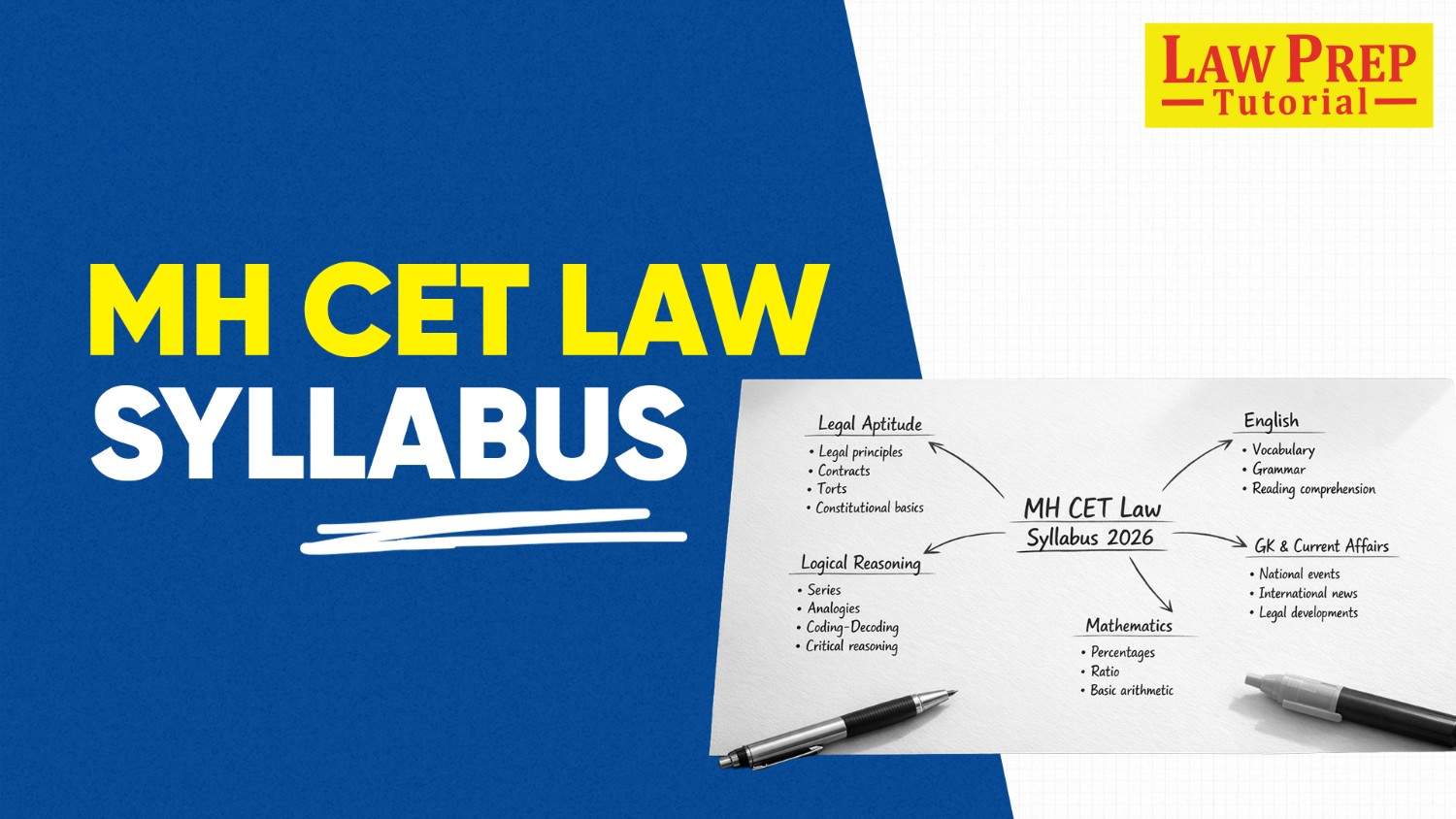

The MH CET Law 2026 syllabus for the 5-year LLB outlines the key subjects and topics candidates must prepare to succeed in the Maharashtra law entrance exam. Conducted by the State Common Entrance Test Cell, Maharashtra, this exam tests a student’s aptitude for legal studies through sections such as legal reasoning, general knowledge, logical thinking, English language skills, and basic mathematics.
Understanding the subject-wise syllabus, exam pattern, important topics, and marking scheme is essential for building an effective preparation strategy. In this guide, students can explore the detailed MH CET syllabus for the 5-year LLB programme, along with important topics, preparation tips, and answers to frequently asked questions to help them prepare confidently for the MH CET Law exam.
MH CET Law Syllabus 2026 – Highlights for 5-Year LLB
Below are the key features of the MH CET Law syllabus:
| Particulars | Details |
| Total Subjects | 5 |
| Subjects Covered | • Legal Aptitude and Legal Reasoning • General Knowledge with Current Affairs • Logical and Analytical Reasoning • English Language • Mathematical Aptitude |
| Level of Syllabus | Based on Class 10–12 level concepts and general awareness |
| Focus Areas | Legal reasoning, analytical ability, language skills, and general knowledge |
| Type of Questions | Concept-based and application-oriented questions |
| Syllabus Purpose | To evaluate aptitude and readiness for legal studies |
Join our Online MH CET Law Coaching to boost your preparation significantly!
MH CET Law Syllabus 2026 for 5-Year LLB (Subject-Wise)
The MH CET syllabus for Law is divided into five sections. Each section evaluates different skills required for legal studies.
Legal Aptitude and Legal Reasoning Syllabus
This section tests a candidate’s ability to apply legal principles to real-life situations and analyse legal arguments.
| Topics | Description |
| Legal Principles | Basic legal concepts and rules commonly used in law |
| Legal Problem Solving | Applying legal principles to factual situations |
| Legal Maxims | Common legal phrases and their meanings |
| Constitutional Concepts | Fundamental rights, duties, and constitutional values |
| Landmark Judgments | Awareness of important legal decisions |
| Legal Awareness | Basic understanding of legal systems and institutions |
General Knowledge and Current Affairs Syllabus
This section evaluates awareness of national and international events, politics, and history.
| Topics | Description |
| Current Affairs | Recent national and international events |
| Indian History | Important historical developments in India |
| Geography | Basic physical and political geography |
| Indian Polity | Structure of government and constitution |
| Economics | Basic economic concepts and developments |
| Awards and Personalities | Important awards, achievements, and personalities |
Logical and Analytical Reasoning Syllabus
This section measures problem-solving ability and logical thinking.
| Topics | Description |
| Analogies | Identifying relationships between concepts |
| Series and Patterns | Recognising number and letter sequences |
| Syllogisms | Drawing logical conclusions from statements |
| Logical Arguments | Evaluating reasoning and identifying patterns |
| Coding and Decoding | Interpreting coded information |
| Puzzles and Problem Solving | Analytical reasoning-based questions |
English Language Syllabus
The English section evaluates vocabulary, grammar, and comprehension ability.
| Topics | Description |
| Reading Comprehension | Understanding passages and answering related questions |
| Grammar | Tenses, articles, prepositions, and sentence structure |
| Vocabulary | Synonyms, antonyms, and word meanings |
| Sentence Formation | Rearranging words to form meaningful sentences |
| Error Detection | Identifying grammatical mistakes |
Basic Mathematics Syllabus
The mathematics section focuses on basic numerical ability.
| Topics | Description |
| Arithmetic | Basic numerical calculations |
| Percentages | Percentage-based calculations |
| Profit and Loss | Business-related mathematical problems |
| Ratio and Proportion | Understanding numerical relationships |
| Averages | Calculating and interpreting averages |
MH CET Law Exam Pattern 2026 for 5-Year LLB
Check out the MH CET Law exam pattern 2026 table below to become familiar with the structure of the exam:
| Particulars | Details |
| Exam Mode | Online (Computer-Based Test) |
| Type of Questions | Multiple Choice Questions (MCQs) |
| Total Questions | 120 |
| Total Marks | 120 |
| Duration of Exam | 120 Minutes |
| Number of Sections | 5 |
| Sections Included | • Legal Aptitude and Legal Reasoning • General Knowledge with Current Affairs • Logical and Analytical Reasoning • English Language • Mathematical Aptitude |
| Marks per Question | 1 Mark |
| Negative Marking | No Negative Marking |
| Medium of Exam | English and Marathi |
Explore the MH CET Application Form here!
Important Topics in MH CET Law 2026 for 5-Year LLB
Understanding the important topics in MH CET Law 2026 for the 5-year LLB exam can help candidates focus on the most relevant areas of the syllabus and prepare more effectively for the entrance test.
Section-Wise Important Topics
The section-wise important topics for MH CET Law 2026 highlight key areas from each subject that candidates should prioritise while preparing for the examination.
| Subject | Important Topics |
| Legal Aptitude and Legal Reasoning | • Indian Constitution • Legal Maxims and Terms • Legal GK • Torts and Contracts (Basic Principles) • Current Legal Developments • Legal reasoning-based assertion–reason questions |
| General Knowledge with Current Affairs | History: • Ancient, Medieval, and Modern History • Socio-religious reform movements Indian Polity: • Structure of Government • Important amendments and acts Geography: • Indian Geography (rivers, mountains, climate, states, and capitals) • Important national parks and wildlife sanctuaries Economics: • Government schemes and policies • Indian economic history and reforms Science and Technology: • Recent scientific developments • Important inventions and discoveries Important Days and Dates: • National and international observance days • Days related to law, education, and global awareness Current Affairs: • National and international news • Legal current affairs • Appointments and resignationsObituaries |
| Logical and Analytical Reasoning | • Coding and Decoding • Blood Relations • Syllogism • Analogies • Puzzles • Series Completion |
| English | • Vocabulary (Synonyms, Antonyms) • Reading Comprehension • Sentence Correction • Grammar • Idioms and Phrases |
| Mathematical Aptitude | • Profit and Loss • Speed and Distance • Time and Work • Algebra • Average |
Also checkout: MH CET Exam Date
Changes in MH CET Law Syllabus 2026 (If Any)
As per the latest information released by the State Common Entrance Test Cell, Maharashtra, there are no major changes in the MH CET Law syllabus 2026 for the 5-year LLB entrance exam. The syllabus continues to cover five main subjects: Legal Aptitude and Legal Reasoning, General Knowledge with Current Affairs, Logical and Analytical Reasoning, English Language, and Basic Mathematics.
MH CET Law 2026 Marking Scheme for 5-Year LLB
Understanding the MH CET Law 2026 marking scheme helps candidates know how marks are awarded in the exam and how their final score is calculated.
| Particulars | Details |
| Total Questions | 120 |
| Total Marks | 120 |
| Marks per Question | 1 Mark |
| Negative Marking | No Negative Marking |
| Unanswered Questions | No marks awarded or deducted |
| Type of Questions | Multiple Choice Questions (MCQs) |
Checkout important resources for MH CET Law Exam here:
| MH CET Law Merit List | MH CET Law Previous Year Question Paper |
| MH CET Law Admit Card | MH CET Law Exam Centers |
| MH CET Law Universities | MH CET Law Counselling |
MH CET Law 2026 Sample Papers and Mock Tests
Practising MH CET Law 2026 sample papers and mock tests is an effective way to know the exam pattern, improve time management, and become familiar with the types of questions asked in the entrance exam.
Benefits of Solving MH CET Law Sample Papers
Solving sample papers for MH CET Law 2026 helps candidates assess their preparation and identify areas for improvement.
Key benefits include:
- Better Understanding of Exam Pattern: Sample papers help candidates become familiar with the structure of the exam and the types of questions asked.
- Improved Time Management: Regular practice enables candidates to manage their time efficiently during the actual exam.
- Identification of Weak Areas: Solving practice papers helps students identify topics where they need additional revision or practice.
- Increased Accuracy: Repeated practice reduces mistakes and improves problem-solving speed.
- Boosts Confidence: Regularly attempting mock papers helps candidates feel more confident before the exam.
How to Attempt MH CET Law Mock Test Effectively
Strategically preparing for mock tests can significantly improve performance in the MH CET Law entrance exam.
Follow these tips:
- Simulate Real Exam Conditions: Attempt mock tests within the 120-minute time limit to practise time management.
- Read Questions Carefully: Ensure that you understand each question properly before selecting an answer.
- Start with Easy Sections: Begin with sections you are most comfortable with to build momentum and confidence.
- Analyse Your Performance: After completing a mock test, review your answers, identify mistakes, and learn from them.
Recommended Books for MH CET Law 2026 (5-Year LLB)
Preparing for the MH CET requires the right study resources alongside a smart preparation strategy. Choosing well-structured and exam-oriented MH CET Law books can make a significant difference in building strong fundamentals in legal aptitude, general knowledge, logical reasoning, English, and mathematics.
| Section | Recommended Books |
| Legal Aptitude and Legal Reasoning | Legal GK for Competitive Examination – Universal Publications |
| Legal Awareness and Legal Reasoning – A.P. Bhardwaj | |
| Complete Guide to Legal Aptitude and Legal Reasoning – Abhishek Krishna Gupta | |
| MH CET: Law for LLB (5-year LLB) – Adv. Rewati Mohite & Gajanan Shewalkar | |
| Logical and Analytical Reasoning | A Modern Approach to Logical Reasoning – R.S. Aggarwal |
| Logical Reasoning for CLAT, SLAT, LSAT India, and Other Law Entrance Exams – Universal Publications | |
| General Knowledge and Current Affairs | Yearly General Knowledge Book – Pearson |
| Newspapers: The Hindu / Indian Express / The Telegraph | |
| Daily, Weekly, and Monthly Current Affairs | |
| General Knowledge – Lucent Book House | |
| Mathematics | NCERT and Board Maths Textbooks (Class 10–12) |
| Taxmann’s Mathematics for CLAT – Shailesh Kumar | |
| Quantitative Aptitude – R.S. Aggarwal | |
| Fast Track Objective Arithmetic – Arihant Publications | |
| Objective Mathematics – R.D. Sharma | |
| English | Maharashtra CET Law Entrance Exam Guide – Arihant Experts |
| Maharashtra CET Law Entrance Exam Question Bank – Arihant Experts | |
| Quick Learning Objective General English – R.S. Aggarwal | |
| Objective General English – A.P. Bhardwaj | |
| MHCET Law Entrance Exam Guide – GK Publications | |
| Practice Books | Pradnya’s MH-CET Law for LLB (5-year) – Adv. Revati Mohril & Gajanan Shewalkar |
| MH CET CLAT – The Best Book for Law Entrance – C.J. Pooniwala | |
| MH CET Law Entrance Exam Solved Papers – Arihant Experts | |
| MH CET Law Entrance Exam Guide – Disha Experts |
Preparation Strategy to Crack MH CET Law 2026
Effective MH CET Law Preparation requires a combination of the right study plan, regular practice, and strong conceptual clarity.
- Understand the Exam Pattern & Syllabus: Start by thoroughly understanding the syllabus, marking scheme, and section-wise weightage of the MH CET Law 2026 (5-year LL.B) exam.
- Create a Realistic Study Plan: Create a daily and weekly timetable that allocates enough time to each subject: Legal Aptitude, General Knowledge & Current Affairs, Logical Reasoning, English, and Basic Mathematics.
- Strengthen Legal Aptitude Basics: Focus on understanding basic legal principles and important legal terms, and on applying them to hypothetical situations.
- Stay Up-to-date with Current Affairs: Read newspapers, monthly current affairs magazines, and online updates regularly to improve your General Knowledge section.
- Practice Logical Reasoning Daily: Solve puzzles, series, analogies, and critical reasoning questions consistently to improve speed and accuracy.
- Improve English Language Skills: Work on vocabulary, grammar, reading comprehension, and sentence correction to perform well in the English section.
- Revise Regularly: Weekly and monthly revisions help retain important concepts and improve recall during the exam.
- Solve Past Year Question Papers: Practicing past papers of MH CET Law helps you understand the difficulty level and commonly asked questions.
- Attempt Mock Tests Frequently: Take full-length mock tests to evaluate your preparation, manage time effectively, and identify weak areas.
- Analyze Your Performance: After each mock test, review mistakes carefully and work on improving accuracy and time management.
FAQs on MH CET Law Syllabus 2026 for 5-Year LLB
The MH CET Law 2026 syllabus for the 5-year LLB programme includes five subjects: Legal Aptitude and Legal Reasoning, General Knowledge with Current Affairs, Logical and Analytical Reasoning, English Language, and Mathematical Aptitude.
The MH CET Law exam consists of 120 multiple-choice questions, each worth 1 mark, for a total score of 120 marks.
No, there is no negative marking in the MH CET Law 2026 exam. Candidates are encouraged to attempt all questions, as unanswered questions incur no penalty.
The MH CET Law 2026 exam lasts 120 minutes (2 hours), during which candidates must answer all 120 questions.
Generally, Legal Aptitude, Legal Reasoning, and Logical and Analytical Reasoning carry significant weightage in the exam. These sections test a candidate’s reasoning ability and understanding of legal concepts.
The Legal Aptitude section includes principle-based questions, legal reasoning scenarios, legal maxims, and questions related to the Indian Constitution and legal awareness.
Current affairs play a crucial role in the General Knowledge section of the exam. Candidates should stay up to date on national and international news, legal developments, government policies, and major events.
The mathematics section in MH CET Law is usually based on basic Class 10 level concepts, including percentages, ratios, averages, and profit and loss.
Beginners should start by:
Understanding the exam pattern and syllabus
Studying basic legal concepts
Reading daily current affairs
Practicing reasoning questions
Attempting mock tests regularly.
Yes, solving previous year question papers helps candidates understand the exam pattern, identify frequently asked topics, and improve time management.
On average, students require 4–6 months of focused preparation to complete the syllabus thoroughly, depending on their familiarity with reasoning, current affairs, and English.
Many candidates find the English Language and General Knowledge sections relatively easier, provided they have strong reading habits and stay up to date with current affairs.
For many students, Logical and Analytical Reasoning can be the most challenging section because it requires strong analytical thinking and consistent practice.
Yes, students from any stream (Science, Commerce, or Arts) who have completed Class 12 from a recognised board can apply for the 5-year LLB programme through MH CET Law.
The difficulty level of MH CET Law is generally considered moderate compared to exams like CLAT, but the competition remains high due to the large number of applicants.
Yes, many students clear the MH CET Law through self-study. With the right books, regular current affairs updates, and consistent practice of mock tests and previous year papers, candidates can prepare effectively without coaching.