

The CLAT 2026 exam analysis reveals that this year’s paper was moderate in difficulty, with a clear shift in the Logical Reasoning section that surprised most aspirants.
While English, GK, and Legal Reasoning followed predictable patterns and remained accessible, Logical Reasoning was dominated entirely by Analytical Reasoning puzzles, with no Critical Reasoning passages, causing serious time pressure for many students.
Quantitative Techniques, on the other hand, was one of the easiest and most scoring sections.
Overall, the CLAT exam analysis 2026 shows a balanced paper with familiar reading-based sections and one unexpectedly challenging reasoning component.
We have covered section-wise difficulty, ideal attempts, expert insights, expected CLAT cut-offs, and marks-vs-rank predictions to help you evaluate your performance accurately.
Upcoming CLAT Exams:
CLAT 2026 Exam Analysis: Difficulty Level
CLAT 2026 was moderate in difficulty. Find the full analysis below:
| Section | Difficulty Level | Key Reason for Difficulty Rating |
| English Language | Moderate | Dense interdisciplinary passages, contextual vocabulary, and tricky inference questions created time pressure. |
| GK & Current Affairs | Easy–Moderate | Mostly direct questions; high accuracy potential; one repeated question; familiar recent events. |
| Legal Reasoning | Easy–Moderate | Reasoning questions were straightforward; minor Legal GK elements added slight challenge. |
| Logical Reasoning | Moderate | Complete shift to puzzle-based Analytical Reasoning; no CR; two sets reached CAT-level difficulty; high time consumption. |
| Quantitative Techniques | Easy–Moderate | Basic arithmetic and percentages; one calculative set; overall predictable and quickly solvable. |
Also Check CLAT 2026 Answer Key
CLAT 2026 Exam Analysis: Sectional Review
| Section | Passages | Questions | Good Attempts | Good Score Range | Time Required | Accuracy Potential |
| English Language | 5 | 24 | 19–22 | 18–20 | 20–25 minutes (Tight) | Medium |
| GK & Current Affairs | 5 | 28 | 23–25 | 23–25 | 7–8 minutes (Comfortable) | High |
| Legal Reasoning | 5 | 30 | 27+ | 26–29 | 18–22 minutes | High |
| Logical Reasoning | 4 | 26 | 20 | 18.5–21 | 30–35 minutes (Tight) | Medium |
| Quantitative Techniques | 2 | 12 | 10–12 | 8–10 | 12–15 minutes (Comfortable) | High |
Key Topics Asked in CLAT 2026 Question Paper
The CLAT 2026 question paper featured these key topics in each section:
| Section | Key Topics Covered |
| English Language | • Inference • Tone • Literary devices • Contextual vocabulary • Political theory • Evolutionary biology • Historical movements • Allegory • Narrative interpretation |
| GK & Current Affairs | • SCO developments • Chess championships • Trump’s tariffs & sanctions • International plane crash • Pahalgam terror attack • Operation Sindoor |
| Legal Reasoning | • Good governance • Preamble • Article 200 • LGBTQI+ rights • Government policy analysis • Constitutional interpretation |
| Logical Reasoning | • Blood relations • Puzzle-based AR • Multi-step reasoning • Inference puzzles • Conclusion and flaw questions embedded in puzzles |
| Quantitative Techniques | • Ratio • Percentage • Speed maths • Arithmetic operations • Basic Data Interpretation |
The CLAT 2026 analysis shows that topics were diverse across sections, reflecting CLAT’s shift toward deeper comprehension and analytical thinking.
- English drew from interdisciplinary sources—history, politics, literature, and science.
- GK focused on major global headlines.
- Legal included constitutional themes mixed with governance and rights-based issues.
- Logical Reasoning leaned heavily on puzzle-driven arithmetic reasoning instead of critical reasoning.
- QT remained rooted in basic arithmetic, ensuring scoring stability.
To upgrade your CLAT Preparation – Join our online CLAT coaching program
English Language – CLAT 2026 Exam Analysis
The CLAT 2026 exam analysis shows that questions predominantly tested inference, tone, central ideas, vocabulary meanings, and recognition of literary devices. While vocabulary words such as “theosophist,” “boorish,” and “knacker” were straightforward for experienced readers, inference-based questions with closely worded options required more caution.
Students found the section lengthy due to the reading load, especially in fiction and political excerpts.
| Parameter | Details |
| Difficulty Level | Moderate |
| Total Passages Appeared | 5 (Diverse themes including history, politics, science, and literature) |
| Passage Sources/Themes | • Non-Cooperation Movement (History) • Sapiens by Yuval Noah Harari (Evolutionary Biology) • Francis Fukuyama’s The Origins of Political Order (Democratization) • The Hungry Stones by Rabindranath Tagore (Narrative) • Animal Farm by George Orwell (Allegory) |
| Total Questions Appeared | 24 |
| Good Attempts | 19–22 |
| Good Score Range | 18–20 |
| Key Topics That Appeared | • Reading comprehension & inference • Tone analysis • Literary devices (hyperbole, allegory, irony) • Vocabulary-in-context • Political/historical analysis • Species classification and evolution • Narrative themes |
| Question Pattern Trend | Consistent with past papers; RC-based questions with surprises in dense literary excerpts and interdisciplinary themes |
| Time Required vs Time Available | Tight |
| Accuracy Potential | Medium (high for vocabulary, lower for close inference-based questions) |
| Student Reaction | Found some passages unfamiliar and slightly tricky; overall lengthy but doable with strong reading practice |
| Major Surprises / Deviations | No major changes; vocabulary density and literary excerpts required deeper reading; fiction passages required more intensive focus |
| Faculty Remarks | Overall doable; 2–3 tricky questions; mixture of literary, historical, political, and scientific texts tested depth of comprehension and vocabulary strength |
The English section in the CLAT 2026 analysis was rated as moderate, driven by dense passages, interdisciplinary themes, and contextual vocabulary testing.
Students faced five passages that drew from a wide range of sources. This variety demanded strong comprehension skills and quick adaptability across genres.
Eventually, the English portion of the analysis of the CLAT 2026 exam paper confirms that the section was highly manageable for students with regular reading habits and RC practice, though time pressure and intensive passages posed challenges for others.
Important Resources After CLAT Exam:
GK & Current Affairs – CLAT 2026 Exam Analysis
The GK section in the CLAT 2026 analysis remained one of the most comfortable and high-scoring parts of the exam.
| Parameter | Details |
| Difficulty Level | Easy–Moderate |
| Total Passages Appeared | 05 |
| Total Questions Appeared | 28 |
| Good Attempts | 23–25 |
| Good Score Range | 23–25 |
| Key Topics That Appeared | • Shanghai Cooperation Organisation (SCO) developments • Major Chess events • Donald Trump’s tariff & sanctions policies • International plane crash incident • Pahalgam terror attack & Operation Sindoor |
| Question Pattern Trend | Focus on prominent, high-visibility topics; only 1–2 questions required reading hints from passages |
| Time Required vs Time Available | 7–8 minutes (comfortable) |
| Accuracy Potential | High |
| Major Surprises / Deviations | One repeated question (Q39 from CLAT 2023) |
| Faculty Remarks | Section aligned with 2020–2023 trend; good diversification across global and national current affairs |
The section featured 28 questions across 5 passages, covering widely reported topics such as developments at the Shanghai Cooperation Organisation (SCO), significant international chess events, Trump’s tariff and sanctions policies, a major plane crash incident, and the Pahalgam terror attack linked to Operation Sindoor.
The questions were direct and rooted in recent news cycles, giving well-prepared aspirants a strong scoring advantage.
Very few questions required deep passage reading, and most could be answered through prior awareness.
Plan your CLAT preparation with this CLAT Study Planner tool.
Logical Reasoning – CLAT 2026 Exam Analysis
The Logical Reasoning section in the CLAT 2026 analysis turned out to be one of the most unexpected components of the exam. Instead of the usual mix of critical reasoning passages and argument-based questions, students encountered entirely puzzle-driven Analytical Reasoning, with no traditional Critical Reasoning at all.
This shift surprised many aspirants who had focused heavily on CR in preparation. The section featured 26 questions across 4 passages, with topics centred around blood relations, multi-step puzzles, and inference-based reasoning embedded within AR structures.
| Parameter | Details |
| Difficulty Level | Moderate |
| Total Passages Appeared | 4 |
| Total Questions Appeared | 26 |
| Good Attempts | 20 |
| Good Score Range | 18.5–21 |
| Key Topics That Appeared | • Blood Relations • Puzzle-Based AR • Multi-step Logical Sets • Inference Puzzles • Conclusion-based Puzzles |
| Question Pattern Trend | Critical Reasoning was completely omitted. Questions on flaw, inference, and conclusion appeared within puzzle formats rather than standard CR passages. |
| Time Required vs Time Available | 30–35 minutes (Tight) |
| Accuracy Potential | Medium |
| Student Reaction | Many were shocked to see only Analytical Reasoning and no CR; puzzles were different from typical AR sets seen in mocks. |
| Major Surprises / Deviations | 26 questions instead of 24; zero passage-based Critical Reasoning; heavy reliance on puzzle-based AR. |
| Faculty Remarks | Puzzle-based AR dominated the section; two passages reached CAT-level difficulty. Time required was higher than expected, reducing available time for other sections. |
Based on the CLAT 2026 exam analysis, the difficulty varied across passages, with at least two sets reaching CAT-level complexity, requiring significant time and layered logic.
Most students reported spending 30–35 minutes here, which affected time allocation for other sections. Accuracy potential remained medium due to the multi-step nature of questions.
Must Know for Every CLAT Aspirant:
| CLAT Eligibility Criteria | CLAT Marking Scheme |
| CLAT Age Limit | Best Books for CLAT |
| How to Prepare for CLAT? | How to Prepare for CLAT? |
| CLAT Exam Pattern | CLAT Syllabus |
Legal Reasoning – CLAT 2026 Exam Analysis
The Legal Reasoning section in the CLAT 2026 exam analysis was largely comfortable and aligned with what well-prepared students expected. With 5 passages and 30 questions, the section balanced conceptual understanding with reading-based reasoning.
| Parameter | Details |
| Difficulty Level | Easy to Moderate |
| Total Passages Appeared | 5 |
| Total Questions Appeared | 30 |
| Good Attempts | 27+ |
| Good Score Range | 26–29 |
| Key Topics That Appeared | Good Governance The Preamble Article 200 LGBTQI+ Rights Government Policies |
| Question Pattern Trend | Passages on Government Policies and the Preamble leaned more toward Legal GK than pure reasoning, requiring some prior knowledge. |
| Time Required vs Time Available | 18–22 minutes |
| Accuracy Potential | High |
| Student Reaction | Found the section easy to moderate; most were able to attempt it confidently. |
| Major Surprises / Deviations | Presence of Legal GK–type questions made certain parts slightly challenging. |
| Faculty Remarks | The section was highly doable; core legal reasoning passages were straightforward with answers traceable directly from the text. |
Most legal reasoning passages were straightforward, and students could locate the reasoning or conclusion directly within the text, making accuracy high.
However, certain passages—especially those on Good Governance, the Preamble, Article 200, LGBTQI+ rights, and government policies—showed a tilt toward Legal GK, requiring light prior familiarity with constitutional or governance concepts.
In the CLAT 2026 analysis, this shift created minor challenges for students who relied purely on passage-based logic.
Still, the overall tone remained easy to moderate, and most aspirants completed the section comfortably within 18–22 minutes.
Quantitative Techniques – CLAT 2026 Exam Analysis
The Quantitative Techniques section in the CLAT 2026 exam analysis emerged as one of the simplest and most manageable parts of the paper. With 2 passages and 12 questions, QT heavily focused on fundamental topics such as Ratio, Percentage, and Speed Maths, all of which appeared in predictable formats.
| Parameter | Details |
| Difficulty Level | Easy–Moderate |
| Total Passages Appeared | 2 |
| Total Questions Appeared | 12 |
| Good Attempts | 10–12 |
| Good Score Range | 8–10 |
| Key Topics That Appeared | Ratio, Percentage, Speed Maths |
| Question Pattern Trend | No major changes; no arithmetic-based caselets like those in sample papers |
| Time Required vs Time Available | Comfortable; solvable within 12–15 minutes |
| Accuracy Potential | High |
| Student Reaction | Very easy; first passage slightly calculative, second passage very easy |
| Major Surprises / Deviations | No surprise element |
| Faculty Remarks | Section was easy, highly doable, and could be completed within 12–15 minutes with no unexpected variations. |
Students reported that the first passage required slightly more calculation, but the second passage was extremely straightforward, making the section overall easy to moderate.
As highlighted in the CLAT 2026 analysis, no new patterns, caselets, or arithmetic-heavy surprises appeared—something many students found reassuring. The entire section could be completed comfortably within 12–15 minutes, with high accuracy potential for anyone familiar with basic quantitative concepts.
Live Analysis of CLAT 2026 Exam: Video
CLAT 2026 Exam Analysis: Student Reactions
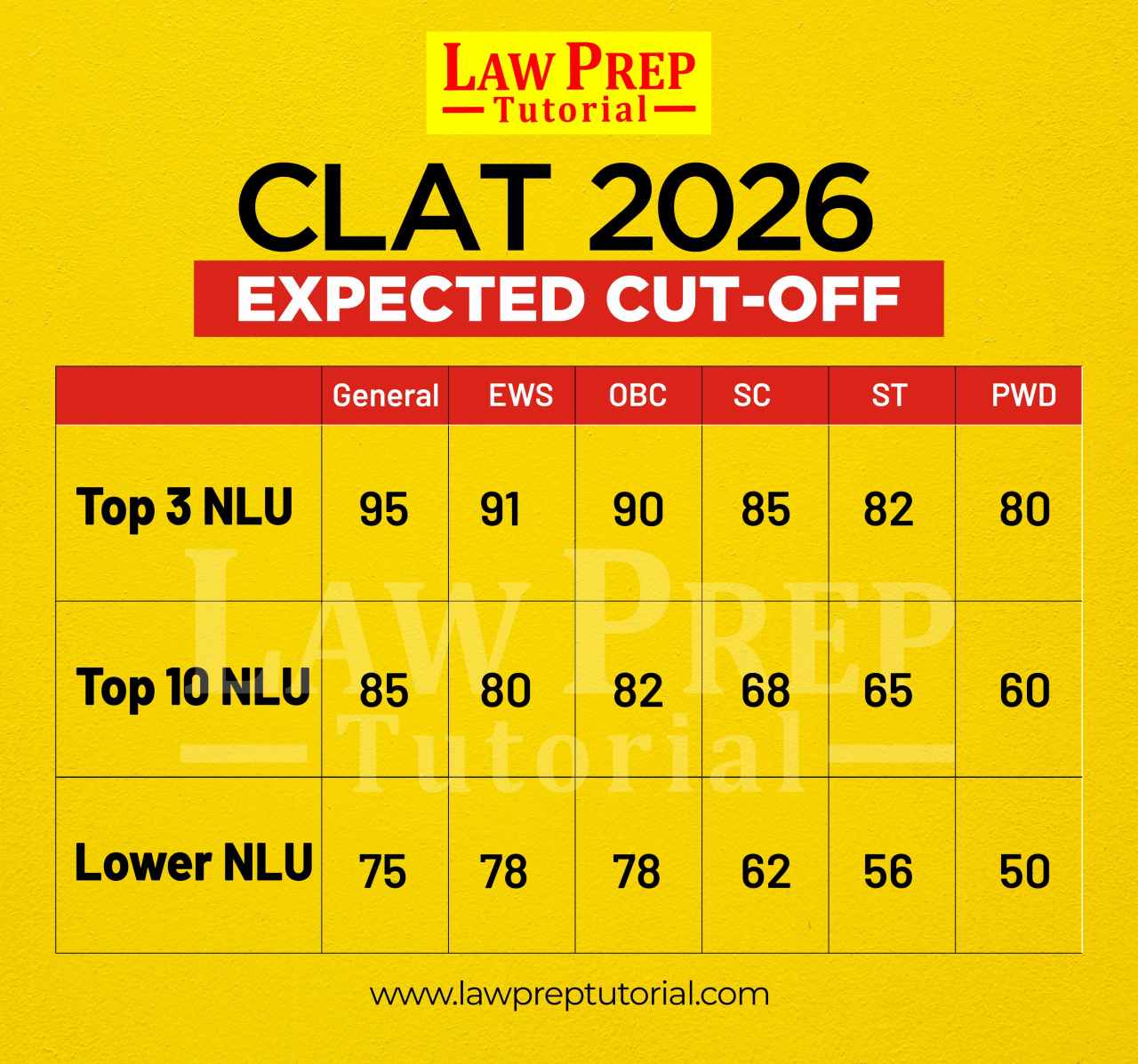
CLAT 2026 Cut-Off Marks for Top NLUs
If you aspire to get admission in one of the top NLUs, then the CLAT cut-off marks 2026 will be as follows (expected):
| NLU | General | OBC | SC | ST | EWS | PWD |
| NLSIU Bengaluru Cut Off | 98 | 95 | 90 | 86 | 96 | 80 |
| NALSAR Hyderabad Cut Off | 95 | 93 | 86 | 82 | 94 | 75 |
| NLIU Bhopal Cut Off | 90 | 88 | 82 | 78 | 89 | 70 |
| WBNUJS Kolkata Cut Off | 93 | 90 | 84 | 80 | 92 | 78 |
| NLU Jodhpur Cut Off | 91 | 89 | 81 | 76 | 90 | 76 |
| HNLU Raipur | 86 | 83 | 74 | 70 | 85 | 65 |
| GNLU Gandhinagar | 89 | 84 | 76 | 72 | 86 | 60 |
| GNLU Silvassa | 82 | 79 | 70 | 66 | 80 | 55 |
| RMLNLU Lucknow | 86 | 84 | 76 | 72 | 85 | 55 |
| RGNUL Punjab | 88 | 83 | 72 | 68 | 84 | 56 |
| CNLU Patna Cut Off | 84 | 81 | 71 | 67 | 82 | 50 |
| NUALS Kochi | 83 | 80 | 70 | 66 | 81 | 48 |
| NLUO Odisha | 84 | 80 | 70 | 66 | 82 | 46 |
| NUSRL Ranchi | 82 | 79 | 69 | 65 | 80 | 47 |
| NLUJA Assam | 81 | 78 | 68 | 64 | 79 | 45 |
| DSNLU Visakhapatnam | 81 | 78 | 68 | 64 | 79 | 45 |
| TNNLU Tiruchirappalli | 80 | 76 | 66 | 62 | 78 | 44 |
| MNLU Mumbai | 88 | 83 | 72 | 68 | 85 | 50 |
| MNLU Nagpur | 78 | 75 | 65 | 61 | 76 | 43 |
| MNLU Aurangabad | 77 | 73 | 63 | 58 | 74 | 42 |
| HPNLU Shimla | 76 | 72 | 62 | 57 | 73 | 40 |
| DNLU Jabalpur | 75 | 71 | 61 | 56 | 72 | 35 |
| DBRANLU Sonepat | 75 | 71 | 61 | 56 | 72 | 34 |
| NLUT Agartala | 74 | 70 | 60 | 55 | 70 | 32 |
CLAT 2026 Marks vs Rank
Below is the CLAT marks and rank 2026:
| Marks Range (CLAT 2026) | CLAT Rank Range | What It Usually Means |
| 95+ | AIR 1 – 50 | Almost certain NLSIU/NALSAR zone |
| 90 – 95 | AIR 50 – 500 | Strong chances for top 5 NLUs |
| 85 – 90 | AIR 500 – 1,500 | Good chances for top 10 NLUs |
| 80 – 85 | AIR 1,500 – 3,000 | Decent chances in mid-tier NLUs |
| 75 – 80 | AIR 3,000 – 5,000 | Newer NLUs become possible |
| 70 – 75 | AIR 5,000 – 7,000 | Lower NLUs + state colleges |
| 65 – 70 | AIR 7,000 – 10,000 | Limited NLU chances |
| Below 60 | AIR 12,000+ | Explore private universities |
CLAT Exam Analysis 2026 – What High Scorers Did Right
1. Smart Passage Selection
Top scorers avoided unnecessarily long or confusing passages and picked high-scoring ones first, saving precious minutes for LR and QT.
2. Controlled Attempt Strategy
They attempted only questions they were confident in, avoiding the trap of over-attempting which leads to negative marking.
3. Consistent Mock-Test Practice
Regular CLAT mock tests helped them identify weak areas, manage time effectively, and anticipate question patterns seen again in CLAT 2026.
4. Strong Reading Discipline
Reading editorials, articles, and reports daily helped build comprehension skills essential for English, Legal, LR, and QT.
5. Staying Calm Under Pressure
Top performers maintained accuracy by staying composed even when encountering tricky LR or QT sets.
What This CLAT 2026 Exam Analysis Means for CLAT 2027 Aspirants?
- Build strong reading habits early; CLAT is now a reading-heavy exam.
- Prioritise comprehension and reasoning over memorisation.
- Solve at least 40–50 CLAT mocks before the exam.
- Analyse mistakes deeply — not just marks.
- Follow trends to predict question style and difficulty for CLAT 2027.
FAQs About CLAT 2026 Question Paper Analysis
The CLAT 2026 paper was moderate overall. English, GK, and Legal were predictable, while Logical Reasoning was the main challenge due to its puzzle-heavy Analytical Reasoning format.
Students were shocked because Critical Reasoning was completely removed. Instead, Logical Reasoning featured only Analytical Reasoning puzzles, some reaching CAT-level difficulty, which increased solving time significantly.
Based on student reactions and expert review, GK & Current Affairs was the easiest. Most questions were direct, high-scoring, and based on widely reported news events.
Logical Reasoning required 30–35 minutes, making it the biggest time-consuming section. This impacted the time available for English and Legal for many aspirants.
The English section was moderate, with dense passages from history, politics, literature, and science. Vocabulary was manageable, but inference-based questions and literary excerpts made some sets tricky.
No structural changes occurred, but the question distribution inside LR changed drastically. The removal of CR and the dominance of AR puzzles became the biggest deviation from previous years.
Legal Reasoning was easy to moderate. While most questions were directly solved through passage reading, a few passages leaned toward Legal GK, creating mild difficulty.
Across all sections, a good attempt range is 90–105 questions, depending on accuracy and time management. Students with strong AR skills handled LR better.
Yes, GK had one repeated question from CLAT 2023, which boosted confidence among students familiar with past papers.
Time management played a critical role, especially due to the lengthy LR section. Students who allocated too much time to puzzles struggled in English and Legal.
Most sections were similar, but LR deviated significantly. No arithmetic caselets appeared in QT, and CR-style passages were absent in LR, unlike in sample papers.
Students with strong reading comprehension, puzzle-solving ability, and consistent mock practice handled the unexpected elements smoothly.
Know more about Law Colleges & Universities in India: