



















 Talk to a Counsellor
IPM/BBA:
Talk to a Counsellor
IPM/BBA:  Support
Kesavananda Bharati v. State of Kerala: Facts, Summary, Judgment
Explore Kesavananda Bharati v State of Kerala case with facts, summary, arguments, Supreme Court judgment & the Basic Structure Doctrine explained.
Last Updated on 14 Jul 2026
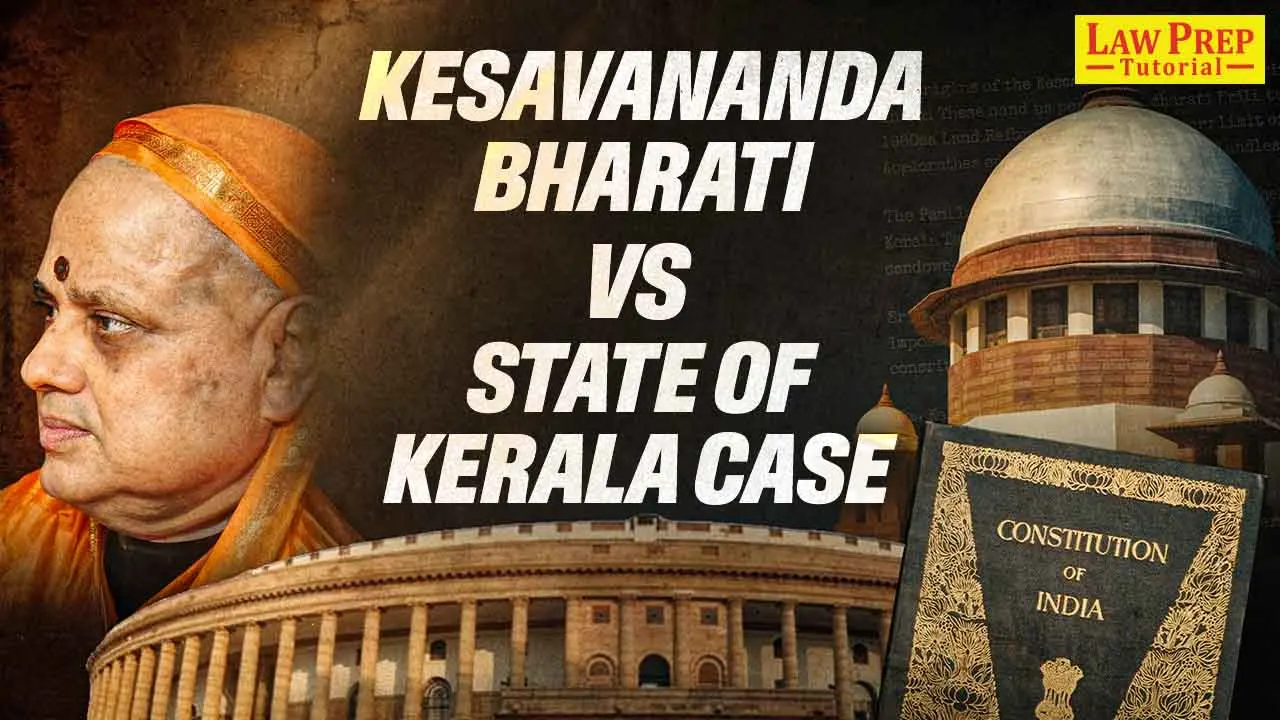
The Kesavananda Bharati v. State of Kerala case is called the most important judgment in Indian constitutional history because it decided a question that could change the future of Indian democracy forever: Can Parliament change every part of the Constitution without limits?
The answer given by the Supreme Court shaped modern India and introduced the historic Basic Structure Doctrine.
The Nani Palkhivala – Kesavananda Bharati case became legendary because of the fearless role played by Nani Palkhivala before the 13-judge Constitutional Bench, the largest bench ever formed in India. His arguments defended democracy, judicial independence, Fundamental Rights, and constitutional morality at a time of growing political tension.
The hearings lasted for months, courtrooms remained packed, and the final judgment became a turning point that still protects the Indian Constitution today.
Table of Contents
Jump to section- CLAT PG: All About CLAT Postgraduate Exam for LLM
Kesavananda Bharati Case: Key Details
These are the most important things to know about the Kesavananda Bharati case:
| Detail | Information |
| Full Case Name | His Holiness Kesavananda Bharati Sripadagalavaru v. State of Kerala |
| Year of Filing | 1970 |
| Judgment Date | 24 April 1973 |
| Court | Supreme Court of India |
| Bench Strength | 13 Judges |
| Chief Justice | S.M. Sikri |
| Petitioner | Kesavananda Bharati |
| Respondent | State of Kerala |
| Main Issue | Limits on Parliament’s power to amend the Constitution |
| Original Matter | Kerala land reform laws affecting Edneer Mutt property |
| Famous Lawyer | Nani Palkhivala |
| Total Hearing Duration | Nearly 5 Months |
| Final Verdict | Parliament can amend Constitution but cannot destroy its Basic Structure |
| Historic Doctrine Introduced | Basic Structure Doctrine |
| Majority Decision | 7:6 |
| Importance of the Case | Protected democracy and constitutional identity |
| Why It Became Historic | Limited unlimited constitutional amendment powers |
| Relevance Today | Still guides constitutional law and Supreme Court judgments in India |
Read more about Nani Palkhivala Moot Court Competition
What Was Kesavananda Bharati v. State of Kerala Case?
The Kesavananda Bharati case officially began in 1970 when Kesavananda Bharati, the head of the Edneer Mutt in Kerala, approached the Supreme Court after the Kerala government introduced land reform laws that affected the mutt’s property and management rights. What initially appeared to be a property dispute soon became a much larger constitutional question that would decide the future of Indian democracy.
At that time, a serious conflict was growing between the Indian Parliament and the judiciary. The government wanted wider powers to amend the Constitution and implement major social and economic reforms. Earlier Supreme Court judgments had already created debates around whether Parliament could change Fundamental Rights through constitutional amendments. Because of this tension, the Kesavananda Bharati case moved beyond land reforms and became a national constitutional issue.
The biggest question before the Supreme Court was simple but extremely powerful: Could Parliament amend any part of the Constitution without any limitation? Or were there certain core principles that even Parliament could not destroy?
To decide this historic issue, the Supreme Court formed the largest Constitutional Bench in Indian history, consisting of 13 judges. The hearings began in October 1972 and continued for nearly five months, making it one of the longest hearings ever conducted by the Indian Supreme Court.
Lawyers, journalists, students, and citizens from across the country closely followed the proceedings because everyone understood that the judgment could shape India’s democratic future.
During the hearings, Nani Palkhivala emerged as the leading constitutional voice defending democracy, judicial review, and Fundamental Rights. His arguments played a major role in influencing the final verdict.
On 24 April 1973, the Supreme Court delivered its historic 7:6 judgment. The Court ruled that Parliament has the power to amend the Constitution, but it cannot destroy its “Basic Structure” or essential identity. This principle became known as the Basic Structure Doctrine, one of the most important safeguards of Indian democracy even today.
Read more about Important Acts in India here!
Important Cases Before Kesavananda Bharati Case
Before the Kesavananda Bharati judgment, several important Supreme Court cases had already created confusion and debate regarding Parliament’s amendment powers:
| Case | Importance |
| Shankari Prasad Case (1951) | Supreme Court held that Parliament could amend Fundamental Rights through constitutional amendments. |
| Sajjan Singh Case (1965) | Court again supported Parliament’s power to amend the Constitution. |
| Golaknath Case (1967) | Supreme Court changed its earlier position and ruled that Parliament could not amend Fundamental Rights. |
These conflicting judgments created uncertainty in constitutional law. The Kesavananda Bharati case was therefore seen as the final and most important attempt to settle the issue permanently.
Read more about Legal Awareness and Law Resources
Role of Nani Palkhivala in the Kesavananda Bharati v. State of Kerala Case
- Nani Palkhivala served as the lead counsel arguing against unlimited parliamentary powers in the Kesavananda Bharati case.
- He represented the constitutional side that believed Parliament should not have absolute authority to destroy or alter the identity of the Constitution.
- His arguments focused on protecting democracy, judicial independence, Fundamental Rights, federalism, and rule of law in India.
- He strongly argued that the Constitution has certain foundational principles that cannot be removed even through constitutional amendments.
- Palkhivala explained that unlimited amendment powers could eventually allow any government to damage democratic institutions and citizens’ freedoms.
- His advocacy before the 13-judge Constitutional Bench became one of the most admired courtroom performances in Indian legal history.
- The hearings continued for nearly five months, and lawyers, students, journalists, and ordinary citizens regularly gathered in packed courtrooms to hear his arguments.
- He presented highly complex constitutional questions in a simple, structured, and persuasive manner, making his submissions influential before the bench.
- His arguments played a major role in shaping the Supreme Court’s final 7:6 judgment that introduced the Basic Structure Doctrine.
- Through this case, Nani Palkhivala emerged as one of the strongest defenders of the Indian Constitution and democratic values.
- His role in the Kesavananda Bharati case is still studied by law students, constitutional scholars, and legal professionals across India.
Also check out Top 20 Facts About Indian Constitution
Kesavananda Bharati v. State of Kerala: Case Summary
The Kesavananda Bharati case was a historic constitutional case decided by the Supreme Court of India in 1973. The case began when Kesavananda Bharati, the head of the Edneer Mutt in Kerala, challenged state land reform laws affecting the mutt’s property rights. Over time, the dispute became much larger and focused on a critical constitutional question: Does Parliament have unlimited power to amend the Constitution?
A 13-judge bench, the largest in Indian history, heard the matter for nearly five months. Nani Palkhivala played a major role in defending constitutional limitations and democratic values before the Court.
In its landmark 7:6 judgment delivered on 24 April 1973, the Supreme Court ruled that Parliament can amend the Constitution, but it cannot destroy its “Basic Structure” or essential identity. This judgment permanently shaped Indian constitutional law and democracy.
Understand How the Indian Constitution is Both Rigid and Flexible
Arguments in the Kesavananda Bharati Case
Arguments Presented by the Government
- Parliament has complete authority to amend any part of the Constitution under Article 368.
- Constitutional amendments should not face judicial limitations because Parliament represents the will of the people.
- Social and economic reforms, especially land reform laws, required wider amendment powers for effective governance.
- Fundamental Rights should not prevent Parliament from implementing welfare policies and national reforms.
- Earlier constitutional amendments passed by Parliament should remain fully valid and unquestioned.
Arguments Presented by Nani Palkhivala and Other Petitioners
- Parliament cannot use amendment powers to destroy the identity or spirit of the Constitution.
- Certain constitutional principles are permanent and must always remain protected.
- Democracy, judicial review, federalism, rule of law, and Fundamental Rights are essential features of the Constitution.
- Unlimited amendment powers could eventually lead to authoritarian rule and weaken democratic institutions.
- The Constitution was created to limit governmental power, not to give absolute authority to Parliament.
- Courts must retain the power of judicial review to protect citizens and constitutional balance.
Also read Courtroom Genius by Nani Palkhivala
Kesavananda Bharati v. State of Kerala: Supreme Court Judgment
The Supreme Court delivered its historic judgment in the Kesavananda Bharati v. State of Kerala case on 24 April 1973 through a narrow 7:6 majority decision. The Court ruled that Parliament has the power to amend the Indian Constitution under Article 368, but this power is not unlimited.
It held that Parliament cannot alter or destroy the “Basic Structure” or essential identity of the Constitution. This judgment gave birth to the Basic Structure Doctrine, which protects core constitutional principles such as democracy, judicial review, rule of law, secularism, federalism, and Fundamental Rights. The decision remains one of the strongest safeguards of Indian democracy today.
Download Kesavananda Bharati Case Judgment PDF
Download the complete Supreme Court judgment PDF to read the original constitutional arguments, judicial opinions, and detailed reasoning behind this historic case.
13-Judge Constitutional Bench in the Kesavananda Bharati v. State of Kerala
| Judge Name | Role / Position in the Case |
| Justice S.M. Sikri | Chief Justice of India and head of the 13-judge bench |
| Justice J.M. Shelat | Part of the majority opinion supporting Basic Structure Doctrine |
| Justice K.S. Hegde | Supported limitations on Parliament’s amendment powers |
| Justice A.N. Grover | Favored protection of constitutional core principles |
| Justice A.K. Mukherjea | Supported the majority judgment |
| Justice P. Jaganmohan Reddy | Upheld constitutional limitations on amendments |
| Justice H.R. Khanna | Played a decisive role in forming the majority view |
| Justice A.N. Ray | Part of the minority opinion favoring wider parliamentary powers |
| Justice D.G. Palekar | Supported broader amendment authority for Parliament |
| Justice K.K. Mathew | Part of the minority view |
| Justice M.H. Beg | Supported wider powers of constitutional amendment |
| Justice S.N. Dwivedi | Part of the minority opinion |
| Justice Y.V. Chandrachud | Initially part of minority side in this judgment |
- Majority (7 Judges): Held that Parliament can amend the Constitution but cannot destroy its Basic Structure.
- Minority (6 Judges): Believed Parliament’s amendment powers under Article 368 were broader and less restricted
Check out More important Indian Constitution topics here:
What is the Basic Structure Doctrine?
The Basic Structure Doctrine is a constitutional principle created by the Supreme Court in the Kesavananda Bharati v. State of Kerala judgment. It means that Parliament can change or amend many parts of the Constitution, but it cannot destroy its most important features or identity. In simple words, the Constitution can be modified, but its core values must always remain safe.
For example, democracy, judicial independence, Fundamental Rights, and rule of law cannot be removed even if a government has a huge majority in Parliament. This doctrine acts like a safety shield that protects the Indian Constitution from misuse of unlimited political power.
Key Features Protected Under the Basic Structure Doctrine:
- Democracy
- Rule of Law
- Judicial Review
- Federalism
- Secularism
- Separation of Powers
- Fundamental Rights
- Independence of Judiciary
- Free and Fair Elections
- Parliamentary System
- Unity and Integrity of India
- Constitutional Supremacy
Important Quotes Related to Nani Palkhivala Kesavananda Bharati Case
“The Constitution is supreme, not Parliament.” — Nani Palkhivala
“Democracy survives through constitutional limitations.” — Nani Palkhivala
“Fundamental Rights are not a gift from the State.” — Constitutional principle argued in the case
“Unlimited power is dangerous in a democracy.” — Nani Palkhivala
“The Constitution exists to control power, not surrender to it.” — Constitutional interpretation associated with the case
Learn more about the Preamble to the Indian Constitution here!
FAQs on Kesavananda Bharati v. State of Kerala

SEO Head
Virendra heads SEO & Content at LPT. A writer at heart, he focuses on building exam-focused content that informs, guides, and supports aspirants in their preparation journey.