
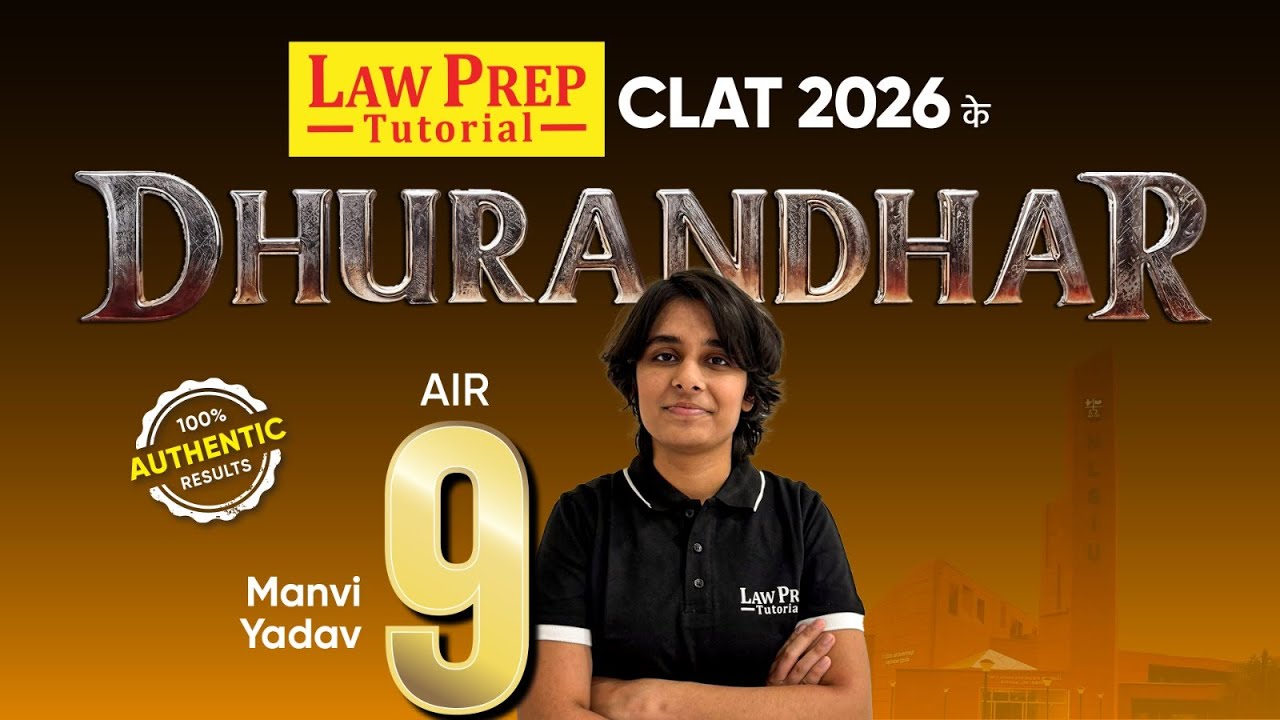

Securing AIR-9 in CLAT 2026, Manvi Yadav’s journey is a powerful example of resilience, discipline, and mental strength. A black-belt karate champion, a guitarist, and a law aspirant who refused to settle after her first attempt, Manvi’s story proves that success in CLAT is not about perfection—it is about clarity of mindset and execution under pressure.
After an underwhelming first attempt and an unsatisfactory experience at her initial law college, Manvi Yadav made the bold decision to restart her CLAT journey with just three months of focused preparation, largely from home by joining LPT’s Best online CLAT coaching in India.
Instead of panicking over time constraints, she relied on strong reading habits, mock-driven practice, and calm adaptability on exam day.
In a year when CLAT replaced Critical Reasoning with Analytical Reasoning and tested mental composure more than ever, Manvi trusted her process and delivered a top-10 rank. This interview captures her preparation philosophy, exam-day mindset, and lessons that every aspirant can learn from.

Upcoming CLAT Exams:
Interview with Manvi Yadav (AIR 9, CLAT 2026)
LPT: Today, I’m joined by one of the most inspiring CLAT 2026 toppers—a guitarist, a black-belt karate champion, and now AIR 9. Welcome, Manvi Yadav.
Manvi: Hello, sir. Thank you so much. I’m really grateful to be here.
LPT: How are you feeling after such an incredible achievement?
Manvi: Honestly, it still doesn’t feel real. Even after walking out of the exam hall, you don’t immediately believe you’ve done so well. This result wasn’t something I expected, so I feel amazing and very grateful.
LPT: Did you have any intuition that you would get such a high rank?
Manvi: Not at all. This wasn’t my first CLAT attempt, so my only expectation this year was to get into a good college. I didn’t have any big rank expectations.
LPT: You appeared for CLAT last year as well. What happened, and why did you decide to try again?
Manvi: Last year was my first attempt, and I had started serious preparation only in Class 12. I understood the basics but wasn’t satisfied with my performance in CLAT and AILET.
I secured AIR 956, which initially qualified me for tier-2 NLUs. Later, due to result-related issues, my rank dropped further by around 400, which was very disappointing. Still, I knew I could do better, and I didn’t want to settle for something that didn’t reflect my potential.
Also checkout: How to Prepare for CLAT in Class 12
LPT: You joined RGNUL Patiala and later shifted to Delhi University. Can you tell us about that phase?
Manvi: Yes. I joined RGNUL Patiala in August, but the experience didn’t feel right for me. When Delhi University opened vacancies for its five-year law course, I applied and shifted in September.
From September onwards, I started CLAT Preparation again entirely from home. I had only three months, so I had to be very focused.
LPT: When did you first decide to pursue law?
Manvi: Quite early, actually—around Grades 6 or 7, I knew I didn’t want to pursue science or maths. I loved reading and writing.
By Grade 9, I started exploring law and journalism colleges and discovered CLAT and AILET. In Grade 11, I took Legal Studies, which gave me a real idea of what studying law would be like. Law felt perfect because it connects history, political science, society, and logic—it’s an all-encompassing field.
LPT: Do you have clarity on your career path after law school?
Manvi: Not yet, and I think that’s okay. I want to explore different opportunities in law school before deciding between litigation, corporate law, judiciary, or something else.

LPT: What is your observation about CLAT as an exam?
Manvi: CLAT is largely an aptitude test. There’s no fixed syllabus—it also tests your mental strength during those two hours.
Last year, I panicked and kept switching sections. This year, my mindset was simple: there are questions in front of me, and I just have to solve them. If something feels tough, it probably is for many others too.
LPT: This year, Analytical Reasoning replaced Critical Reasoning. How did you react?
Manvi: I was actually happy because Analytical Reasoning is one of my strengths. I stuck to my mock sequence—English, GK, Legal, Logical, then Maths. I didn’t change my strategy at all.
LPT: How important are mock tests in your opinion?
Manvi: CLAT Mocks are extremely important. The actual exam feels like a mock. They help you understand patterns, assess where you stand nationally, and build exam temperament. All-India Open Mocks are especially useful.
LPT: Which subject do you think matters the most in CLAT?
Manvi: CLAT is fairly balanced. Legal has high weightage, but overall, reading comprehension and inference skills matter the most. Strong reading habits give you a huge edge across sections.
LPT: GK is vast and intimidating. How did you prepare for it?
Manvi: I actually enjoyed preparing GK. I regularly read The Indian Express, especially the Explained section.
I relied heavily on CLAT Express because it’s concise and question-oriented. For static GK, I used middle-school GK and quiz books from Grades 6–8. Quizzing helped me retain information better than plain memorisation.
Important Resources After CLAT Exam:
| CLAT College Predictor | CLAT Answer Key |
| CLAT Counselling | CLAT Rank Predictor |
| CLAT Marks vs Rank | CLAT Toppers |
| CLAT Allotment List | CLAT Result |
| CLAT 2026 Question Paper |
LPT: You’re a black-belt karate champion and a guitarist. Tell us about that journey.
Manvi: My parents always encouraged sports. I started karate when I was around 5 or 6 and competed at state and national levels by Grades 9–10. I also aspire to play in UKL, which is like the IPL of karate. Music and guitar have always been a big part of my life as well.
LPT: You’re an early riser. How did that habit help during preparation?
Manvi: Early mornings are distraction-free, and I’m mentally most active then. Waking up early during CLAT preparation helped me focus better and start the day productively.
LPT: You prepared seriously for just three months. What’s your view on preparation time?
Manvi: It depends on how fast you master the basics. Once basics are done, it’s all about practice. In the last three months, I focused more on solving questions than learning new concepts.
LPT: How many hours should one study daily?
Manvi: I didn’t follow fixed hours. I followed a to-do list system. Flexibility matters. Productivity is more important than clocking hours.
LPT: Many students fear Quantitative Techniques. What’s your advice?
Manvi: Don’t avoid QT—it’s non-negotiable. CLAT maths is basic: ratios, percentages, averages. Focus on basics, use shortcuts, maintain a maths register, track mistakes, and don’t rush.
LPT: How did you manage screen time?
Manvi: I completely stayed off social media for the last three months. Preparation was online, so screen time was unavoidable, but leisure scrolling wasn’t. Self-control is key.

LPT: Who would you like to credit for your success?
Manvi: My parents and friends played a huge role. I explained GK topics to my mom—it helped with retention. Talking to friends after bad mocks helped emotionally.
I also credit Law Prep Tutorial, especially CLAT Express, for my CLAT GK preparation.
LPT: Is online coaching sufficient for CLAT?
Manvi: Absolutely. Online CLAT coaching by Law Prep Tutorial worked better for me because it gave flexibility and independence. It depends on the student, but online preparation is completely sufficient if used properly. Know your strengths, understand your productive hours, and don’t fear the exam—just solve what’s in front of you with confidence.
More important resources for CLAT exam:
Watch Interview of AIR-9 CLAT 2026
Know more about Law Colleges & Universities in India:
| CLAT Colleges in India | NLU Shimla |
| NLSIU Bangalore | NLU Delhi |
| NALSAR Hyderabad | NLU Prayagraj |
| NLU Jodhpur | MNLU Nagpur |
| NUJS Kolkata | NLIU Bhopal |
| GNLU Gandhinagar | IIULER Goa |
| NLU Ranchi | RMNLU Lucknow |
Explore CLAT coaching centers across different cities: