Talk to a Counsellor
 Support
CLAT 2027 Preparation Strategy: Best Tips for Each Section
Get CLAT 2027 preparation tips with structured section-wise strategy, study plan, and expert advice to help you crack the law entrance exam easily.
Last Updated on 08 Jul 2026
Download Free CLAT Notes
Cracking CLAT demands clarity, consistency, and the right guidance from day one. If you’re trying to understand how to prepare for CLAT in a way that actually improves your scores, this guide will give you a clear starting point.
We, at Law Prep Tutorial, have shared the practical and best CLAT 2027 preparation strategy that helps you build strong concepts, develop speed, and master the type of questions that appear in the exam.
No complicated advice, no confusing theories; only simple steps you can follow every single day. Whether you are in Class 11, Class 12, or preparing full-time, this approach will help you stay sharp, stay disciplined, and stay ahead of the competition.
Table of Contents
Jump to section- CLAT PG: All About CLAT Postgraduate Exam for LLM
CLAT Exam: Key Highlights
Before starting preparation for CLAT exam, you must know these things about it:
| Parameter | Details |
| Exam Name | Common Law Admission Test (CLAT) |
| Conducting Body | Consortium of NLUs |
| Mode of Exam | Offline, pen-and-paper based |
| Duration | 2 hours (120 minutes) |
| Total Questions | 120 multiple-choice questions |
| Total Marks | 120 |
| Marking Scheme | +1 for each correct answer, −0.25 for each wrong answer, 0 for unattempted questions |
| Sections | English Language, Current Affairs & GK, Legal Reasoning, Logical Reasoning, Quantitative Techniques |
| Question Type | Passage-based MCQs focusing on comprehension, reasoning, and application |
| Eligibility (Academics) | Passed or appearing in Class 12 (10+2) from a recognised board |
| Minimum Marks | 45% for General/OBC; 40% for SC/ST (as per latest notification) |
| Age Limit | No upper age limit |
| Frequency | Once a year |
Plan your CLAT preparation with this CLAT Study Planner tool.
Which CLAT Exam Year You’re Targeting?
| CLAT Exam Year | Exam Date | Ideal For Students Who… | Academic Entry in NLUs |
|---|---|---|---|
| CLAT 2027 | 6 December 2026 | Will enter Class 12 in 2026 or are droppers planning one solid year of focused prep | 2027–28 |
| CLAT 2028 | 5 December 2027 | Will enter Class 11 in 2026 and want a long, two-year structured preparation path | 2028–29 |
How to Prepare for CLAT 2027?
Below is the full CLAT 2027 preparation strategy
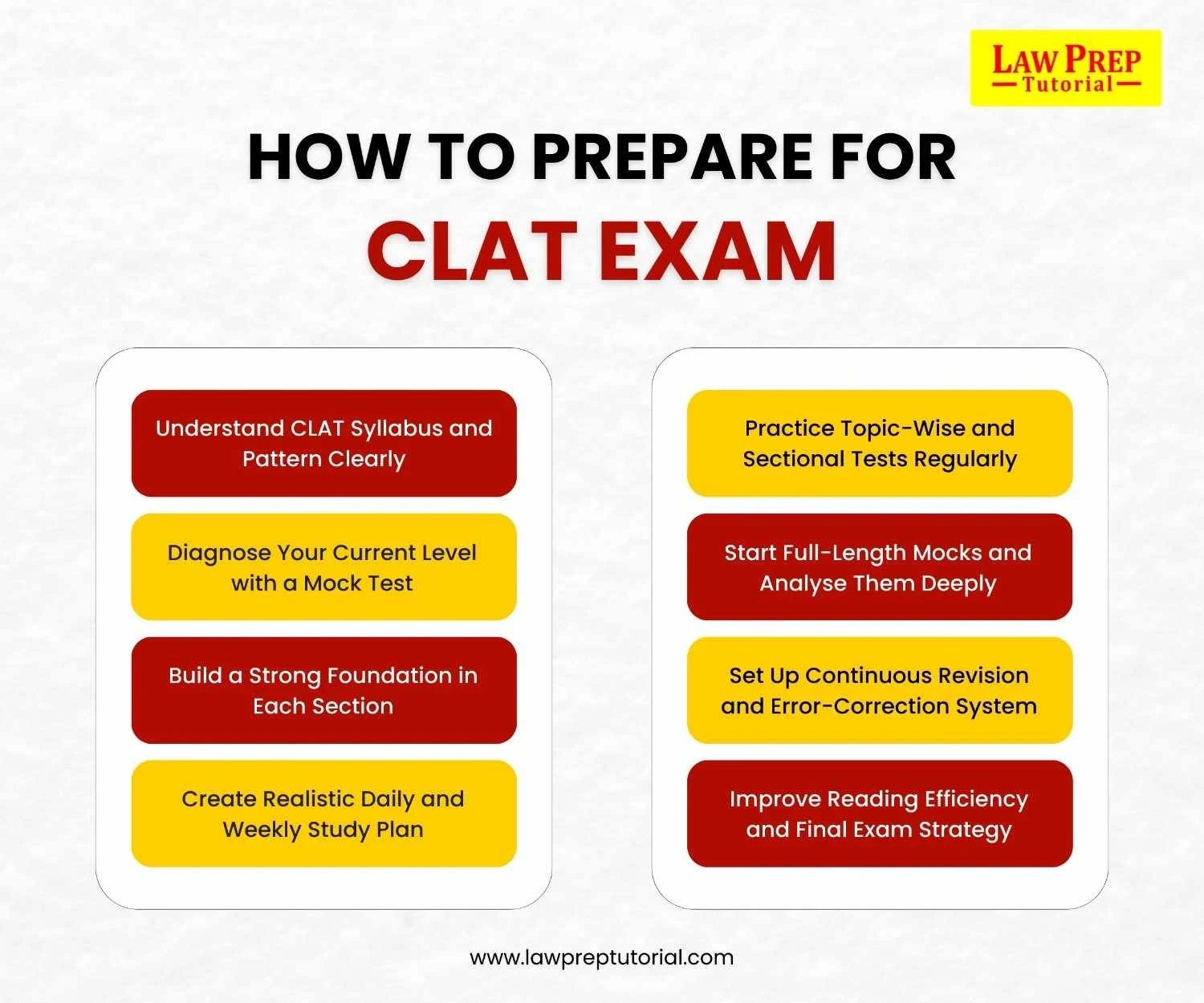
1. Understand CLAT Syllabus and Pattern Clearly
Start by reading the official CLAT syllabus and exam pattern line by line. Note down all sections, weightage, and negative marking rules. This avoids random study.
This is the syllabus of CLAT:
| Section | Key Topics |
|---|---|
| English Language | • Reading Comprehension • Vocabulary • Synonyms • Antonyms • English Grammar • Tenses • Parts of Speech • Literary Devices • Reading Comprehension • Vocabulary • Synonyms • Antonyms • English Grammar • Tenses • Parts of Speech • Literary Devices |
| Current Affairs, including GK | • Constitution • International Relations • Indian Economy • History • Art & Culture • Current Events |
| Legal Reasoning | • Constitution • Contract Law • Tort Law • Criminal Laws • Family Law • Evidence Act • International Law |
| Logical Reasoning | • Critical Reasoning (Assumptions, Inference, Cause & Effect) • Analytical Reasoning (Blood Relations, Syllogisms) |
| Quantitative Techniques | • Data Interpretation • Percentage • Profit & Loss • Time & Work • Mensuration • Probability |
Download Complete Syllabus PDF
The exam pattern of CLAT is as follows:
| Particulars | Details |
|---|---|
| Mode of CLAT Exam | Offline (Pen and paper) |
| CLAT Exam Duration | 2 hours (120 minutes) |
| Language | English |
| Type of Questions | Multiple-choice Questions |
| Total Marks in CLAT | 120 |
| CLAT Marking Scheme | +1 marks for every correct answer -0.25 marks for every wrong answer |
Once you know what is actually asked, every hour of CLAT preparation starts hitting the right target. If you struggle with understanding the pattern, joining a structured offline or online CLAT coaching program gives you immediate clarity.
2. Diagnose Your Current Level with a Mock Test
Give one full-length CLAT mock test before creating your plan. Don’t worry about marks; focus on finding strong and weak areas.
Attempt a free CLAT mock test online.
3. Build a Strong Foundation in Each Section
Spend the first phase building concepts in English, Legal Reasoning, Logical Reasoning, GK, and Maths. Learn basic rules, reading strategies, and question formats.
If concepts feel confusing, foundation classes offered in Law Prep’s online and offline programs help you understand topics faster and avoid unnecessary mistakes.
4. Create Realistic Daily and Weekly Study Plan
Break your week into clear slots: reading, concept study, practice, and revision. Set non-negotiable daily study hours and plan your weekly targets. Track your progress and adjust your study plan when needed.
5. Practice Topic-Wise and Sectional Tests Regularly
After building concepts, shift to topic-wise and sectional practice. This is where you learn how passages work and how reasoning questions behave. Access large banks of topic tests and section tests, which help you master each area step by step without feeling lost.
Recommended resources for you:
- CLAT English Mock Test
- CLAT Legal Reasoning Mock Test
- CLAT Logical Reasoning Mock Test
- CLAT Quant Mock Test
- CLAT Critical Reasoning Mock Test
- CLAT Analytical Reasoning Mock Test
6. Start Full-Length Mocks and Analyse Them Deeply
Introduce full-length CLAT mock tests once you’ve covered the basics. Attempt them in exam-like conditions and analyse them thoroughly.
A good mock-test series matters a lot; Law Prep’s mock tests reflect the real CLAT difficulty level and give accurate performance insights that help you correct mistakes faster.
7. Set Up Continuous Revision and Error-Correction System
Maintain a “mistake notebook” or digital sheet where you list difficult concepts, tricky questions, and frequent errors. Revise it every week.
Coaching programs make this easier with regular doubt-solving, revision sessions, and mentor support, ensuring you don’t repeat the same errors throughout your preparation.
CLAT 2027 Preparation Strategy: Section-Wise
Find the section-wise CLAT preparation strategy:
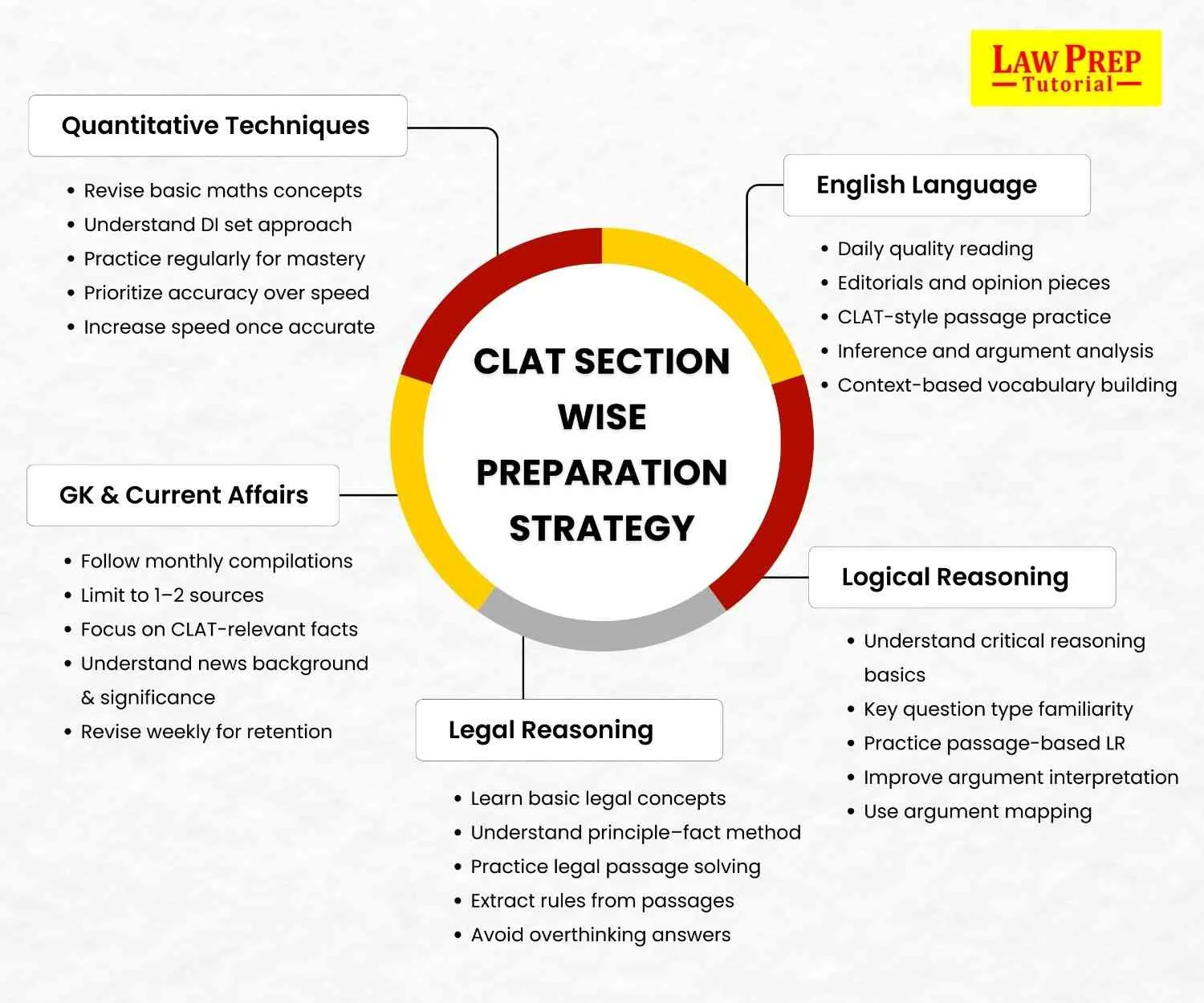
1. English Language Preparation Strategy
The CLAT English section checks your ability to understand and analyse long reading passages. Questions revolve around comprehension, viewpoints, tone, summarisation, vocabulary-in-context, and inference.
The goal is not grammar-it’s pure reading ability and clarity of thought.
What It Tests
- Reading speed and comprehension
- Ability to identify arguments and themes
- Understanding of implied meanings
- Vocabulary through context, not rote memorisation
- Distinguishing between opinions, facts, and assumptions
How to Prepare for It
- Daily Reading (20–30 minutes minimum):
- Editorials, long articles, opinion pieces, and reports from reputed publications.
- Practice CLAT-style Passages: Focus on inference, strengthening/weakening arguments, and tone detection.
- Improve Vocabulary Naturally: Do not memorise lists. Learn words from passages and usage.
Learn Passage Breakdown
- First read: Understand central idea
- Second read: Identify structure (facts, opinions, evidence)
- Final read: Solve questions efficiently
What to Practice
- RC sets (10–15 passages per week)
- Tone & inference questions
- Vocabulary-in-context
- Summarisation questions
- Sectional English tests
- Topic-wise tests from Law Prep’s LMS
Free Resources for English Preparation:
| CLAT English Syllabus | How to prepare for CLAT English? |
| CLAT English Questions | How to improve Vocabulary for CLAT? |
| CLAT English Grammar Preparation | Vocabulary for CLAT |
2. Logical Reasoning Preparation Strategy
CLAT Logical Reasoning focuses on evaluating and analysing arguments presented in passage form. This section tests your ability to recognize patterns, identify flaws, and draw logical conclusions.
What It Tests
- Critical reasoning
- Identifying assumptions, flaws, conclusions
- Strengthen/weaken logic
- Cause-effect relationships
- Application of reasoning to unfamiliar contexts
How to Prepare for It
- Master Critical Reasoning Basics: Learn question types such as assumptions, inference, analogy, strengthen/weaken, paradox, evaluation.
- Practice Passage-Based LR: The majority of questions are embedded in 300–450 word passages. Practice reading, interpreting arguments, and answering quickly.
- Learn Argument Mapping: Identify claim → evidence → conclusion. This helps with accuracy and speed.
What to Practice
- CR question sets (assumption, inference, strengthen, weaken)
- Logical games/patterns (limited but useful for speed)
- Passage-based LR sectional tests
- Topic-wise tests from Law Prep’s question bank
- 10–15 CR passages weekly
Free Resources for Logical Reasoning Preparation:
| Blood Relation Questions For CLAT Logical Reasoning | CLAT Logical Reasoning Syllabus |
| CLAT Logical Reasoning Questions | CLAT Logical Reasoning Passages |
3. Legal Reasoning Preparation Strategy
CLAT Legal Reasoning is not about learning law. It is about using legal principles to solve logical cases based on facts. CLAT tests your ability to apply rules, interpret conditions, and draw precise conclusions.
What It Tests
- Ability to apply principles to new situations
- Reading and understanding dense passages
- Identifying relevant facts
- Logical application of rules
- Consistency in reasoning
How to Prepare for It
- Learn Basic Legal Concepts: Torts, Contracts, Criminal Law, Constitutional Law—at a basic, principle-level.
- Understand Principle-Fact Method: Read principle → break it down → apply ONLY the rule to the facts → ignore personal opinion.
- Master Passage Solving: CLAT gives long passages with multiple principles embedded. Practice extracting rules fast.
- Avoid Overthinking: Stick strictly to the given principle. CLAT rewards discipline and accuracy.
What to Practice
- Principle–fact questions (50+ weekly)
- Legal reasoning sectional tests
- Passage-based legal sets
- Topic-wise legal principles (e.g., negligence, contracts, homicide, fundamental rights)
Free Resources for Legal Reasoning Preparation:
| CLAT Legal Reasoning: All details | CLAT Legal Reasoning Questions |
| CLAT Legal Reasoning Passages |
4. GK & Current Affairs Preparation Strategy
GK is largely current-affairs based, with questions drawn from national and international news, government schemes, awards, environment, law & policy, committees, economy, history in news, etc.
What It Tests
- Awareness of major events
- Ability to recognise context
- Understanding of news impact
- Retention of high-weight information
How to Prepare for It
- Follow Monthly Compilations: If daily reading is tough, rely on structured monthly CA notes (Law Prep provides monthly GK digests).
- Limit Sources: Use 1–2 trusted sources; avoid overload.
- Focus on What CLAT Asks: Background of news, facts within news, related developments, and significance—not headlines.
- Revise Weekly: GK becomes strong only through repetition.
What to Practice
- Current Affairs quizzes
- Yearly revision tests
- Static GK from topics frequently in news
- Topic-wise GK tests (environment, polity, economy, geography)
Free Resources for GK and Current Affairs Preparation:
| Important GK Topics for CLAT | How to Prepare for CLAT GK? |
| CLAT GK Questions | CLAT Current Affairs |
5. Quantitative Techniques Preparation Strategy
CLAT Quantitative Techniques includes maths-based reasoning sets built on Class 8–10 concepts. The focus is on interpreting graphs, tables, charts, and solving numerical data questions.
What It Tests
- Basic mathematical concepts
- Data interpretation
- Ability to handle numerical problems under time pressure
- Logical application of numbers
How to Prepare for It
- Revise Basic Maths Concepts: Percentages, ratios, averages, SI/CI, profit-loss, time-work, speed-distance.
- Learn DI Set Approach: Understand how to interpret tables, bar graphs, and line charts quickly.
- Practice Regularly: Maths improves only through repetition, not theory.
- Focus on Accuracy Over Speed Initially: Once accuracy stabilises, speed automatically increases.
What to Practice
- DI sets (tables, charts, caselets)
- Percentage, ratio, average questions
- Mixed arithmetic sets
- QT sectional tests
- 10–12 topic-wise tests per week from Law Prep’s LMS
Free Resources for Quantitative Techniques Preparation:
| CLAT Quantitative Techniques Syllabus | CLAT Quantitative Techniques Questions |
| Tips to Prepare for CLAT Quants |
10-Month Preparation Strategy for CLAT 2027
This plan assumes you are beginning now or will properly start between March–April 2026, which is the most common timeline.
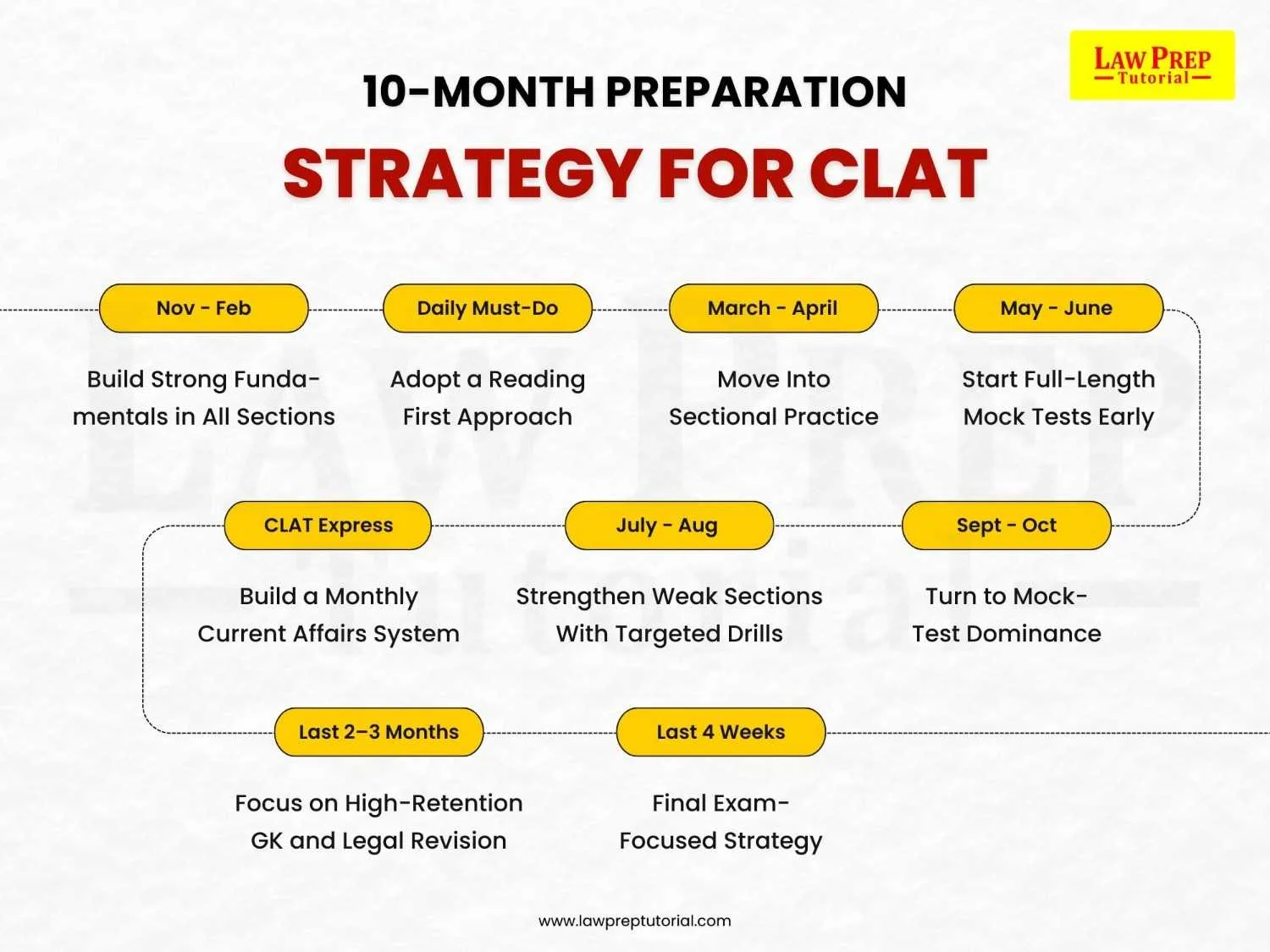
1. Build Strong Fundamentals in All Sections (Nov 2025 – Feb 2026)
Your first goal is to fix your basics in English, Legal Reasoning, Logical Reasoning, GK, and QT. Learn concepts slowly and practise with light-level sectional tests.
This phase should focus on reading consistency, understanding CR question types, and solving beginner-friendly legal and maths sets. Students who need proper structure can join online/offline coaching at Law Prep with up to 100% scholarship through the CLAT Scholarship Test.
2. Adopt a Reading-First Approach (Daily Must-Do)
CLAT rewards students who read fast and understand passages deeply. Read editorials, long-form articles, and opinion pieces every day for 20–30 minutes. Focus on understanding tone, arguments, and ideas.
The reading habit will automatically improve English, LR, and Legal scores. Use CLAT Express magazine for curated reading, summaries, and monthly CA coverage.
3. Move Into Sectional Practice (March–April 2026)
Once fundamentals are built, switch to targeted practice. Attempt sectional tests in English, CR, Legal, QT, and GK. This builds comfort with the exam style and helps you identify slow and weak areas.
Practise topic-wise sets like percentage questions, DI tables, CR strengthen/weakens, or principle-fact questions. Law Prep’s LMS includes hundreds of such practice sets to help you progress steadily.
4. Start Full-Length Mock Tests Early (May–June 2026)
Do not wait until the last 3–4 months for mocks. Start taking one full mock every 10–12 days. At this stage, the aim is to build familiarity, not chase marks. Analyse each mock in detail-question type, time spent, accuracy, and patterns of mistakes.
Law Prep’s mock tests replicate exact CLAT difficulty and structure, making your transition to real exam conditions smooth.
5. Build a Monthly Current Affairs System (Using CLAT Express)
GK carries nearly 25% weightage, and revision matters more than daily reading. Use a monthly approach: read CA summaries, revision sheets, and background explanations. CLAT Express gives curated monthly editions with all essential news, context, and quizzes.
Solve weekly and monthly GK quizzes to build retention and avoid last-minute overload.
6. Strengthen Weak Sections With Targeted Drills (July–Aug 2026)
Do a deep analysis of your mocks and sectional tests to identify specific weaknesses-slow RC passages, inference questions, tort law principles, ratios/percentages, or LR flaws. Work on these through targeted drills: topic sets, practice modules, and doubt-solving.
Law Prep’s online/offline coaching helps revise exactly what you need instead of wasting time on random content.
7. Turn to Mock-Test Dominance (Sept–Oct 2026)
Increase mock-test frequency to 1 mock every 3–4 days. Solve full-length papers at 2–4 PM, the actual exam timing, to train your brain’s peak performance cycle.
Start using Law Prep’s CLAT All India Open Mocks—these are conducted in real exam patterns, and attempting them offline is highly recommended to simulate actual CLAT pressure and real seating environment.
8. Focus on High-Retention GK and Legal Revision (Last 2–3 Months)
Attend GK Marathons during the last months to revise the entire year’s current affairs in one place.
Revise legal principles, important CR patterns, frequently tested maths topics, and high-yield news events. Keep practising with mini sectional tests and short quizzes. This phase is about sharpening accuracy and refreshing memory for maximum output on exam day.
9. Final Exam-Focused Strategy (Last 4 Weeks)
Reduce theory, increase practice. Take mocks every 2–3 days while maintaining revision cycles for notes, mistake logs, legal principles, and GK lists.
Attempt at least two offline All India Open Mocks to check speed, stamina, and focus. Maintain a calm study routine, fix your section order, and polish your exam temperament.
Also explore: How to prepare for CLAT without coaching?
How to Prepare for CLAT 2028?
CLAT 2028 is the best target year for students entering Class 11 in 2026 or those who prefer a long, well-paced preparation journey. You get nearly 18 months to prepare from now (Nov 2025), which allows you to build concepts slowly, master reading skills, and improve accuracy with consistent practice.
This long duration also helps you prevent burnout, manage school workload easily, and still score high for a top NLU. Most students start around March–April 2026, but starting now gives you a serious advantage.
Check how to prepare for CLAT from class 11th:
| Phase | Timeline | Focus |
|---|---|---|
| Phase 1: Foundation Building | Nov 2025 – March 2026 | Reading habit, basic concepts, light practice |
| Phase 2: Concept Mastery | April – July 2026 | Section-wise mastery, topic-wise tests |
| Phase 3: Practice & Consistency | Aug – Dec 2026 | Sectional tests, speed improvement |
| Phase 4: Mock-Test Phase 1 | Jan – May 2027 | 1 mock every 10 days, in-depth analysis |
| Phase 5: Mock-Test Phase 2 | June – Sept 2027 | 1 mock every 4–5 days, pattern familiarity |
| Phase 6: Final Preparation | Oct – Dec 2027 | Mock marathons, GK revision, offline All India Open Mocks |
When to Start CLAT Preparation?
The best time to start CLAT preparation is as early as possible, ideally in Class 11 or the beginning of Class 12. This gives you enough time to build reading skills, practise reasoning, and cover current affairs without pressure. If you’re a dropper or starting late, you can still prepare well with a focused 8–12 month plan.
Start by understanding the syllabus, building a reading habit, taking a diagnostic test, and following a structured routine. Early starters get more time for revision and mock tests, which usually leads to higher accuracy and better performance in the final exam.
Important Resources After CLAT Exam:
| CLAT Allotment List | CLAT Answer Key |
| CLAT Cut Off | CLAT Rank Predictor |
| CLAT Marks vs Rank | CLAT College Predictor |
| CLAT Result | CLAT Counselling |
| CLAT Toppers | CLAT 2026 Question Paper |
Books & Resources for CLAT 2027 Preparation Strategy
These are the best resources and books for CLAT preparation:
| CLAT Section | Recommended Books | Additional Resources |
|---|---|---|
| English Language | • Word Power Made Easy – Norman Lewis • Objective General English – SP Bakshi (selected chapters) • 30 Days to a More Powerful Vocabulary – Wilfred Funk & Norman Lewis |
• Editorials from The Hindu / Indian Express • Law Prep English sectional tests |
| Logical Reasoning | • A Modern Approach to Logical Reasoning – RS Aggarwal (basics) • Critical Reasoning – MK Pandey |
• Law Prep Critical Reasoning drills • Passage-based LR sectional tests |
| Legal Reasoning | • Legal Reasoning – AP Bharadwaj • Legal Aptitude – Universal’s Guide (select chapters only for principles) |
• Law Prep Legal Reasoning workbook • Principle–Fact practice sets |
| General Knowledge (Current Affairs + Static) | • Manorama Yearbook (for reference only) • Lucent’s GK (selected static topics) |
• CLAT Express Magazine (Law Prep) • Monthly CA PDFs • Daily/Weekly GK quizzes |
| Quantitative Techniques | • Quantitative Aptitude – RS Aggarwal (selected topics) • 10th Standard NCERT Maths (revision) |
• Law Prep QT sectional tests • DI practice sets |
| Practice & Mock Tests | — | • Law Prep CLAT Mock Test Series • All India Open Mocks • Topic-wise & sectional tests |
Common Mistakes to Avoid in CLAT 2027 Preparation Strategy
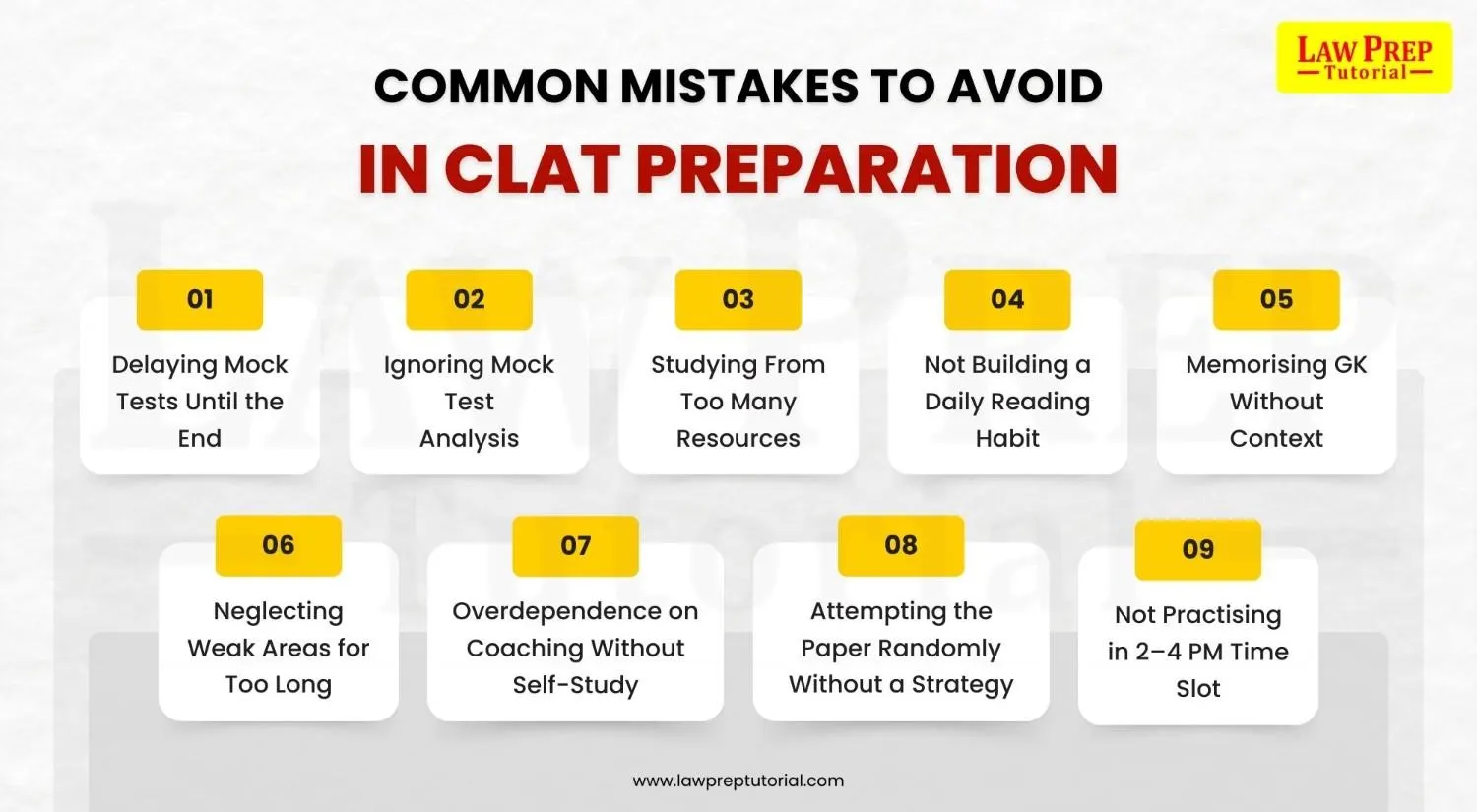
- Delaying Mock Tests Until the End: Many students wait for syllabus completion before attempting mocks. This is a major mistake. Early mocks help you understand the paper pattern, reading load, and time pressure, and they guide your preparation.
- Ignoring Mock Analysis: Just taking mocks is not enough. You must analyse every error, note question patterns, and track accuracy. Analysis improves scores, not the mock test itself.
- Studying From Too Many Resources: Using 6–7 books, multiple websites, and random GK sources leads to confusion. Stick to limited, reliable study material and revise it repeatedly.
- Not Building a Daily Reading Habit: CLAT is a reading-heavy exam. Skipping daily reading slows comprehension, affects accuracy, and hurts performance in English, LR, and Legal.
- Memorising GK Without Context: CLAT asks contextual current affairs, not one-liners. Learn background stories, significance, and related developments-not just headlines.
- Overdependence on Coaching Without Self-Study: Coaching helps, but you must revise and practise independently. CLAT rewards consistent daily effort, not just classroom attendance.
- Neglecting Weak Areas for Too Long: Students keep practising their strong sections and avoid weak ones. CLAT demands balanced performance across all five sections.
- Attempting the Paper Randomly Without a Strategy: Going into the exam without a fixed section order or time plan leads to panic and low scores. Your approach must be tested in mocks.
- Not Practising in 2–4 PM Time Slot: CLAT is always held between 2–4 PM. Practising in this time window trains your concentration and energy levels for the actual exam.
CLAT 2027 Preparation Tips From Toppers
Watch CLAT topper interviews to understand what they did right and how you can implement them in your strategy for CLAT preparation:
1. They Read Every Single Day Without Fail
Top scorers maintain a strict reading routine-editorials, long articles, reports, and case-based content. This daily habit strengthens comprehension, improves inference skills, and boosts performance in English, LR, and Legal. Even 20–30 minutes a day creates a huge advantage over months.
2. They Take Mocks Consistently and Analyse Deeply
CLAT toppers don’t wait for “perfect preparation” to begin mocks. They attempt them throughout the year and spend more time analysing mistakes than taking the test. They track patterns-slow RCs, weak CR types, recurring legal errors-and fix them one by one.
3. They Keep Their Study Material Limited and High-Quality
Instead of jumping across multiple books, toppers use a few trusted sources and revise them repeatedly. This avoids confusion and improves retention, especially for GK and frequently tested reasoning patterns.
4. They Maintain a Dedicated ‘Mistake Notebook’
Toppers write down every error they make-wrong assumptions, misread lines, tough legal principles, GK facts missed, and difficult DI sets. Reviewing this notebook weekly ensures they never repeat the same mistakes in future mocks.
5. They Practise in the Actual 2–4 PM Exam Slot
To train their brain for peak performance, toppers solve sectional tests, full mocks, and tough passages exactly during CLAT’s real-time window. This reduces exam-day fatigue, improves stamina, and stabilises performance.
6. They Follow a Weekly GK Revision Plan
Instead of cramming in the end, toppers revise GK every week using monthly CA PDFs or CLAT Express. They focus on background stories, significance, and related events, not just headlines or one-liners.
Do check out How to prepare for CLAT with Class 12th
7. They Fix Their Section Order Early
Toppers experiment with different section orders in mocks until they find the sequence that gives them the highest score. They then stick to that order for months so that the exam feels predictable and calm.
8. They Keep Their Preparation Balanced
Top scorers don’t ignore QT or GK just because they’re weak. They give every section enough time, ensuring no area becomes a liability. Balanced preparation consistently delivers higher total scores.
9. They Stay Calm and Avoid Panic Before the Exam
Instead of adding new sources or changing strategy at the last minute, toppers trust their preparation. They stick to their revision lists, mock plans, and weekly targets. This stability helps them stay confident on exam day.
FAQs on CLAT 2027 Preparation

SEO Head
Virendra heads SEO & Content at LPT. A writer at heart, he focuses on building exam-focused content that informs, guides, and supports aspirants in their preparation journey.
CLAT Trending Blogs