Talk to a Counsellor
 Support
2 Months Study Plan for CLAT PG 2027: Preparation Strategy, Timetable & Subject-Wise Plan
The CLAT PG 2 Months Study Plan should focus on covering high-weightage subjects first, completing the remaining syllabus, and leaving enough time for revision and mock tests. With 120 questions to solve in 120 minutes and 0.25 marks deducted for every wrong answer, the last two months need a focused approach.
Last Updated on 03 Oct 2026

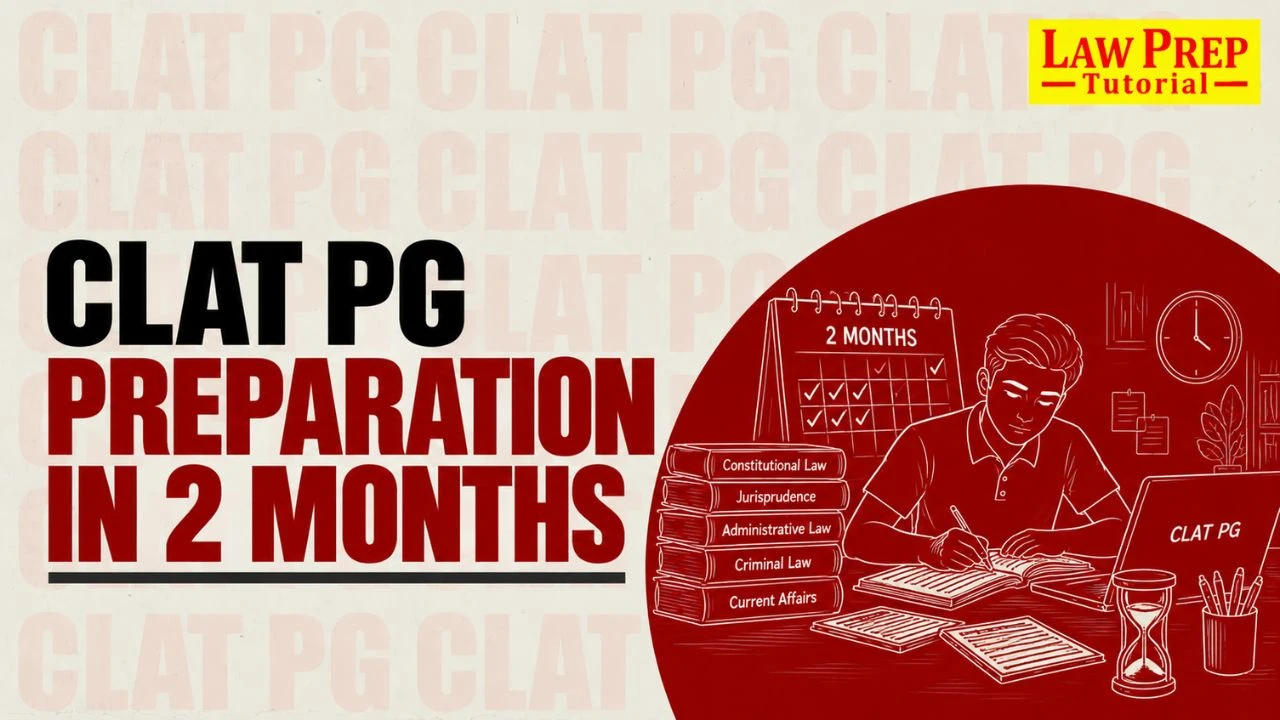
Read ahead to know how to prepare for CLAT PG in 2 months along with topic-wise weightage and other details.
Table of Contents
Jump to section- CLAT PG: All About CLAT Postgraduate Exam for LLM
CLAT PG 2027 Exam Pattern: What You Need to Plan For
Before starting the CLAT PG 2 Months preparation strategy, understand the paper structure. CLAT PG 2027 will be conducted offline on December 6, 2026, from 2 PM to 4 PM.
| Particular | CLAT PG 2027 Details |
| Exam mode | Offline |
| Exam date | December 6, 2026 |
| Exam time | 2 PM to 4 PM |
| Duration | 2 hours |
| Total questions | 120 |
| Maximum marks | 120 |
| Question type | Objective-type questions |
| Marks per correct answer | 1 mark |
| Negative marking | 0.25 mark for each wrong answer |
| Sections | 1 section |
| Syllabus base | Mandatory subjects of the undergraduate law programme |
| Major focus | Comprehension-based questions |
The paper covers Constitutional Law, Jurisprudence, Administrative Law, Contract, Torts, Family Law, Criminal Law, Property Law, Company Law, Public International Law, Tax Law, Environmental Law, and Labour & Industrial Law.
CLAT PG 2 Months Study Plan 2027
A CLAT PG 2 month study plan becomes easier when each month has a specific purpose. You can divide preparation into syllabus coverage, revision and exam practice.
| Month | Main Goal | What to Cover | Practice Target |
| Month 1 | Build the base and cover major syllabus | Constitutional Law, Jurisprudence, Criminal Law, Contract Administrative Law, Torts, Company Law, Family Law, Property Law, Public International Law, Tax law, Environmental Law | Topic-wise MCQs + sectional tests + short notes |
| Month 2 | Finish + revise | Labour & Industrial Law + complete revision | Full mocks + previous questions + error analysis |
Month 1: Start With the High-Weightage Subjects
Use the first month for the subjects expected to contribute more questions. Constitutional Law is expected to carry around 20-25 marks, while Jurisprudence and Criminal Law may contribute around 10-15 marks each.
| Week | Subjects | Key Topics | Weekly Focus |
| Week 1 | Constitutional Law | Preamble, Fundamental Rights, DPSPs, Fundamental Duties, separation of powers | Build concepts + solve MCQs |
| Company Law + Family Law | Incorporation, directors, corporate governance, shares, winding up; marriage, divorce, maintenance, adoption, succession | Sectional tests | |
| Week 2 | Constitutional Law | Judicial review, basic structure, emergency provisions, amendments, writs, federalism | Complete core topics + revise Week 1 |
| Administrative Law + Torts | Delegated legislation, judicial review, natural justice, discretion, tribunals; negligence, nuisance, defamation | Topic-wise MCQs | |
| Week 3 | Jurisprudence | Nature of law, sources, legal theories, rights and duties, justice and morality | Concepts + theory-based questions |
| Property Law + Public International Law | Transfer of property, sale, lease, mortgage, easements; treaties, jurisdiction, immunity, recognition, ICJ | Mixed MCQs | |
| Week 4 | Criminal Law + Contract | Mens rea, general exceptions, offences, defences, sentencing; offer, acceptance, consideration, consent | Finish core topics + mixed practice |
| Tax + Environmental Law | Direct/indirect taxes, income tax, GST, tax provisions; Environment Protection Act, polluter pays, sustainable development, PIL | Topic revision + MCQs |
Month 2: Revision, Labour Law and Mock Tests
The final month should not be treated as another full syllabus month. The focus should gradually shift from learning new topics to recall, question practice and time management.
| Week | Main Task | Topics/Activities | Test Plan |
| Week 1 | Finish syllabus | Labour & Industrial Law + pending topics | 2 sectional tests |
| Week 2 | First revision | Constitutional Law, Jurisprudence, Criminal Law, Contract | 2-3 mixed tests |
| Week 3 | Second revision | Administrative, Torts, Company, Family, Property, PIL | 3-4 mixed tests |
| Week 4 | Final revision | Tax, Environmental, Labour + weak areas + important notes | Full-length mocks + error analysis |
Explore diverse career opportunities after CLAT PG
CLAT PG Preparation in 2 Months: Subject-Wise Priority
Expected weightage can help you decide how much time to give each subject. These figures are approximate, so candidates should not treat them as a fixed question distribution.
| Subject | Expected Weightage | Priority in 2-Month Plan | Suggested Approach |
| Constitutional Law | 20-25 marks | Very High | Give the maximum study and revision time |
| Jurisprudence | 10-15 marks | High | Focus on theories, concepts and legal principles |
| Criminal Law | 10-15 marks | High | Revise core concepts, offences and defences |
| Law of Contract | 8-10 marks | High | Focus on formation, consent, breach and remedies |
| Company Law | 5-8 marks | Moderate | Focus on incorporation, directors and governance |
| Administrative Law | 5-8 marks | Moderate | Cover core doctrines and administrative mechanisms |
| Public International Law | 5-8 marks | Moderate | Cover treaties, jurisdiction and state-related concepts |
| Law of Torts | 5-8 marks | Moderate | Prioritise liability, negligence and remedies |
| Environmental Law | 5-8 marks | Moderate | Revise major principles, laws and conventions |
| Labour & Industrial Law | Around 5 marks | Moderate | Focus on disputes, unions, wages and social security |
| Family Law | Around 5 marks | Moderate | Cover major personal law concepts |
| Property Law | Around 5 marks | Moderate | Revise transfer, sale, lease and mortgage |
| Tax Law | 3-5 marks | Targeted | Cover basic taxation concepts and constitutional provisions |
How to Prepare for CLAT in 2 Months: Daily Study Routine
A fixed daily routine can prevent one subject from taking up the entire preparation period. A candidate can divide the study day between new topics, revision and questions.
| Study Block | Time | Task |
| Session 1 | 2 hours | Study a new topic |
| Session 2 | 1.5 hours | Continue the subject or complete another topic |
| Session 3 | 1 hour | Solve MCQs from the topics studied |
| Session 4 | 1 hour | Revise older topics |
| Session 5 | 30 minutes | Review mistakes and update short notes |
| Total | 6 hours | Balanced daily preparation |
Candidates with less available time can keep the same structure and shorten each session. The important point is to keep daily question practice and revision in the routine.
Check out the CLAT PG preparation resources:
| CLAT PG Syllabus | CLAT PG Important Topics |
| CLAT PG Exam Pattern | CLAT PG Previous Year Question Papers |
| CLAT PG 2026 Question Paper | CLAT PG 2025 Question Paper |
CLAT PG 2 Month Study Plan: What to Study in Each Subject
Look at the CLAT PG 2 months preparation strategy for all subjects shared below:
Constitutional Law
Constitutional Law should get the largest share of your preparation time because it carries the highest weightage. Focus on the following areas:
- Preamble
- Fundamental Rights
- DPSPs
- Fundamental Duties
- Separation of powers
- Judicial review
- Basic Structure Doctrine
- Emergency provisions
- Constitutional amendments
- Writ jurisdiction
- Federalism and Centre-State relations
Jurisprudence
Build clarity around the basic concepts of law before moving to theories. Focus on the following areas:
- Nature and definition of law
- Sources of law
- Austin, Kelsen, Hart and Salmond
- Rights and duties
- Justice and morality
- Ownership and possession
- Liability and sanctions
- Legal personality
- Legal Realism and Natural Law
Criminal Law
The preparation should cover both criminal liability and major defences. Focus on the following areas:
- General exceptions
- Mens rea
- Joint liability
- Offences against person and property
- Criminal defences
- Sentencing principles
Law of Contract
Revise the complete process from formation to breach and remedies. Focus on the following areas:
- Offer and acceptance
- Consideration
- Free consent
- Void and voidable contracts
- Breach of contract
- Quasi contracts
- Indemnity and guarantee
- Agency
Administrative Law
Give special attention to the principles controlling administrative action. Focus on the following topics:
- Delegated legislation
- Judicial review
- Natural justice
- Administrative discretion
- Ombudsman and Lokpal
- Tribunals
Law of Torts
Prioritise the major forms of liability and available remedies. Focus on the following areas:
- Negligence
- Nuisance
- Defamation
- Vicarious liability
- Strict and absolute liability
- Remedies
Family Law
Cover the major areas connected with family relationships and personal laws. Focus on the following areas:
- Marriage and divorce
- Maintenance
- Adoption and guardianship
- Succession and inheritance
- Uniform Civil Code
Property Law
Study the rules related to transfer and interests in property. Focus on the following aspects:
- Transfer of property
- Sale
- Lease
- Mortgage
- Easements and licences
- Doctrine of part performance
- Ownership and possession
Company Law
Focus on the legal structure and management of companies. Focus on the following areas:
- Incorporation
- Directors' duties
- Corporate governance
- Share capital
- Winding up
Public International Law
Keep the preparation focused on core international legal principles. Focus on the following areas:
- Sources of international law
- State jurisdiction and immunity
- Law of treaties
- Recognition of states and governments
- International Court of Justice
Tax Law
Cover this subject through basic concepts and key constitutional provisions. Focus on the following topics:
- Direct and indirect taxes
- Income Tax and GST basics
- Constitutional provisions on taxation
- Tax assessment and appeals
Environmental Law
Focus on important laws, principles and international developments. Focus on the following topics:
- Environment Protection Act, 1986
- Polluter Pays Principle
- Sustainable development
- Public Interest Litigation
- International environmental conventions such as Rio, Kyoto and Stockholm
Labour & Industrial Law
Keep the final syllabus coverage focused on the major labour-law areas. Focus on the following topics:
- Industrial disputes and resolution
- Trade unions
- Minimum wages and bonus laws
- Social security laws
- Labour Codes, 2020
Explore Important Topics of Indian Constitution:
CLAT PG 2 Months Preparation Strategy: Weekly Revision System
Revise throughout the two months instead of postponing it until the final week.
| Revision Cycle | What to Revise | When |
| Same-day revision | Topics studied that day | Before ending study |
| Weekly revision | All topics covered during the week | Last study session of the week |
| 15-day revision | Important concepts and weak areas | Every two weeks |
| Monthly revision | Complete subjects covered in that month | End of Month 1 and Month 2 |
| Final revision | Short notes, mistakes and high-priority topics | Month 3 |
CLAT PG Mock Test Strategy for the Last 2 Months
The mock test practice should also include time-bound solving. Negative marking makes error analysis important because wrong attempts reduce the overall score.
| Preparation Stage | Mock/Test Frequency | Main Purpose |
| Week 1-3 | 2 sectional/mixed tests/week | Improve question-solving speed |
| Week 4-5 | 2-3 tests/week | Identify weak subjects |
| Week 6-7 | 3-4 tests/week | Improve timing and accuracy |
| Final Week | Regular full-length mocks | Final exam simulation |
After every test, divide mistakes into three groups:
- Concept mistake: You need to study the topic again.
- Recall mistake: You knew the concept but didn't remember it correctly.
- Question-reading mistake: You answered incorrectly because you misread or rushed.
Practice with CLAT PG Mock Tests and boost your accuracy.
How to Crack CLAT in 2 Months: Mistakes to Avoid
A short preparation period requires strong time management. Avoid these common problems in the CLAT PG prepartaion:
- Spending too many days on one subject.
- Leaving revision until the final week.
- Studying only high-weightage subjects and avoiding the rest of the syllabus.
- Taking mocks without analysing mistakes.
- Making very long notes during the final month.
- Attempting questions randomly.
- Starting new topics repeatedly instead of focusing on weak areas.
Explore Our Related Blogs:
| CLAT PG Notification | CLAT PG Results |
| CLAT PG Eligibility Criteria | CLAT PG Answer Key |
| CLAT PG Registration Form | CLAT PG Colleges |
CLAT PG 2 Months Study Plan: Final 7-Day Revision
Use the final week for revision and exam practice. The last day should focus on recall and maintaining a steady routine.
| Day | Revision Plan |
| Day 1 | Constitutional Law |
| Day 2 | Jurisprudence + Criminal Law |
| Day 3 | Contract + Administrative Law |
| Day 4 | Torts + Family Law + Property Law |
| Day 5 | Company Law + Public International Law |
| Day 6 | Tax + Environmental + Labour & Industrial Law |
| Day 7 | Short notes, serious mistakes and light revision |
A two-month CLAT PG study plan should balance syllabus coverage, revision, MCQs and mock tests. Candidates who want guided preparation can consider the Law Prep Tutorial CLAT PG course, with self-paced, Crash Course and Target batch options. Its live classes, mock and sectional tests, study material, judgment updates and mentorship can be used alongside a fixed two-month study schedule.
Join CLAT PG Online Coaching for structured preparation and expert guidance.
FAQs About CLAT PG 2 Months Study Plan

SEO Head
Virendra heads SEO & Content at LPT. A writer at heart, he focuses on building exam-focused content that informs, guides, and supports aspirants in their preparation journey.
CLAT PG Trending Blogs
Other Related Blogs