Talk to a Counsellor
 Support
Best Short Stories for CLAT RC, Vocabulary & Critical Thinking
Explore the best short stories for CLAT RC, vocabulary & critical thinking to boost comprehension, reading speed, accuracy & overall exam performance.
Last Updated on 05 Jul 2026
Download Free CLAT Notes
A strong reading habit helps you improve your scores in CLAT English, Legal Reasoning, Current Affairs, as well as Logical Reasoning. And one of the recommended things to do is read short stories.
Because short stories train you to understand tone, inference, symbolism, emotions, arguments, and hidden meanings much faster. Stories like Karma, Gift of the Magi, The Tell-Tale Heart, The Model Millionaire, and A Cup of Tea are highly recommended to CLAT aspirants because they improve reading comprehension, vocabulary, critical thinking, and interpretation naturally.
The best short stories to read for CLAT help you become comfortable with passage-based questions without making reading feel boring or exhausting.
Table of Contents
Jump to section- CLAT PG: All About CLAT Postgraduate Exam for LLM
Short Stories to Read for CLAT
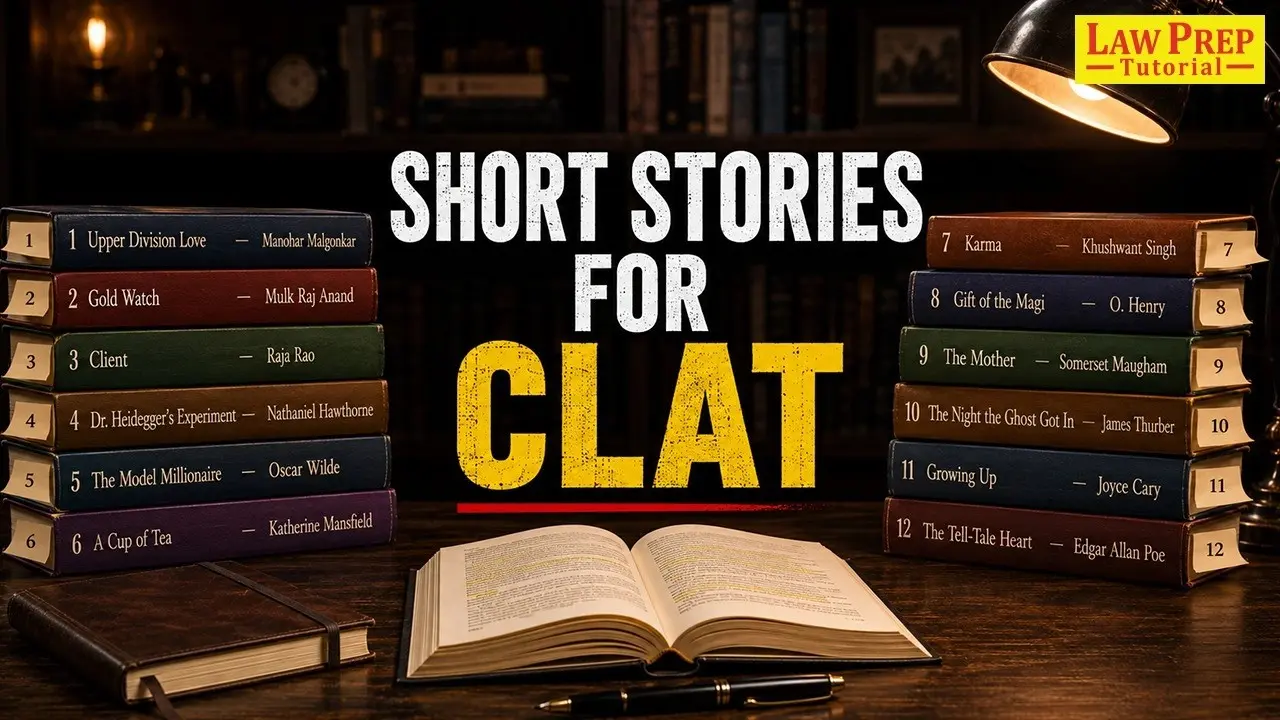
These are some of the most recommended short stories for CLAT aspirants:
| S.No | Short Story | Author | Best For in CLAT |
| 1 | Upper Division Love | Manohar Malgonkar | Social Understanding & RC |
| 2 | Gold Watch | Mulk Raj Anand | Emotional Interpretation |
| 3 | Client | Raja Rao | Human Psychology & Analysis |
| 4 | Dr. Heidegger’s Experiment | Nathaniel Hawthorne | Symbolism & Interpretation |
| 5 | The Model Millionaire | Oscar Wilde | Tone & Irony |
| 6 | A Cup of Tea | Katherine Mansfield | Character Analysis |
| 7 | Karma | Khushwant Singh | Irony & Social Commentary |
| 8 | Gift of the Magi | O. Henry | Emotional Comprehension |
| 9 | The Mother | Somerset Maugham | Emotional Depth & RC |
| 10 | The Night the Ghost Got In | James Thurber | Humor & Narrative Style |
| 11 | Growing Up | Joyce Cary | Perspective Understanding |
| 12 | The Tell-Tale Heart | Edgar Allan Poe | Psychological Reading & Inference |
1. Upper Division Love by Manohar Malgonkar
Upper Division Love by Manohar Malgonkar is a socially layered short story that explores ambition, class consciousness, office culture, and emotional expectations in middle-class Indian society.
The story revolves around an office clerk whose dreams and emotional fantasies are shaped heavily by status and professional hierarchy. As the story progresses, readers understand how social image, economic position, and personal insecurities influence relationships and decision-making. The story presents ordinary situations with subtle emotional depth and realistic social commentary, making it highly relatable and intellectually engaging.
The writing style is straightforward yet layered with irony and observation. Malgonkar uses realistic narration and social detail to communicate deeper emotional and psychological meanings without becoming overly complex.
Best For:
- CLAT Reading Comprehension
- Social Interpretation
- Tone Understanding
- Critical Thinking
2. Gold Watch by Mulk Raj
Gold Watch by Mulk Raj Anand is a deeply emotional story that highlights themes of exploitation, labor, dignity, and social inequality. The story focuses on the emotional and psychological condition of workers who dedicate their lives to institutions but are often treated unfairly or forgotten.
Through simple yet powerful storytelling, the narrative exposes the gap between recognition and real human value. The emotional tension within the story makes readers reflect on social structures, class differences, and moral responsibility.
Best For:
- Emotional Comprehension
- Reading Comprehension
- Social Awareness
- Tone Analysis
Explore important resources for CLAT preparation:
3. Client by Raja Rao
Client by Raja Rao is a psychologically rich story that explores human relationships, dependency, communication, and subtle emotional conflict. The story focuses on interactions between individuals where power dynamics, emotional needs, and personal motives shape behavior gradually. Raja Rao’s storytelling emphasizes thought, silence, and observation rather than direct explanation, making readers actively interpret situations and emotions while reading.
The writing style is reflective and layered, which makes it excellent for improving comprehension and inference-making ability. Since many CLAT passages require students to understand hidden meanings, implied emotions, and indirect arguments, stories like this train the mind to read carefully and analytically.
The story also improves concentration because readers need to observe small emotional and psychological details to fully understand the narrative. It is especially useful for aspirants trying to strengthen interpretation-based reading skills.
Best For
- Analytical RC
- Human Psychology
- Inference Skills
- Perspective Understanding
Also checkout: How to Attempt Lengthy Passages in CLAT
4. Dr. Heidegger’s Experiment by Nathaniel Hawthorne
Dr. Heidegger’s Experiment by Nathaniel Hawthorne is a symbolic and philosophical story that explores human nature, aging, regret, temptation, and the inability to learn from past mistakes. The story revolves around Dr. Heidegger, who conducts a mysterious experiment involving four elderly friends and a magical liquid that temporarily restores youth. As the experiment progresses, the characters repeat the same flaws and behaviors from their younger days, revealing deeper truths about human nature.
The writing style is symbolic, descriptive, and layered with philosophical meaning. Hawthorne uses allegory and subtle moral commentary rather than direct explanations, which makes the story extremely useful for CLAT aspirants.
It improves interpretation, symbolic understanding, and critical reading skills because readers must constantly identify hidden meanings behind actions and dialogue.
Best For:
- Critical Thinking
- Symbolic Reading
- Interpretation Skills
- Analytical RC
5. The Model Millionaire by Oscar Wilde
The Model Millionaire by Oscar Wilde is a witty and emotionally warm story that explores kindness, generosity, appearances, and irony. The story follows Hughie Erskine, a charming but financially weak young man who unknowingly helps a millionaire disguised as a beggar. The story cleverly challenges assumptions around wealth, appearance, and generosity while maintaining a light and engaging tone throughout.
Oscar Wilde’s writing style is elegant, humorous, and filled with irony, making the story extremely enjoyable as well as intellectually useful. The narration improves tone understanding and helps students identify irony, hidden humor, and emotional contrast within passages.
Best For:
- Tone Identification
- Reading Comprehension
- Irony Understanding
- Inference Skills
Explore the detailed CLAT Study Planner for smart preparation.
6. A Cup of Tea
A Cup of Tea by Katherine Mansfield is a psychologically layered story that explores class differences, insecurity, vanity, and emotional conflict. The story revolves around Rosemary Fell, a wealthy woman who impulsively invites a poor girl home after meeting her on the street.
Initially, Rosemary sees herself as generous and compassionate, but her emotions begin changing when insecurity and jealousy enter the situation. The story highlights how human behavior is often influenced by ego, social image, and hidden emotions rather than pure kindness.
The writing style is subtle, elegant, and deeply character-focused. Mansfield communicates emotional shifts through dialogue, observations, and atmosphere instead of direct explanation. This makes the story highly useful for CLAT aspirants because it improves inference-making, emotional interpretation, and tone understanding. Students also learn to identify hidden motives and psychological tension within seemingly simple conversations.
Best For:
- Reading Comprehension
- Character Analysis
- Tone Understanding
- Psychological Reading
Read more about: Ways to Improve Vocabulary for CLAT
7. Karma by Khushwant Singh
Karma by Khushwant Singh is one of the most recommended short stories for CLAT aspirants because of its sharp irony and social commentary. The story follows Sir Mohan Lal, an Indian man obsessed with English manners, language, and British culture, while looking down upon his own roots and people. During a train journey, his arrogance and identity crisis eventually lead to humiliation, creating a powerful ironic ending. The story explores themes like colonial mentality, identity, class consciousness, and social pretension.
The writing style is crisp, engaging, and filled with satire and irony. Khushwant Singh uses simple narration but creates deep meaning through character behavior and situational contrast. This makes the story excellent for improving interpretation, author tone identification, and critical reading. Since CLAT passages can test irony, attitude, and implied meaning, stories like this become extremely valuable reading practice.
Best For:
- Reading Comprehension
- Tone Analysis
- Social Commentary
- Critical Thinking
8. Gift of the Magi by O Henry
Gift of the Magi by O. Henry is a touching emotional story about love, sacrifice, and selflessness. The story revolves around a poor couple, Jim and Della, who sacrifice their most precious possessions to buy gifts for each other during Christmas. The emotional irony in the ending reveals the depth of their love and generosity. Despite its short length, the story leaves a powerful emotional impact and teaches readers about human relationships and priorities.
The writing style is simple, warm, and emotionally engaging, making it highly beginner-friendly for CLAT aspirants. O. Henry’s famous twist ending also improves prediction and inference-making skills.
Best For:
- Emotional RC
- Tone Understanding
- Inference Skills
- Reading Fluency
9. The Mother by W. Somerset Maugham
The Mother by W. Somerset Maugham is a powerful story about maternal love, sacrifice, suffering, and emotional resilience. The story explores the emotional journey of a mother who continues fighting difficult circumstances for the sake of her children. Maugham presents human pain, survival, and emotional strength in a realistic and deeply moving manner. The emotional intensity within the narrative forces readers to think carefully about human relationships and emotional motivations.
The writing style is clear yet emotionally layered, which helps CLAT aspirants improve comprehension of emotionally heavy passages. The story develops interpretation skills because many emotions are expressed indirectly through actions and situations instead of dramatic dialogue. It also improves understanding of human psychology and emotional conflict, both of which are useful in analytical RC passages.
Best For:
- Emotional Reading
- Reading Comprehension
- Character Analysis
- Inference Skills
Important Resources to explore after CLAT Exam:
| CLAT College Predictor | CLAT Answer Key |
| CLAT Counselling | CLAT Rank Predictor |
| CLAT Marks vs Rank | CLAT Toppers |
| CLAT Allotment List | CLAT Result |
| CLAT Cut-off | CLAT 2026 Question Paper |
10. The Night the Ghost Got In by James Thurber
The Night the Ghost Got In by James Thurber is a humorous and entertaining story filled with confusion, chaos, misunderstanding, and comic exaggeration. The story begins with a mysterious noise in the house, which gradually turns into complete panic and absurdity involving family members, neighbors, and police officers. Thurber uses humor and exaggerated situations to create a highly engaging reading experience.
The writing style is light, conversational, and fast-paced, which makes the story perfect for improving reading speed and tone identification. Since the humor is situational and subtle, students improve their ability to understand narrative tone, exaggeration, and author attitude. The story also improves focus because readers need to track rapidly changing situations and reactions carefully.
Best For:
- Tone Analysis
- Fast Reading
- Narrative Understanding
- Comprehension Practice
11. Growing Up by Joyce Cary
Growing Up by Joyce Cary is a reflective story about maturity, emotional growth, identity, and changing perspectives. The narrative explores how experiences shape personality and understanding over time. The story focuses more on emotional and psychological development than dramatic external events, which makes it deeply introspective and thoughtful.
The writing style is reflective and observation-driven, encouraging readers to think carefully about emotions, relationships, and perspective shifts. This helps CLAT aspirants improve inference-making and interpretation because much of the meaning lies beneath the surface narration. Students also improve their ability to understand subtle emotional changes and perspective-based storytelling, which are common in modern RC passages.
Best For:
- Reading Comprehension
- Perspective Understanding
- Emotional Analysis
- Inference Skills
12. The Tell-Tale Heart
The Tell-Tale Heart by Edgar Allan Poe is one of the most psychologically intense short stories recommended for CLAT aspirants. The story follows an unnamed narrator who insists on his sanity while describing a disturbing crime he committed. As guilt and paranoia increase, the narrator begins hearing imaginary sounds, leading to psychological breakdown and confession. The story explores madness, guilt, fear, and unreliable narration in a gripping way.
The writing style is dark, intense, and psychologically layered. Poe creates tension through repetition, emotional instability, and dramatic narration, forcing readers to analyze the narrator’s mental state carefully. This makes the story highly useful for CLAT because it improves inference-making, psychological interpretation, and analytical reading skills. Students also learn to identify unreliable narration and hidden emotional conflict within passages.
Best For:
- Psychological RC
- Critical Thinking
- Tone Analysis
- Analytical Reading
Free CLAT Study Material for You:
| CLAT Previous Year Papers PDF | CLAT Sample Papers |
| CLAT Videos | CLAT Current Affairs |
Benefits of Reading Short Stories for CLAT Preparation
Short stories are one of the smartest reading tools for CLAT aspirants because they improve multiple skills within limited reading time.
1. Improves Reading Comprehension Faster
Short stories train you to understand passages, emotions, arguments, and themes quickly without feeling mentally exhausted during preparation.
2. Develops Inference-Making Ability
Most stories contain hidden meanings, indirect emotions, and implied messages that improve interpretation skills required in CLAT RC.
3. Improves Vocabulary Naturally
You learn practical vocabulary through context, conversations, and narration instead of memorizing random word lists separately.
4. Helps in Understanding Tone and Irony
Stories improve your ability to identify sarcasm, humor, criticism, emotional tone, and author attitude within passages.
5. Builds Reading Consistency
Since stories are shorter than novels, they are easier to finish regularly and help build strong daily reading habits.
6. Improves Focus and Concentration
Reading complete stories trains your mind to stay attentive from beginning to ending without losing comprehension.
7. Develops Critical Thinking Skills
Stories involving psychology, society, morality, and human behavior improve analytical thinking and reasoning ability naturally.
8. Helps in Handling Passage-Based Questions
Regular story reading improves comfort with lengthy passage reading, which directly helps in modern CLAT English sections.
Tips to Efficiently Read Short Stories for CLAT Preparation
- Focus on understanding tone, emotions, and themes
- Highlight difficult vocabulary words and revise them later
- Try summarizing the story in your own words
- Observe irony, symbolism, and hidden meanings carefully
- Read slowly initially instead of rushing through stories
- Practice RC questions after finishing a story
- Read stories from different genres regularly
Also checkout: Best Novels for CLAT Exam
Mistakes to Avoid While Reading Short Stories for CLAT
- Reading Only for Entertainment: Remember, CLAT reading preparation requires analytical understanding, not just enjoying the storyline casually.
- Ignoring Tone and Themes: Many students understand the plot but fail to identify irony, symbolism, and author perspective.
- Reading Too Fast: Rushing reduces comprehension quality and weakens interpretation ability during passage-based questions.
- Choosing Only Easy Stories: Reading only beginner-level stories limits growth in comprehension and analytical reading skills.
- Skipping Vocabulary Revision: Learning new words without revising them regularly reduces long-term retention and practical usage.
- Reading Inconsistently: Irregular reading habits slow improvement in reading speed, focus, and comprehension.
- Avoiding Difficult Passages: Difficult stories improve analytical thinking and inference-making, which are important for CLAT preparation.
FAQs About Short Stories to Read for CLAT

SEO Head
Virendra heads SEO & Content at LPT. A writer at heart, he focuses on building exam-focused content that informs, guides, and supports aspirants in their preparation journey.
CLAT Trending Blogs