Talk to a Counsellor
 Support
CLAT PG 2027 Revision Strategy: Subject-Wise Study Plan
CLAT PG 2027 subject-wise revision strategy should be based on weightage, syllabus coverage and question practice. The paper has 120 objective questions for 120 marks, with 0.25 marks deducted for every incorrect answer.
Last Updated on 10 Oct 2026

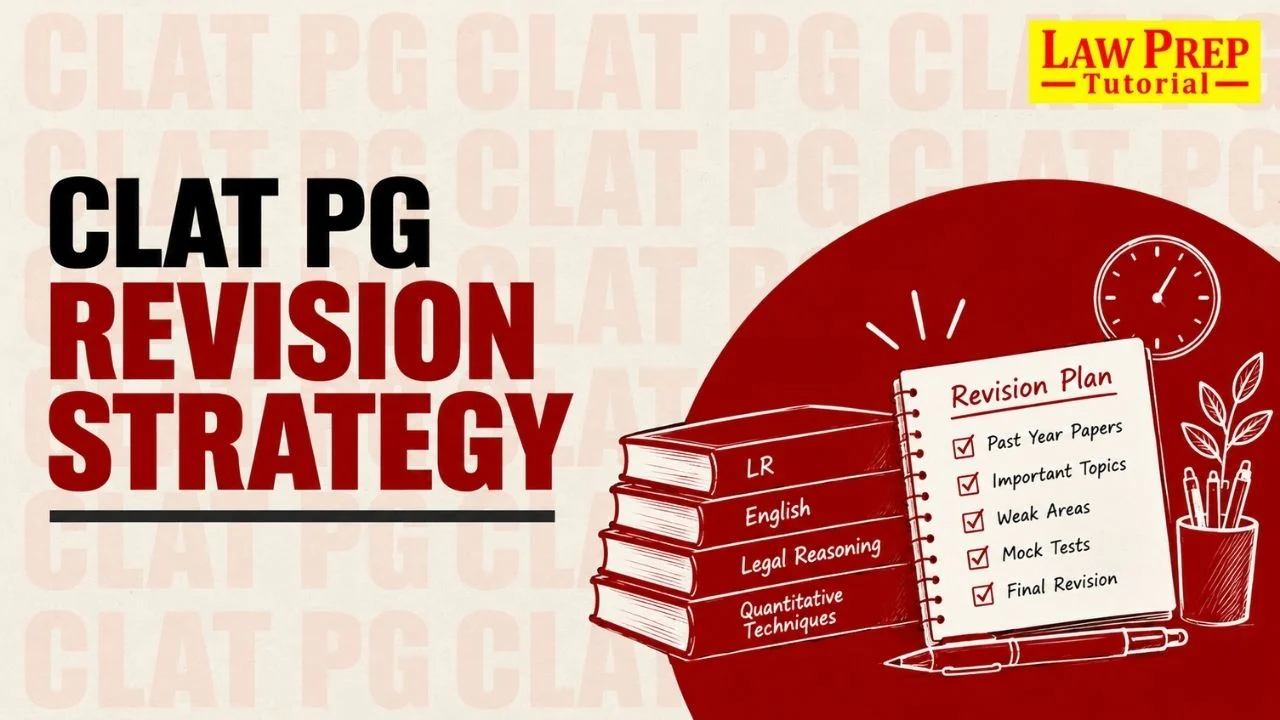
Among the 13 core law subjects, Constitutional Law carries the highest approximate weightage of 20-25 marks, followed by Jurisprudence and Criminal Law with 10-15 marks each.
Candidates can spend more revision time on higher-weightage topics, while covering Family Law, Labour & Industrial Law, Property Law, and Tax Law in a shorter revision period. Read ahead to know the CLAT PG subject-wise revision strategy, including important topics and other relevant details.
Table of Contents
Jump to sectionCLAT PG 2027 Revision Strategy: Know Sectional Weightage
The CLAT PG syllabus covers Constitutional Law, Jurisprudence, Administrative Law, Law of Contract, Torts, Family Law, Criminal Law, Property Law, Company Law, Public International Law, Tax Law, Environmental Law, and Labour & Industrial Law.
The approximate weightage can be used to set revision priorities:
| Subject | Approx. Weightage |
|---|---|
| Constitutional Law | 20-25 marks |
| Jurisprudence | 10-15 marks |
| Criminal Law | 10-15 marks |
| Law of Contract | 8-10 marks |
| Administrative Law | 5-8 marks |
| Company Law | 5-8 marks |
| Law of Torts | 5-8 marks |
| Public International Law | 5-8 marks |
| Environmental Law | 5-8 marks |
| Family Law | Around 5 marks |
| Labour & Industrial Law | Around 5 marks |
| Property Law | Around 5 marks |
| Tax Law | 3-5 marks |
Practice with CLAT PG Mock Tests and boost your accuracy.
How to Revise Constitutional Law for CLAT PG 2027?
Constitutional Law deserves a large share of the CLAT PG 2027 revision plan because it has an approximate weightage of 20-25 marks. Revision should focus on understanding constitutional principles and linking them with important provisions.
Important Constitutional Law Topics
- Preamble of Indian Constitution
- Fundamental Rights
- Directive Principles of State Policy
- Fundamental Duties
- Separation of Powers
- Judicial Review
- Basic Structure Doctrine
- Emergency Provisions
- Amendments of Indian Constitution
- Writ Jurisdiction
- Federalism and Centre-State Relations
CLAT PG Constitutional Law Revision Tips
Start by revising the constitutional provisions linked to each major topic. Prepare short notes containing the provision, principle and key legal development.
Give separate revision time to Fundamental Rights, judicial review, basic structure, writ jurisdiction and federalism. These areas also provide a useful framework for understanding several constitutional questions.
During practice, do not just mark the correct option. Jot down why the other options are wrong. This can help when two options look similar.
Read more related topics:
| Fundamental Rights of Indian Constitution Borrowed From Which Country? | Fundamental Duties of Indian Constitution Borrowed From Which Country? |
CLAT PG 2027 Criminal Law Revision Strategy
Revise Criminal Law through concepts rather than meaning. Focus on the ingredients of offences, mental elements, exceptions and principles governing criminal responsibility.
Important Criminal Law Topics
- General Exceptions
- Mens Rea
- Joint Liability
- Offences Against Person and Property
- Sentencing Principles
- Defences in Criminal Law
How to Revise Criminal Law
Create separate revision sheets for general principles, offences and defences. For each major offence, recall its essential ingredients before attempting questions.
Mens rea deserves focused revision because intention, knowledge and other mental elements can change the legal position. Cover joint liability separately so the basis of criminal responsibility involving multiple persons is clear.
For the final revision cycle, use problem-based questions to test whether you can apply a rule to facts rather than simply remember its wording.
How to Revise Contract Law for CLAT PG?
Contract Law has an approximate weightage of 8-10 marks. You can divide revision into contract formation, validity, performance, breach, and special contractual relationships.
Important Contract Law Topics
- Offer and Acceptance
- Consideration
- Free Consent
- Void and Voidable Contracts
- Breach of Contract
- Quasi-Contracts
- Indemnity and Guarantee
- Agency
Contract Law Revision Method
Begin with offer, acceptance and consideration because these concepts form the base of contract formation. Move next to free consent and distinguish the circumstances that affect genuine consent.
After revising validity-related concepts, focus on breach and remedies. Finish the subject with quasi-contracts, indemnity, guarantee and agency.
A useful method is to create comparison notes for concepts that are easy to confuse. For example, revise different forms of defective consent side by side rather than studying them separately.
Check our other blogs:
| CLAT PG 2027: All details | CLAT PG Career Opportunities |
| CLAT PG Eligibility Criteria | CLAT PG Notification |
| CLAT PG Registration Form | CLAT PG Exam Pattern |
CLAT PG 2027 Torts Revision Strategy
Law of Torts carries an approximate weightage of 5-8 marks. Revision should concentrate on the basis of liability, common torts and available remedies.
Important Torts Topics
- Negligence
- Nuisance
- Defamation
- Vicarious Liability
- Strict Liability
- Absolute Liability
- Remedies
How to Revise Torts
For negligence, revise the elements required to establish liability and then practise applying them to short factual situations.
Keep strict liability and absolute liability in separate notes and focus on their legal distinctions. Revise vicarious liability by focusing on the relationship between the wrongdoer and the person or entity held responsible.
Finish with remedies and make a quick list of the relief available in different situations. Practice questions should focus on identifying the applicable tort from the facts given.
How to Revise Family Law for CLAT PG 2027?
Family Law has an approximate weightage of around 5 marks. Its limited weightage does not make it a subject to skip. A compact revision cycle can cover the major areas without taking time away from heavier subjects.
Important Family Law Topics
- Marriage and Divorce
- Maintenance
- Adoption and Guardianship
- Succession and Inheritance
- Uniform Civil Code
CLAT PG Family Law Revision Tips
Divide your notes into personal law concepts and broader legal principles. For marriage and divorce, revise requirements, legal grounds and related consequences.
Revise maintenance, adoption, guardianship, and succession by focusing on their core rules and distinctions. Keep UCC as a separate topic and revise the constitutional and legal context surrounding the concept.
Use short question sets after each topic. Family Law revision is more efficient when you test recall immediately.
Learn How to Analyse CLAT PG Mock Tests and improve your exam performance
CLAT PG 2027 Property Law Revision Tips
Property Law carries an approximate weightage of 5 marks. The subject includes several connected concepts, so revision should follow the movement and control of property rights.
Important Property Law Topics
- Transfer of Property
- Sale
- Lease
- Mortgage
- Easements and Licences
- Doctrine of Part Performance
- Ownership and Possession
Property Law Revision Strategy
First revise the basic rules governing transfer of property. Then study sale, lease and mortgage as separate concepts and note their distinguishing features.
Revise easements and licences together, as comparison can make their legal character easier to recall. Give separate attention to part performance and its requirements.
End the revision with ownership and possession. Prepare a one-page comparison sheet for concepts that have overlapping terminology.
How to Revise Company Law for CLAT PG?
Company Law is expected to contribute around 5-8 marks. Organise your revision around the company’s life cycle, from incorporation to winding up.
Important Company Law Topics
- Incorporation
- Directors’ Duties
- Corporate Governance
- Share Capital
- Winding Up
CLAT PG Company Law Revision Tips
Revise incorporation first to understand how a company comes into existence. Next, focus on directors’ duties and corporate governance, particularly the responsibilities attached to company management.
Revise share capital separately, focusing on its legal structure and ownership aspects. Save winding up for the end of the subject, since it covers a company’s closure and liquidation.
Use short MCQ sets after completing each area. Mark questions where you are confused between two corporate concepts and include them in your final revision sheet.
Explore CLAT PG Previous Year Papers here:
| CLAT PG Previous Year Question Papers | CLAT PG 2026 Question Paper |
| CLAT PG 2025 Question Paper |
CLAT PG 2027 Environmental Law Revision Strategy
Environmental Law has an approximate weightage of 5-8 marks. It combines statutory law, legal principles, constitutional remedies and international developments.
Important Environmental Law Topics
- Environment Protection Act, 1986
- Polluter Pays Principle
- Sustainable Development
- Public Interest Litigation
- International Environmental Conventions
- Rio, Kyoto and Stockholm developments
How to Revise Environmental Law
Start with the Environment Protection Act and identify its basic purpose and regulatory framework. Then revise the major environmental principles separately.
Understand polluter pays and sustainable development as legal principles. Revise PIL in the context of environmental protection and public welfare.
For international conventions, prepare a compact chronology containing the name of the development and its broad legal significance. This is easier to revise during the final days than lengthy notes.
How to Revise Labour and Industrial Law for CLAT PG?
Labour and Industrial Law carries an approximate weightage of 5 marks. Revision should cover disputes, worker representation, wages, social security and labour codes.
Important Labour and Industrial Law Topics
- Industrial Disputes and Resolution
- Trade Unions
- Minimum Wages and Bonus Laws
- Social Security Laws
- Labour Codes, 2020
CLAT PG Labour Law Revision Tips
Begin with industrial disputes and understand the basic framework used for resolving employer-worker conflicts. Follow this with trade unions and their legal position.
Revise minimum wages and bonus provisions as a separate unit. Social security should cover major areas such as provident fund and gratuity.
Keep the Labour Codes as the final revision block. A comparison chart of the major labour areas can help you revise the subject without repeatedly going through lengthy material.
Learn How to Prepare for CLAT PG in 2 Months with a detailed study plan.
How to Revise Administrative Law for CLAT PG?
Administrative Law has an approximate weightage of 5-8 marks. Its major areas revolve around the exercise and control of administrative power.
Important Administrative Law Topics
- Delegated Legislation
- Judicial Review
- Natural Justice
- Administrative Discretion
- Ombudsman and Lokpal
- Tribunals
Administrative Law Revision Strategy
Revise delegated legislation by focusing on why subordinate authorities receive rule-making powers and the limits placed on those powers.
Revise natural justice by focusing on its procedural safeguards. Administrative discretion requires attention to both the authority granted to administrators and the legal controls over its use.
Keep judicial review separate from general constitutional revision so that its administrative law application remains clear. Finish with tribunals and Ombudsman/Lokpal mechanisms.
CLAT PG 2027 Jurisprudence Revision Strategy
Jurisprudence has an approximate weightage of 10-15 marks, making it one of the subjects that should receive substantial revision time.
Important Jurisprudence Topics
- Nature and Definition of Law
- Sources of Law
- Legal Theories
- Rights and Duties
- Justice and Morality
- Ownership and Possession
- Liability and Sanctions
- Legal Personality
- Legal Realism
- Natural Law
How to Revise Jurisprudence
Begin with the meaning and nature of law, then move to its sources. Then revise major legal theories associated with Austin, Kelsen, Hart and Salmond.
Theories should be studied comparatively. Prepare short notes on each thinker’s central idea instead of memorising lengthy explanations.
Revise rights and duties, legal personality, liability, and sanctions as individual concepts. Keep Natural Law and Legal Realism in a separate comparison sheet so their basic approaches remain distinct.
CLAT PG 2027 Public International Law Revision Strategy
Public International Law carries an approximate weightage of 5-8 marks. Focus your revision on the foundations of international law, relations between states, and dispute resolution.
Important Public International Law Topics
- Sources of International Law
- State Jurisdiction and Immunity
- Law of Treaties
- Recognition of States and Governments
- International Court of Justice
Public International Law Revision Tips
Start with the sources of international law and then move to treaties. Revise the stages and legal principles of international agreements in a structured way.
Study state jurisdiction and immunity together because both concern the authority and legal position of states. Revise state and government recognition, focusing on definitions and distinctions.
Keep the International Court of Justice as a separate revision topic and remember its basic role in resolving disputes between states.
Explore other related articles:
| CLAT PG Answer Key | CLAT PG Admit Card |
| CLAT PG Important Topics | CLAT PG Colleges |
| CLAT PG Cut Off | CLAT PG Results |
CLAT PG 2027 Tax Law Revision Strategy
Tax Law has an approximate weightage of 3-5 marks. Since its expected share is lower than several other subjects, candidates can use short but regular revision sessions.
Important Tax Law Topics
- Direct and Indirect Taxes
- Income Tax Basics
- GST Basics
- Constitutional Provisions on Taxation
- Tax Assessment and Appeals
- How to Revise Tax Law
Begin by distinguishing direct and indirect taxes. Then revise the basic structure of income tax and GST, without spending too much time on peripheral details.
Articles 265-289 should receive dedicated revision because they form the constitutional framework for taxation powers. Finish with the basic process of tax assessment and appeals.
Use objective questions to identify gaps because tax terminology can appear similar across different concepts.
How to Prioritise CLAT PG Subjects During Revision?
Prioritise subjects based on approximate weightage, your level of preparation, and the time left before the exam.
- High-weightage subjects: Constitutional Law, Jurisprudence and Criminal Law
- Next priority: Contract Law
- Medium-weightage subjects: Administrative Law, Company Law, Torts, Public International Law and Environmental Law
- Short revision subjects: Family Law, Labour & Industrial Law, Property Law and Tax Law
This does not mean completing one category and completely abandoning the next. Use a rotation system. For example, spend a major study block on Constitutional Law and Jurisprudence, then follow it with a shorter session on Family Law or Tax Law.
Keep a separate list of weak topics. A subject that carries fewer marks can still affect your score if the questions come from an area you have repeatedly missed.
Explore the CLAT PG Difficulty Level and know what to expect in the exam!
CLAT PG Revision Plan: Timetable
Use a 14-day revision plan when you have already studied the CLAT PG syllabus once. This timetable aims to revise all 13 subjects while giving extra time to higher-priority areas.
| Day | Main Revision | Secondary Revision | Practice |
|---|---|---|---|
| Day 1 | Constitutional Law | – | 30-40 MCQs |
| Day 2 | Constitutional Law | Writs/Federalism | 30-40 MCQs |
| Day 3 | Jurisprudence | – | 30-40 MCQs |
| Day 4 | Criminal Law | – | 30-40 MCQs |
| Day 5 | Contract Law | – | 25-30 MCQs |
| Day 6 | Administrative Law | Property Law | 25-30 MCQs |
| Day 7 | Company Law | Family Law | 25-30 MCQs |
| Day 8 | Torts | Environmental Law | 25-30 MCQs |
| Day 9 | Public International Law | Labour & Industrial Law | 25-30 MCQs |
| Day 10 | Tax Law | Weak topics | 20-25 MCQs |
| Day 11 | Constitutional Law | Jurisprudence | Mixed practice |
| Day 12 | Criminal Law | Contract Law | Mixed practice |
| Day 13 | All weak areas | Error-log revision | 60-80 MCQs |
| Day 14 | Full syllabus revision | Key notes only | Full-length mock |
CLAT PG 2027 Revision Tips for Better Accuracy
The paper has 120 questions in 120 minutes, so revision should also improve recall speed. Candidates can use the following methods:
1. Maintain an Error Log
Record every question you get wrong in mocks or practice sets. Mention the exact reason for the mistake, such as poor recall, confusion between concepts or incorrect application of a rule.
2. Use One-Page Subject Notes
Do not keep adding information to your notes during the final revision. Reduce each subject to key provisions, concepts, distinctions and difficult areas.
3. Revise Similar Concepts Together
Comparison-based revision is useful when two doctrines, principles or legal concepts have similar terminology. Keeping them side by side can reduce confusion during MCQs.
4. Follow Active Recall
Conclude your notes and explain a concept in simple words. If you cannot recall the rule without looking at the material, mark it for another revision cycle.
5. Practise Under a Time Limit
The paper allows about one minute per question on average. Hence, timed practice can help you assess whether your revision is translating into faster decision-making.
6. Review the Reason for Every Error
Checking only the correct answer is not enough. Find out why you selected the wrong option and whether the mistake came from a missed rule or weak recall.
7. Keep the Final Revision Selective
The last revision should not become another full reading of all textbooks. Focus on your short notes, error log, difficult concepts and questions you previously marked for review.
FAQs on CLAT PG Revision Before Exam

SEO Head
Virendra heads SEO & Content at LPT. A writer at heart, he focuses on building exam-focused content that informs, guides, and supports aspirants in their preparation journey.
CLAT PG Trending Blogs
Other Related Blogs