
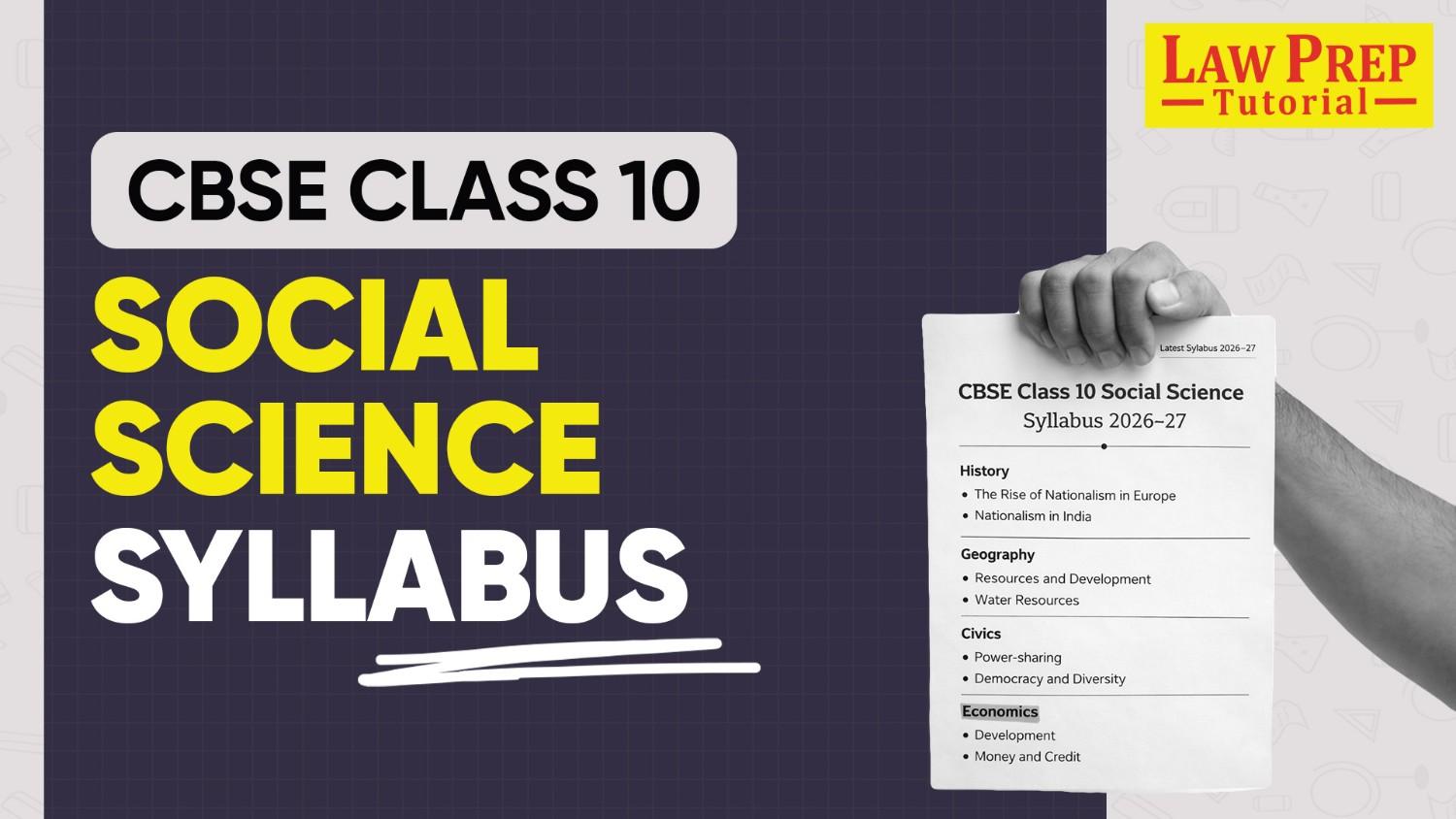

CBSE Syllabus for Class 10 Social Science helps you understand how different events, ideas, and systems shape the world around you, especially when you are preparing for the CBSE Board Exam. Social Science is not limited to memorising facts. A clear understanding of concepts helps you connect history, geography, civics, and economics with real-life situations and current events.
The syllabus is divided into four parts, History, Geography, Civics, and Economics. Each subject focuses on a different aspect, from past events and resources to governance and economic systems. You learn how to analyse causes and effects, read maps, understand policies, and interpret data. The board exam follows a structured format with a mix of objective and descriptive questions, while map work and internal assessment add to your overall score.
This guide explains each part of the CBSE Class 10th Social Science syllabus in a clear and organised way. You will find subject-wise topics, map work details, and exam components, so you can prepare with better understanding and confidence.

CBSE Class 10th Social Science Subjects
The CBSE Board Class 10 Social Science syllabus is organised into four subjects, History, Geography, Political Science, and Economics. Each subject carries equal marks, so balanced preparation across all sections helps you improve your overall score. A clear view of chapter-wise coverage in the CBSE Board Class 10 syllabus helps you identify important areas and plan revision with better focus.
The syllabus combines different types of learning. History and Geography include map-based questions that require regular practice. Political Science and Economics focus more on understanding concepts, linking ideas, and applying knowledge in answers. Internal assessment also plays a role through project work and activities, so consistent effort throughout the year supports better performance in the CBSE Board Class 10 exams.
To understand how chapters are distributed across subjects and how each area is assessed, refer to the simplified table below for the CBSE Board Class 10 social science syllabus.
| CBSE Social Science Subject | Written Paper Marks | Map Work Marks | Total Marks |
| History | 18 | 2 | 20 |
| Geography | 17 | 3 | 20 |
| Political Science | 20 | 0 | 20 |
| Economics | 20 | 0 | 20 |
| Total (Written Exam) | 75 | 5 | 80 |
| Internal Work (Projects, Tests) | — | — | 20 |
| Final Total | — | — | 100 |
Must Checkout CBSE 10th Result 2026
CBSE Class 10th Social Science Syllabus PDF
A syllabus PDF gives you a complete and official view of all chapters, topics, and exam structure in one place. When you refer to the official document, you avoid confusion and make sure that preparation stays aligned with board guidelines. A clear syllabus helps you track progress, plan revision, and avoid missing any topic.
You can download the latest syllabus directly from the CBSE Academic website. The document includes chapter-wise content, learning outcomes, map work, and assessment details for the academic session.
CBSE Class 10th SST Syllabus Subject-wise
A clear view of the CBSE Class 10th Social Science syllabus chapter-wise helps you plan study in a structured way. Instead of reading chapters randomly, you can move subject by subject and understand what each chapter expects from you.
The table below breaks the syllabus into chapters along with the exact focus areas you should prepare for exams.
| Subject | Unit / Section | Chapter No. | Chapter Name | What You Should Study in Each Chapter |
| History | Events and Processes | 1 | The Rise of Nationalism in Europe | – Growth of nationalism, French Revolution, – Role of symbols and leaders |
| 2 | Nationalism in India | – Gandhian movements, freedom struggle timeline, – Mass participation | ||
| Livelihoods, Economies and Societies | 3 | The Making of a Global World | – Trade routes, colonisation, – Economic changes across countries | |
| 4 | The Age of Industrialisation | – Industrial growth, workers’ life, – Factory system development | ||
| Everyday Life, Culture and Politics | 5 | Print Culture and the Modern World | – Role of print in spreading ideas, – Education, and reform movements | |
| Geography | Contemporary India | 1 | Resources and Development | – Types of resources, planning, – sustainable use, conservation methods |
| 2 | Forest and Wildlife Resources | Biodiversity, conservation strategies, protected areas | ||
| 3 | Water Resources | Water scarcity, conservation, dams and their advantages and issues | ||
| 4 | Agriculture | Cropping seasons, major crops, farming types, challenges in India | ||
| 5 | Minerals and Energy Resources | Distribution, types, importance, and conservation of resources | ||
| 6 | Manufacturing Industries | Industrial development, major industries, environmental impact | ||
| 7 | Lifelines of the National Economy | Transport, communication, trade and their role in growth | ||
| Political Science | Democratic Politics | 1 | Power-sharing | Forms of power-sharing, case studies like Belgium and Sri Lanka |
| 2 | Federalism | Structure of government, division of powers, decentralisation | ||
| 3 | Gender, Religion and Caste | Social differences, equality, and political impact | ||
| 4 | Political Parties | Functions, types, national and regional parties, challenges | ||
| 5 | Outcomes of Democracy | Economic, social, and political outcomes of democracy | ||
| Economics | Understanding Economic Development | 1 | Development | Income comparison, human development indicators, sustainability |
| 2 | Sectors of the Indian Economy | Primary, secondary, tertiary sectors, employment patterns | ||
| 3 | Money and Credit | Role of money, banks, loans, formal and informal sectors | ||
| 4 | Globalisation and the Indian Economy | Global trade, multinational companies, impact on India | ||
| 5 | Consumer Rights | Consumer laws, rights, responsibilities, complaint process |
Also checkout CBSE Full Form here!
History Syllabus Class 10th (India and the Contemporary World – II)
The History Syllabus Class 10th provides a clear view of how major events, ideas, and movements have shaped modern societies. A strong understanding of these chapters helps you connect past developments with present-day situations. When you focus on causes, outcomes, and connections, answers become more structured and meaningful.
The History syllabus for Class 10th is organised around key themes such as nationalism, global connections, industrial growth, and the spread of ideas. You learn how revolutions influenced societies, how leaders guided movements, and how economic and social changes affected people across regions. Regular revision of timelines, important events, and real examples improves retention and answer accuracy in exams.
The following section presents a chapter-wise breakdown of the History syllabus with key learning areas for each chapter.
1. The Rise of Nationalism in Europe
- Influence of the French Revolution on European societies
- Development of the idea of a nation-state
- Role of different social groups in nationalist movements
- Spread of nationalism across Europe
- Link between nationalism and the beginning of World War I
2. Nationalism in India
- Growth of unity among people in India
- Leadership of Mahatma Gandhi in mass movements
- Participation of different groups in the freedom struggle
- Impact of World War I on Indian society and economy
- Beginning of the Non-Cooperation and Khilafat Movements
3. The Making of a Global World
- Early trade routes and global connections
- Changes in the world during the nineteenth century
- Economic impact of major wars
- Process of global recovery after wars
- Effects of colonialism on different regions
- Development of globalisation over time
4. The Age of Industrialisation
- Life and production systems before industrialisation
- Growth of industries and factories
- Role of machines in transforming production
- Impact on workers and social structure
- Effect of industrialisation on colonies such as India
5. Print Culture and the Modern World
- Beginning of print technology in East Asia
- Spread of printing in Europe and India
- Difference between handwritten manuscripts and printed texts
- Role of print in spreading ideas and knowledge
- Influence of print culture on society and public opinion
Geography Syllabus Class 10th (Contemporary India – II)
After understanding how historical events shaped societies, Geography Syllabus Class 10th helps you see how natural resources and human activities influence everyday life. A clear understanding of geographical concepts allows you to connect land, water, agriculture, and industries with economic development and sustainability. When you relate topics with real-life examples, answers become more practical and easier to write.
The Geography syllabus for Class 10th focuses on resources, environment, agriculture, minerals, and infrastructure. Each chapter builds your understanding of how natural and human systems work together. Map work, case studies, and data-based questions form an important part of preparation, so regular practice improves accuracy and confidence in exams.
The following section presents a chapter-wise breakdown of the Geography syllabus with key learning areas for each chapter.
1. Resources and Development
- Understanding how different resources depend on each other
- Importance of planning for proper use of resources in India
- Reasons behind resource development
- Analysis of land use patterns and underutilised land
- Practical ways to improve resource use and reduce wastage
2. Forest and Wildlife Resources
- Importance of conserving forests and wildlife for ecological balance
- Relationship between forests, wildlife, and sustainable development
- Impact of activities such as grazing and wood cutting
- Reasons for conserving biodiversity
- Creative presentation of conservation ideas
3. Water Resources
- Need for conserving water resources in India
- Role of multipurpose projects in water management
- Link between water availability and development
4. Agriculture
- Need for conserving water resources in India
- Role of multipurpose projects in water management
- Link between water availability and development
5. Minerals and Energy Resources
- Types of minerals and energy resources
- Link between raw materials and location of industries
- Importance of industries in economic growth
- Environmental impact of industrial activities
- Need for sustainable industrial development
6. Manufacturing Industries
- Types of industries based on raw materials and production processes
- Role of industries in economic development
- Environmental challenges caused by industrial growth
- Measures to promote sustainable industrial practices
7. Lifelines of National Economy
- Importance of transport and communication in economic development
- Role of trade in connecting different regions
- Link between national and global markets
Political Science Syllabus Class 10th (Democratic Politics – II)
After learning how resources and development shape a country, Political Science Science Syllabus Class 10th helps you understand how decisions are made and how power is shared in a democracy. A clear understanding of democratic systems allows you to connect governance, rights, and participation with real-life situations. When you relate concepts with current events and examples, answers become more analytical and balanced.
The Political Science syllabus for Class 10th focuses on power sharing, federal structure, social diversity, political parties, and democratic outcomes. Each chapter explains how democracy functions at different levels and how citizens play an active role. Concept-based questions require clear understanding, so regular revision and use of examples improve answer quality.
The following section presents a chapter-wise breakdown of the Political Science syllabus with key learning areas for each chapter.
1. Power Sharing
- Need for sharing power in a democratic system
- Challenges faced by countries such as Belgium and Sri Lanka
- Comparison of power-sharing models in different countries
- Role of power sharing in maintaining unity and stability
2. Federalism
- Structure of federal system in India
- Division of powers between different levels of government
- Policies and political developments that strengthened federalism
3. Gender, Religion and Caste
- Role of social differences in a democratic society
- Impact of gender, religion, and caste on politics
- Positive and negative effects of social divisions in democracy
4. Political Parties
- Process of elections and role of political parties
- Importance of the right to vote and citizen participation
- Functions and significance of political parties in democracy
5. Outcomes of Democracy
- Factors that define the success of democracy
- Role of government quality, economic development, and equality
- Importance of freedom, dignity, and reduction of social conflict
Economics Syllabus Class 10th
Economics Syllabus Class 10th helps you understand how income, resources, and systems influence daily life and national progress. A clear understanding of economic concepts allows you to connect topics such as development, employment, banking, and trade with real-world situations. When you focus on practical examples, answers become more relevant and easier to explain.
The Economics syllabus for Class 10th covers development, sectors of the economy, money and credit, and globalisation. Each chapter builds your understanding of how economic activities function at different levels. Data-based questions, case studies, and examples are important, so regular revision improves accuracy and confidence in exams.
The following section presents a chapter-wise breakdown of the Economics syllabus with key learning areas for each chapter.
1. Development
- Understanding how people set different development goals
- Role of per capita income in measuring economic condition
- Comparison of income levels across countries
- Analysis of different perspectives on development
- Evaluation of development strategies and outcomes
2. Sectors of the Indian Economy
- Role of primary, secondary, and tertiary sectors in growth
- Contribution of different sectors to national income
- Difference between organised and unorganised sectors
- Role of public and private sectors
- Solutions to improve employment and productivity
3. Money and Credit
- Role of money as a medium of exchange
- Evolution from barter system to modern banking
- Different sources of credit
- Importance of self-help groups in improving rural livelihoods
- Role of credit in economic development
4. Globalisation and the Indian Economy
- Meaning and features of globalisation
- Factors that enabled globalisation
- Production across countries and global markets
- Role of World Trade Organisation in trade regulation
- Need for fair and balanced globalisation
- Role of global platforms such as G20 in economic cooperation
Project Work Component
Project work forms an important part of internal assessment. Common areas include:
- Consumer Rights
- Social Issues
- Sustainable Development
Check the latest CBSE Class 10th syllabus for all subjects below:
Class 10th CBSE Social Science Syllabus 2026-27: Deleted and Added Topics
Before you begin preparation, you should understand how the Class 10th CBSE Social Science Syllabus works.
CBSE follows a structured academic framework, and any changes in syllabus or textbooks are announced through official notifications on the CBSE Academic website.
As per the latest available information, the Class 10th CBSE Social Science Syllabus 2026-27, Deleted and Added Topics update shows no deletion of topics. The current syllabus structure remains unchanged, so you can prepare without skipping any chapter or worrying about removed content.
The syllabus continues to follow National Council of Educational Research and Training textbooks, which form the base for exam preparation. Any future changes in the Class 10th CBSE Social Science Syllabus Topics will be introduced through revised textbooks and official curriculum updates.
CBSE Class 10th SST Syllabus for Map Work
Map work plays an important role in Class 10th Social Science preparation. Regular practice helps you improve accuracy, save time in exams, and score easily in map-based questions. A clear understanding of locations, along with consistent revision, makes map work simple and scoring.
Map-based questions appear mainly in History and Geography. You are expected to identify, locate, and label important places on the map. Practising these locations multiple times helps you remember them better and avoid mistakes during the exam.
The following section presents chapter-wise map work details for Class 10th Social Science.
| Class 10th Subjects for Map Work | Name of Chapter | Topic of the Map Work for Class 10th | Locations To Be Located in Class 10th Map |
| History | Nationalism in India | Congress Sessions | – Calcutta (1920) – Nagpur (1920) – Madras (1927) |
| Nationalism in India | Satyagraha Movements | – Kheda – Champaran – Ahmedabad | |
| Nationalism in India | Important Events | – Jallianwala Bagh – Dandi | |
| Geography | Resources and Development | Soil Types | – Major soil types of India |
| Water Resources | Dams | – Salal- Bhakra Nangal – Tehri- Rana Pratap Sagar – Sardar Sarovar – Hirakund – Nagarjun Sagar – Tungabhadra | |
| Agriculture | Crop Areas | – Rice growing areas – Wheat growing areas – Sugarcane (major states) – Tea (major states) – Coffee (major states) – Rubber (major states) – Cotton (major states) – Jute (major states) | |
| Minerals and Energy Resources | Iron Ore Mines | – Mayurbhanj – Durg – Bailadila – Bellary – Kudremukh | |
| Minerals and Energy Resources | Coal Mines | – Raniganj – Bokaro – Talcher – Neyveli | |
| Minerals and Energy Resources | Oil Fields | – Digboi – Naharkatia – Mumbai High – Bassien – Kalol – Ankaleshwar | |
| Minerals and Energy Resources | Thermal Power Plants | – Namrup – Singrauli – Ramagundam | |
| Minerals and Energy Resources | Nuclear Power Plants | – Narora – Kakrapara – Tarapur – Kalpakkam | |
| Manufacturing Industries | Cotton Textile Centres | – Mumbai – Indore – Surat – Kanpur – Coimbatore | |
| Manufacturing Industries | Iron and Steel Plants | – Durgapur – Bokaro – Jamshedpur – Bhilai – Vijayanagar – Salem | |
| Manufacturing Industries | Software Technology Parks | – Noida – Gandhinagar – Mumbai – Pune – Hyderabad – Bengaluru – Chennai – Thiruvananthapuram | |
| Lifelines of National Economy | Major Sea Ports | – Kandla – Mumbai – Marmagao – New Mangalore – Kochi – Tuticorin – Chennai – Visakhapatnam – Paradip – Haldia | |
| Lifelines of National Economy | International Airports | – Amritsar – Delhi – Mumbai – Chennai – Kolkata – Hyderabad |
Checkout more important resources for the CBSE Exam here:
| CBSE Class 11th Syllabus | CBSE Class 12th Syllabus |
| CBSE Class 11th: All details | CBSE Class 11th Commerce Subjects |
| CBSE Class 11th Hornbill | CBSE Class 11th Commerce Books |
CBSE Class 10th Social Science Exam Pattern and Subject-wise Weightage
After completing the syllabus, you should understand how marks are divided and how questions are asked in the exam. A clear understanding of the exam pattern helps you plan preparation in a more focused way. When you know where marks come from, you can give more attention to important areas and avoid random study.
The Social Science paper is divided equally into four subjects: History, Geography, Political Science, and Economics. Each subject carries 20 marks, so ignoring any one subject can reduce your overall score. Map work is included in History and Geography, which gives you a chance to score marks through regular practice and accuracy.
Different types of questions carry different weightage in the paper. Multiple-choice questions make up 25 percent of the paper, so strong basic concepts help you score quickly. Long answer questions also carry 25 percent weightage, which means clear explanation and proper answer structure become important. Case study questions and 3-mark questions together form a large part of the paper, so practising application-based questions helps you improve performance.
The paper also checks different levels of understanding. Around half of the paper focuses on analysing, evaluating, and writing answers based on understanding. Around 30 percent of the paper checks your basic concepts and memory, while a smaller portion focuses on applying knowledge in new situations. Map work carries 5 marks, so regular practice can help you secure these marks without much difficulty.
The following sections present a clear breakdown of subject-wise weightage, types of questions, and skill-based distribution to help you understand the paper structure better.
| Subject | Chapters Included | Marks | Percentage |
| History | – The Rise of Nationalism in Europe – Nationalism in India – The Making of a Global World (Subtopics 1–1.3) – Print Culture and the Modern World – Map Work | 18 + 2 | 25% |
| Political Science | – Power Sharing – Federalism – Gender, Religion and Caste – Political Parties – Outcomes of Democracy | 20 | 25% |
| Geography | – Resources and Development – Forest and Wildlife Resources – Water Resources – Agriculture – Minerals and Energy Resources – Manufacturing Industries – Lifelines of National Economy – Map Work | 17 + 3 | 25% |
| Economics | – Development – Sectors of the Indian Economy – Money and Credit – Globalisation and the Indian Economy | 20 | 25% |
Weightage to Type of Questions
The given section explains the distribution of different types of questions in the exam.
| Type of Question | Details | Marks | Percentage |
| 1 Mark (MCQs) | 20 Questions (including Assertion-Reason and case-based MCQs) | 20 | 25% |
| 2 Marks | 4 Short answer questions | 8 | 10% |
| 3 Marks | 5 descriptive questions | 15 | 18.75% |
| 4 Marks | 3 case study-based questions | 12 | 15% |
| 5 Marks | 4 long answer questions | 20 | 25% |
| Map Work | Map-based questions | 5 | 6.25% |
Weightage to Competency Levels
The following section highlights how marks are divided based on different levels of learning and understanding.
| Competency | Description | Marks | Percentage |
| Remembering and Understanding | Recall facts, explain concepts, and describe ideas clearly | 24 | 30% |
| Applying | Use knowledge to solve problems in new situations | 11 | 13.75% |
| Analysing, Evaluating and Creating | Break information into parts, form opinions, justify answers, and suggest solutions | 40 | 50% |
| Map Skills | Identify and label locations correctly | 5 | 6.25% |
Preparing for IPMAT? Learn from the experts with leading Online IPMAT Coaching in India.
CBSE Syllabus for Class 10th Social Science Internal Assessment
CBSE Syllabus Class 10th Social Science Internal assessment plays an important role in your overall score, as it carries 20 marks. Regular performance throughout the year helps you score well without depending only on the final exam. A clear understanding of each component allows you to stay consistent and avoid last-minute pressure.
Internal assessment includes different activities that check your understanding, participation, and practical application of concepts. You are evaluated through tests, projects, classwork, and interactive activities, so steady effort across all areas improves your final score.
The following table explains how marks are distributed across different internal assessment components.
| Type of Assessment | Description of Class 10th Social Science Internal Assessment | Alloted Marks |
| Periodic Assessment | Written tests conducted during the year to check understanding of topics | 5 |
| Multiple Assessment | Activities such as quizzes, debates, role play, viva, group discussions, concept maps, and peer or self-assessment | 5 |
| Subject Enrichment Activity | Project work on topics like Consumer Rights, Social Issues, or Sustainable Development | 5 |
| Portfolio | Classwork, assignments, reflections, and participation in activities such as quizzes and subject-related tasks | 5 |

NCERT Books for Class 10th Social Science
NCERT books form the base of your Class 10th Social Science preparation. Most questions in the board exam are directly or indirectly based on these textbooks. A clear understanding of NCERT content helps you build strong concepts and write accurate answers.
Each subject has a specific prescribed book, and studying all of them regularly ensures complete syllabus coverage. You should focus on reading chapters carefully, understanding examples, and revising important points.
The following table shows the prescribed NCERT books for Class 10th Social Science.
| Class 10th Social Science Subjects | Name of the Book | Publisher |
| History | India and the Contemporary World – II | NCERT |
| Political Science | Democratic Politics – II | NCERT |
| Geography | Contemporary India – II | NCERT |
| Economics | Understanding Economic Development | NCERT |
| Disaster Management | Together, Towards a Safer India – Part III | CBSE |
CBSE Class 10th Social Science syllabus becomes easier to manage when you follow a clear and structured approach. A strong focus on NCERT books, chapter-wise understanding, and regular practice helps you build confidence step by step. When you understand the exam pattern, weightage, and map work, preparation becomes more focused and less stressful.
Balanced preparation across History, Geography, Political Science, and Economics helps you improve your overall score. Regular revision, practice of different question types, and attention to internal assessment can make a clear difference in your performance. A consistent effort throughout the year helps you stay prepared and perform better in the final exam.
FAQs on CBSE Social Science Syllabus for Class 10th
The syllabus includes four subjects: History, Geography, Political Science, and Economics. Each subject covers specific chapters along with map work and internal assessment components.
The syllabus includes chapters from all four subjects, with each subject having multiple chapters based on different themes such as nationalism, resources, democracy, and development.
NCERT books are the main source for preparation. Most questions in the exam are based on NCERT content, so thorough reading and revision of these books is important.
The paper is divided equally among four subjects, with each subject carrying 20 marks. Map work is included in History and Geography.
The Social Science exam includes multiple-choice questions, short answer questions, long answer questions, case study-based questions, and map-based questions.
Map work carries marks in the exam and can help you score easily with regular practice and correct labeling.
Internal assessment carries 20 marks and includes periodic tests, project work, class activities, and portfolio work.
You should write answers in a structured format with clear points and simple explanations. Adding examples improves answer quality.
You should practise writing answers within a time limit and attempt questions based on marks distribution to manage time effectively.
A strong strategy includes understanding concepts, revising regularly, practising different types of questions, and covering the complete syllabus without skipping topics.
Check the latest CBSE Class 11 syllabus for all subjects below:
Discover CLAT exam resources that can help you get started early:
Explore CLAT coaching centers across different cities: