
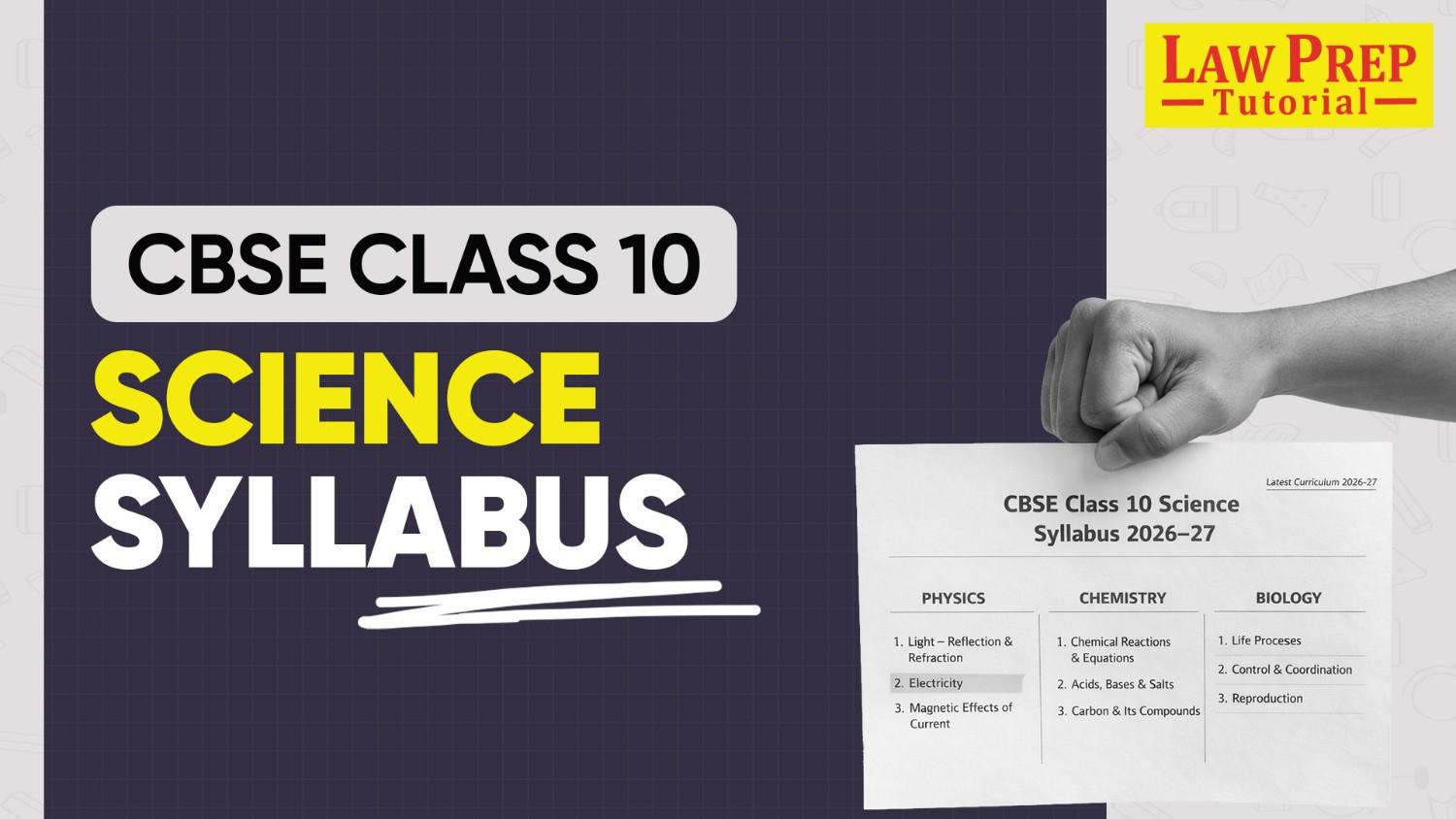

The CBSE Class 10th Science syllabus is not just about memorising formulas or definitions for exams. It helps you understand how the natural and physical world works and how scientific ideas apply in everyday life. When you build clear concepts and practise regularly, you can solve problems accurately and improve your overall score in the board exam.
CBSE designs the Science syllabus as an integrated subject that combines Physics, Chemistry, and Biology. You study topics across themes like Food, Materials, The World of the Living, How Things Work, Moving Things, People and Ideas, Natural Phenomena, and Natural Resources. These themes help you connect different concepts instead of studying each subject separately.
The syllabus includes theory, practical work, experiments, and application-based questions. For example, you may explain a chemical reaction, solve a numerical problem from Physics, or describe a biological process. The course also builds skills like observation, analysis, and scientific reasoning. This guide explains the complete CBSE Class 10th Science syllabus so you can plan your preparation and study with clarity.

CBSE Class 10th Science Syllabus Overview
The CBSE Class 10th Science syllabus gives you a clear direction for your board exam preparation. It shows you how the subject is organised into units and which areas carry more weight, so you can plan your study time effectively.
The course is divided into key units that cover different areas of Science. In Chemical Substances, Nature and Behaviour, you study reactions, equations, and properties of materials. In World of Living, you learn about life processes, control systems, and reproduction. Natural Phenomena explains concepts like light and its effects, while Effects of Current focuses on electricity and its applications. Natural Resources helps you understand environmental issues and the sustainable use of resources.
The syllabus follows a competency-based approach as per the National Curriculum Framework 2023. You not only learn concepts but also apply them through experiments, observations, and problem-solving activities.
The theory paper carries 80 marks and covers the entire syllabus with objective, short, and long-answer questions. The remaining 20 marks come from internal assessment, which includes periodic tests, classroom activities like quizzes or projects, and practical or laboratory work completed during the year.
Below are the major highlights that define the CBSE Class 10th Science syllabus assessment.
| Unit Number | Name of Unit | Alloted Marks |
| I | Chemical Substances-Nature and Behaviour | 25 |
| II | World of Living | 25 |
| III | Natural Phenomena | 12 |
| IV | Effects of Current | 13 |
| v | Natural Resources | 05 |
| Internal Assessment | 20 | |
| Grand Total | 100 |
Must Checkout CBSE 10th Result 2026
CBSE Board Science Syllabus for Class 10th 2026-27 PDF
The CBSE board Science syllabus for class 10th PDF gives you a clear idea of what to study and what to skip. Instead of guessing topics, you can follow the exact structure set by CBSE and prepare with confidence.
CBSE Science Class 10th PDF includes section-wise details, marking scheme, prescribed books, and internal assessment components in one place. Such a structure helps you plan your preparation in a focused and organised way.
Detailed CBSE Class 10th Science Syllabus (Unit wise and Chapter wise)
The CBSE Class 10th Science syllabus is organised into units that cover Chemistry, Biology, and Physics in a structured way. Each unit focuses on specific concepts and builds your understanding step by step. When you study unit-wise, you can connect topics easily and prepare more effectively for exams.
The syllabus moves from chemical reactions and materials to life processes, then to physical concepts like light and electricity, and finally to environmental studies. For example, you first learn how substances react, then how living organisms function, and later how light and current behave in real life. This progression helps you develop both conceptual clarity and application skills.
Below is a detailed unit-wise and chapter-wise table that shows what you need to study in each part of the syllabus.
| Unit | Chapters for CBSE Class 10th Science | Important Topics Covered |
| Unit I: Chemical Substances-Nature and Behaviour | Chemical Reactions and Equations | – Types of reactions (combination, decomposition, displacement, double displacement), – Balanced equations, – Oxidation and reduction, – Exothermic and endothermic reactions |
| Acids, Bases and Salts | pH scale, – Properties of acids and bases, – Indicators, neutralisation, – Uses of common compounds like bleaching powder, – Baking soda, – Washing soda, – Plaster of Paris | |
| Metals and Non-metals | – Physical and chemical properties, – Reactivity series, – Ionic compounds, – Corrosion and prevention, – Basic metallurgy | |
| Carbon and its Compounds | – Covalent bonding, – Hydrocarbons, – Homologous series, – Functional groups, – Properties of ethanol and ethanoic acid, – Soaps and detergents | |
| Unit II: World of Living | Life Processes | – Nutrition, – Respiration, – Transportation, – Excretion in plants and animals |
| Control and Coordination | – Nervous system, – Hormones, – Reflex actions, – Plant movements (tropic movements) | |
| Reproduction | – Asexual and sexual reproduction, – Reproductive health, – Family planning, – HIV/AIDS awareness | |
| Heredity and Evolution | – Mendel’s laws, – Inheritance of traits, – Sex determination, – Basics of evolution | |
| Unit III: Natural Phenomena | Light – Reflection and Refraction | – Spherical mirrors, – Mirror formula, – Magnification, – Refraction laws, – Lenses, – Power of lens, – Human eye and defects |
| Light – Dispersion and Scattering | – Prism, – Dispersion of light, – Scattering, – Real-life applications | |
| Unit IV: Effects of Current | Electricity | – Ohm’s law, resistance, – Resistivity, – Series and parallel circuits, – Heating effect, – Electric power |
| Magnetic Effects of Current | – Magnetic field, – Field lines, – Electromagnetism, – Fleming’s Left Hand Rule, – AC vs DC, – Domestic circuits | |
| Unit V: Natural Resources | Our Environment | – Ecosystem, – Environmental problems, – Ozone depletion, – Waste management, – Biodegradable and non-biodegradable substances |
Preparing for IPMAT? Learn from the experts with leading Online IPMAT Coaching in India.
CBSE Board Class 10th Science Practical Syllabus and Internal Assessments
The practical syllabus helps you apply what you learn in theory classes. You perform experiments, observe results, and record your findings. This process improves your understanding of concepts like reactions, electricity, and life processes.
Practical work also forms an important part of your internal assessment. You carry out experiments throughout the year, maintain a record file, and perform activities in the lab. These tasks help you build accuracy, observation skills, and confidence during exams.
The table below lists all the prescribed experiments along with their respective units for better clarity.
| Experiment Number | Unit Number | Experiment for Class 10 CBSE |
| 1A | Unit I | Finding pH using pH paper/universal indicator (HCl, NaOH, Ethanoic acid, Lemon juice, Water, Hydrogen carbonate) |
| 1B | Unit I | Studying properties of acids and bases using litmus, zinc metal, and sodium carbonate |
| 2 | Unit I | Observing and classifying reactions (combination, decomposition, displacement, double displacement) |
| 3 | Unit I | Observing reactions of Zn, Fe, Cu, Al with salt solutions and arranging reactivity order |
| 4 | Unit IV | Studying relation between potential difference and current; plotting V-I graph |
| 5 | Unit IV | Determining equivalent resistance in series and parallel combinations |
| 6 | Unit II | Preparing temporary mount of leaf peel to show stomata |
| 7 | Unit II | Showing release of CO₂ during respiration |
| 8 | Unit I | Studying properties of acetic acid (odour, solubility, litmus effect, reaction) |
| 9 | Unit I | Comparing cleaning capacity of soap in soft and hard water |
| 10 | Unit III | Determining focal length of concave mirror and convex lens |
| 11 | Unit III | Tracing path of light through rectangular glass slab |
| 12 | Unit II | Studying binary fission and budding using slides |
| 13 | Unit III | Tracing path of light through a glass prism |
| 14 | Unit II | Identifying parts of a dicot seed embryo |
Also checkout CBSE Full Form here!
Internal Assessment Structure for Class 10th Science
The internal assessment helps you track your progress throughout the year rather than relying solely on the final exam. It evaluates your understanding through tests, activities, and practical work, so you stay consistent with your preparation.
The assessment carries 20 marks and includes different components that focus on both theoretical understanding and practical application. The table below shows the complete breakdown of marks and components included in internal assessment.
| Components of Internal Assessment | Details for CBSE Board Class 10th Science | Alloteed Marks |
| Periodic Tests | Best two out of three tests are considered for final calculation | 5 |
| Multiple Assessment | Activities like quizzes, projects, presentations, and concept maps | 5 |
| Practical Work | Experiments conducted in the lab with proper records | 5 |
| Portfolio | Overall work, assignments, and progress throughout the year | 5 |
| Total Marks | 20 |

Also checkout CBSE Class 10th all details now!
CBSE Class 10th Science Deleted Syllabus
CBSE has reduced certain topics from the Class 10th Science syllabus to make your preparation more focused and manageable. When you know exactly what has been removed, you can avoid unnecessary chapters and spend more time on scoring topics.
Below is the Class 10th CBSE Science topics that are no longer part of the current syllabus.
| CBSE Deleted Chapter for Class 10th | Details of Deleted Content |
| Periodic Classification of Elements | Full chapter removed |
| Heredity and Evolution | Chapter renamed to Heredity; topics related to evolution such as Darwin’s theory, origin of life, speciation, fossils, human evolution, molecular phylogeny, and acquired traits removed |
| Human Eye and Colourful World | Explanation of colour of the sun at sunrise and sunset removed |
| Sustainable Management of Natural Resources | Full chapter removed |
| Sources of Energy | Full chapter removed |
| Electricity & Magnetic Effects of Current | Some minor boxes and in-text topics removed |
Check the latest CBSE Class 10th syllabus for all subjects below:
NCERT Books for Class 10th Science
NCERT books form the foundation of your CBSE Class 10th Science preparation. You should rely on these resources to understand concepts, practise questions, and prepare for both theory and practical exams.
Below are the important NCERT and CBSE-recommended books for Class 10th Science.
| NCERT Books for Class 10 Science | Title of the Book | Publisher |
| Science Textbook for Class X | Vigyan (विज्ञान) | NCERT |
| Science Exemplar Problems Class X | Vigyan Exemplar Samasyaen | NCERT |
| Laboratory Manual Science Class X | Vigyan Prayogshala Pustika | NCERT |
The CBSE Class 10th Science syllabus gives you a clear roadmap for your board exam preparation. It organises topics from Physics, Chemistry, and Biology into structured units, helping you focus on what matters most and manage your time effectively.
As you study, you start connecting scientific concepts with real-life situations, which makes learning more meaningful and easier to remember. This approach not only improves your understanding but also helps you answer application-based questions confidently.
To perform well, rely on NCERT books, practise numericals and diagrams regularly, and revise each unit multiple times. Also, give importance to practical work and internal assessment, as they contribute to your final score. With consistent effort and a clear strategy, you can cover the syllabus smoothly and approach your exam with confidence.
Checkout more important resources for the CBSE Exam here:
| CBSE Class 11th Syllabus | CBSE Class 12th Syllabus |
| CBSE Class 11th: All details | CBSE Class 11th Commerce Subjects |
| CBSE Class 11th Hornbill | CBSE Class 11th Commerce Books |
FAQs on CBSE Class 10th Science Syllabus
Class 10th CBSE Science covers concepts from Physics, Chemistry, and Biology. The course includes units such as Chemical Substances, World of Living, Natural Phenomena, Effects of Current, and Natural Resources. Each unit helps you understand scientific concepts and their real-life applications.
The Class 10th Science course is divided into five main units. Each unit focuses on a specific area of Science and builds your understanding step by step. This structure helps you plan your preparation in a clear and organised way.
CBSE board Class 10th Science follows a total of 100 marks. The theory examination carries 80 marks. Internal assessment carries 20 marks and includes periodic tests, practical work, and subject-related activities.
Class 10th CBSE Science includes five units. Each unit has a fixed weightage in the examination. This distribution helps you decide how much time to allocate to each unit.
The Class 10th CBSE Science syllabus provides a clear outline of topics and marks distribution. The syllabus helps you focus on important areas and avoid unnecessary content. Regular study based on the syllabus improves accuracy and confidence.
Class 10th Science includes practical work based on key concepts from Physics, Chemistry, and Biology. Students perform experiments, record observations, and complete lab activities. Practical work also contributes to internal assessment marks.
Units such as Chemical Substances and World of Living usually carry higher weightage in CBSE board Class 10th Science. Strong preparation in these units can improve overall performance in the examination.
The Central Board of Secondary Education has reduced certain topics to make learning more focused. Chapters such as Periodic Classification of Elements and Sources of Energy are not included in the current Class 10th CBSE Science course.
Class 10th CBSE Science includes around 14 prescribed experiments. These experiments cover important concepts from all three branches of Science and form a key part of internal assessment.
The official syllabus PDF is available on the website of the Central Board of Secondary Education. The document provides detailed unit-wise topics, marking scheme, and preparation guidelines.
Check the latest CBSE Class 11 syllabus for all subjects below:
Discover CLAT exam resources that can help you get started early:
Explore CLAT coaching centers across different cities: