
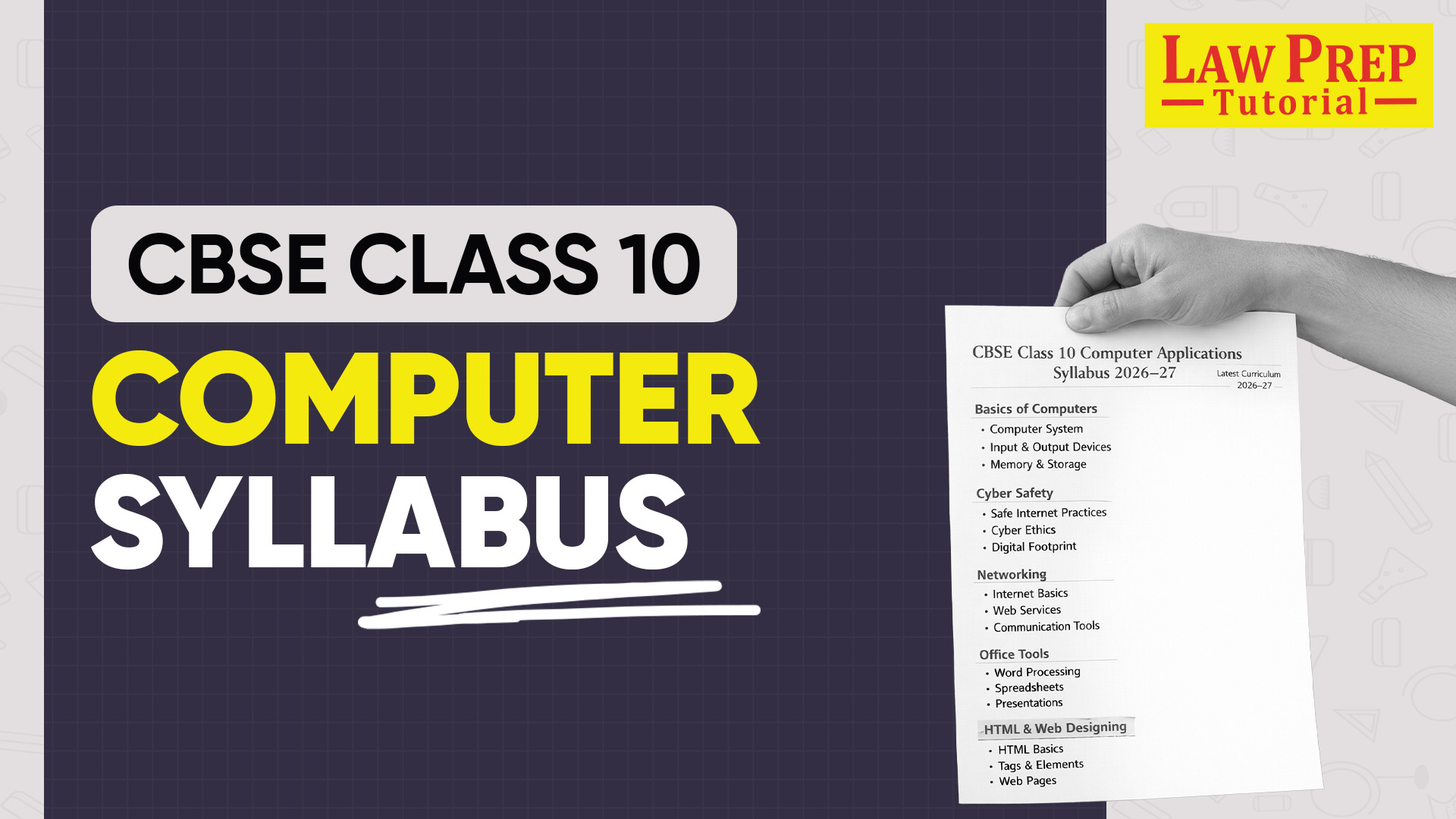

CBSE Class X Computer Syllabus introduces you to the basics of how computers work and how technology supports everyday tasks. As you prepare for the CBSE Exam, the subject goes beyond theory and helps you understand how to use digital tools, manage data, and solve simple problems using logical thinking.
The syllabus covers areas such as computer fundamentals, programming concepts, data handling, and practical applications. You learn how to write basic programs, understand input and output processes, and work with real data. Practical sessions play an important role, as regular practice helps you apply concepts clearly. The exam pattern for the CBSE Class 10th includes theory, practical work, and internal assessment based on projects and assignments.
This guide explains each part of the CBSE Class 10th Computer syllabus in a clear and structured way. You will find important topics, practical components, and details related to the exam, so you can prepare with better understanding and confidence.

CBSE Class 10 Syllabus for Computer Science
CBSE Class 10th Computer Syllabus Chapter-wise Weightage helps you understand how marks are distributed across different units in both Computer Applications (Code 165). A clear view of weightage allows you to focus more on high-scoring areas and plan your preparation in a structured way.
Both subjects carry 100 marks, divided equally between theory (50 marks) and practical (50 marks). However, the learning approach differs. Computer Applications focuses more on web development and HTML-based concepts, while Information Technology focuses on practical tools like LibreOffice and workplace skills.
To make preparation easier, the combined table below gives a complete breakdown of units, marks, and key focus areas.
| CBSE Class 10th Computer Science Syllabus | |||
| Part | Chapter / Unit Name | Marks | Weightage |
| Theory | Unit 1: Networking | 15 | 30% |
| Unit 2: HTML + CSS | 25 | 50% (Highest) | |
| Unit 3: Cyber Ethics | 10 | 20% | |
| Total (Theory) | 50 | 100% | |
| Practical | Lab + Project + Viva | 50 | — |
Must Checkout CBSE 10th Result 2026
CBSE Class 10th Computer Syllabus PDF
Before starting your preparation, download the latest CBSE Class 10th Computer syllabus from the official website. The official syllabus gives you a clear idea of topics, unit-wise weightage, and exam structure. A downloaded copy helps you track your progress and avoid studying topics that are not required.
CBSE Class 10th Syllabus for Computer Science
Computer Applications focuses on concepts such as networking, web development using HTML and CSS, and cyber ethics. HTML and CSS carry higher weightage, so regular practice in creating web pages helps improve scores. Networking builds understanding of how the internet works, while cyber ethics develops awareness about responsible use of technology.
To understand how marks are distributed across different units, refer to the table below in the CBSE Class 10th Syllabus for Computer Science.
Unit 1: Networking
Unit 1 in the CBSE Class 10th Syllabus for Computer Science explains how computers connect and share information through networks. Internet works as a global system that links users, websites, and services. Learning networking concepts helps you understand how online platforms operate and how communication takes place in real time.
Knowledge of networking supports better use of digital tools such as email, search engines, and mobile applications. Understanding these concepts also helps in identifying how data moves between devices and systems.
The table below organises the networking topics in a clear and structured format.
| Topics for CBSE Class 10th | Details of the Topics |
| Internet | • World Wide Web (WWW) connects web pages across the globe • Web servers store data and web clients access information • Websites contain multiple web pages • Web browsers display content • Blogs and news groups support sharing ideas |
| Addressing and Data Transfer | • Web address (URL) identifies location of a website • E-mail address helps send and receive messages • Uploading sends data to a remote system • Downloading retrieves data from remote systems |
| Internet Protocols | • TCP/IP manages communication between devices • HTTP and HTTPS enable web page access • SMTP and POP3 manage email sending and receiving |
| Remote Login and File Transfer | • SSH provides secure access to remote systems • SFTP and FTP transfer files between systems • SCP copies files securely • TELNET allows remote login access |
| Internet Services | • Information retrieval allows access to online data • Search engines help locate websites • Online tools help find people and information |
| Web Services | • Chat and email enable communication • Video conferencing supports virtual meetings • e-Learning platforms support education • e-Banking and e-Shopping support transactions • e-Reservation and e-Governance provide services • Social networking connects users |
| Mobile Technologies | • SMS and MMS support message sharing • 3G, 4G, and 5G improve speed and connectivity • Mobile networks enable internet access on devices |

Unit 2: HTML
Unit 2 in the CBSE Class 10th Syllabus for Computer Science focuses on web page designing using HTML. HTML helps you create and structure web pages so that browsers can display content correctly. Learning HTML builds a basic understanding of how websites are designed.
The unit starts with simple page creation and moves towards adding formatting, images, forms, and styles. Regular practice helps you understand how each tag changes the appearance of a web page.
The table below breaks the HTML topics into clear sections for easy understanding.
| Topics for CBSE Class 10th | Details of the Topics |
| Introduction to HTML | • Create and save an HTML document • Open and view a web page using a web browser |
| Basic HTML Tags | • Structure tags: html, head, title, body • Body attributes: text, background, bgcolor, link, vlink, alink • Line break (br) and horizontal rule (hr) • Comments in HTML |
| Text Formatting | • Headings: h1 to h6 • Paragraph (p) • Bold (b), italic (i), underline (u) |
| Lists | • Unordered list (ul) and ordered list (ol) • List item (li) • Description list: dl, dt, dd • Attributes: start, type (ol), type (ul) |
| Font and Styling | • Font tag with attributes: face, size, color |
| Images and Text Effects | • Insert images using img tag (src, width, height, alt) • Superscript (sup) and subscript (sub) |
| HTML Forms | • Textbox and password fields • Radio buttons and checkboxes • List and combobox |
| Multimedia | • Embed audio and video in a web page |
| Tables | • Table creation using table, tr, th, td • Rowspan and colspan |
| Links | • Importance of linking web pages • Anchor tag with href and mailto • Target attribute |
| Cascading Style Sheets (CSS) | • Colour and background-colour • Border-style and outline • Margin, height, width • Font: family, style, size • Alignment and float |
Also checkout CBSE Full Form here!
Unit 3: Cyber Ethics
Unit 3 in the CBSE Class 10th Syllabus for Computer Science focuses on responsible and safe use of digital technologies. Increasing use of online platforms for communication, learning, and transactions makes ethical awareness important. Understanding these concepts helps you protect personal information and respect digital content.
Awareness of rights, responsibilities, and risks supports better decision-making while using online platforms. Knowledge of cyber ethics also helps in avoiding issues such as plagiarism, misuse of data, and online fraud.
The table below presents cyber ethics topics in a structured format.
| Topics for CBSE Class 10th | Details of the Topics |
| Netiquettes | • Rules for polite and respectful communication online • Avoiding offensive language and spam • Maintaining clarity and professionalism in messages |
| Software Licenses and Open Source | • Meaning of software licenses • Differences between free and paid software • Open source software and community-driven development |
| Intellectual Property Rights | • Ownership of digital content • Plagiarism and copying without permission • Digital property rights and fair use |
| Freedom of Information and Digital Divide | • Access to information online • Unequal access to technology among different groups • Impact of limited internet access on education and growth |
| E-commerce and Security | • Online buying and selling platforms • Privacy concerns in digital transactions • Risks such as fraud and data theft • Importance of secure data transmission |
Lab Exercises
Lab Exercises in the CBSE Class 10th Syllabus for Computer Science focus on practical application of HTML and related concepts. Regular practice helps you understand how code converts into a visible web page. Each task builds your ability to design, organise, and present content clearly.
Working on lab activities also improves problem-solving skills. Combining elements such as text, images, and forms helps you create complete and functional web pages.
The table below outlines the lab activities in a structured format.
| List of Lab Exercises Activities for CBSE Class 10th Computer Syllabus | Details of the Lab Exercises Activities |
| Create Static Web Pages | • Design simple web pages using basic HTML structure • Add headings, paragraphs, and formatting elements |
| Apply CSS Styling | • Use style sheets to control layout and appearance • Maintain consistent design across pages |
| Add Multimedia Elements | • Embed images using img tag • Insert audio and video into web pages |
| Work with Tables and Frames | • Create tables using rows and columns • Organise content clearly using table structure |
| Enhance Visual Design | • Decorate pages with colours, fonts, and graphical elements • Improve readability and presentation |
| Build a Website | • Create multiple linked web pages • Use any open source or proprietary tool for development |
| Design HTML Forms | • Add textbox, password field, radio buttons, and checkboxes • Include list and combo box for user input |
| Create Blog Pages | • Develop a blog using HTML pages • Write content on viruses, malware, spam, and antivirus tools |
| Web Page on Plagiarism | • Create a page explaining plagiarism • Include real cases and consequences • Describe punishments in different countries based on intellectual property laws |
Preparing for IPMAT? Learn from the experts with leading Online IPMAT Coaching in India.
Class 10th Computer Application Syllabus 2027-28: Deleted and Added Topics
The CBSE Class 10th Computer syllabus for 2027–28 remains the same. There are no new chapters added and none removed, so you can study without worrying about changes.
Computer Applications (Code 165) will continue with the same topics. You will cover networking, HTML, cyber ethics, digital documents, spreadsheets, and databases.
Some difficult topics were already removed earlier and are still not included:
- Advanced networking models (client-server, peer-to-peer)
- Deep internet structure details
- System-level configurations
The exam pattern now focuses more on practical understanding. You will see:
- Case-based questions
- More project work and viva
- Application-based questions
- Use of LibreOffice tools (for IT)
Focus more on practice, especially HTML and CSS, as they carry high marks.
Check the latest CBSE Class 10th syllabus for all subjects below:
CBSE Board Class 10th Computer Practical Syllabus
CBSE Class 10th Computer Applications practical syllabus focuses on building real digital skills through regular practice. Practical marks carry 50 out of 100, so consistent hands-on work directly improves your final result.
The syllabus centres around HTML and CSS, where you learn to create functional web pages. You design pages using headings, images, tables, and forms, and then improve layout using styling. Project work connects these skills with real situations, such as creating simple websites that follow proper structure and design.
Practical skills developed through HTML, CSS, and project work are evaluated through different components in the exam. To see how marks are divided, refer to the table below.
| Components of CBSE Board Class 10th Computer Practical Syllabus | Allotted Marks |
| Lab Test – Word Processing – Handling Spreadsheets- Creating Presentations | 30 |
| – Report File- Viva Voce | 10 |
| – Project | 10 |
| Total Marks | 50 |
Checkout more important resources for the CBSE Exam here:
| CBSE Class 11th Syllabus | CBSE Class 12th Syllabus |
| CBSE Class 11th: All details | CBSE Class 11th Commerce Subjects |
| CBSE Class 11th Hornbill | CBSE Class 11th Commerce Books |
Class 10th CBSE Computer Books
Choosing the right books for Class 10th Computer helps you cover both theory and practical work in a structured way. Good books follow the CBSE syllabus and include examples, exercises, and practical tasks, so you can prepare for both written exams and lab work.
Most recommended books focus on HTML, CSS, web development, and cyber ethics for Computer Applications, along with practical-based learning. A balanced book helps you understand concepts and also practice questions that appear in exams.
To help you choose the right resource, here are some of the most recommended books aligned with the CBSE syllabus
| Class 10th CBSE Computer Book Title | Author |
| Computer Applications Textbook | Sumita Arora (Dhanpat Rai) |
| Computer Applications Class X | S. Chand (Tiwari et al.) |
| All-in-One Computer Applications | Arihant Publications |
| Computer Masti Level 10th | Next Education |
Supplementary Resources for Class 10th CBSE Computer Books
Along with textbooks, additional resources can improve your preparation:
- Free PDFs from CBSE and NCERT websites for syllabus reference
- Online notes and chapter-wise summaries for quick revision
- Video lectures that explain topics step by step
- Practice questions and sample papers for exam readiness
FAQs on CBSE Class 10th Computer Syllabus
CBSE offers two subject options: Computer Applications (Code 165) and Information Technology (Code 402). Computer Applications covers networking, HTML, and cyber ethics. Information Technology focuses on practical tools such as LibreOffice Writer, Calc, and Base, as well as workplace skills.
Each subject in CBSE Class 10th Computer carries 100 marks in total. The theory paper is worth 50 marks, and the practical work is worth 50 marks. Strong performance in practical components such as project, lab test, and viva improves the overall score.
HTML with CSS carries 25 marks in Computer Applications. Database Management carries 12 marks in Information Technology and has the highest weightage in Part B.
Questions for Computer Theory include definitions, short answers, and case-based questions. Computer Applications asks about HTML structure, networking concepts, and cyber safety. Information Technology asks about Writer, Calc, Base, and data-related concepts.
Computer Practical includes four parts. Lab test requires creating a web page or performing software tasks. The project requires a real-life task using HTML or LibreOffice tools. The practical file includes completed exercises. Viva includes questions based on file and project.
Programming is not required for Computer Application in CBSE Computer. Students can use basic HTML tags like, <html>, <table>, and <form>. CSS is used to style web pages with properties such as colour and layout.
Scoring depends on practice. Computer Applications becomes easier with HTML practice. Information Technology becomes easier with regular work on software tools.
Project work carries 10 marks. You may create a small HTML website or prepare a case study using Writer, Calc, and Base. The project also helps you answer viva questions.
Recent syllabus updates do not include new topics or removals. The structure remains the same, so you can prepare using the current syllabus.
To prepare best for the CBSE Computer Class 10th exam, focus on high-weightage topics like HTML and Database. Practice practical tasks regularly. Complete your practical file on time. Revise key concepts before the exam.
Check the latest CBSE Class 11 syllabus for all subjects below:
Discover CLAT exam resources that can help you get started early:
Explore CLAT coaching centers across different cities: