

The Constitution of India is the foundation of our country and the set of rules that guides how India functions. It tells us about the rights of citizens, duties, powers of the government, and the system through which the country is run. The Indian constitution was adopted on 26 November 1949 and came into effect on 26 January 1950, which we celebrate as Republic Day every year.
Dr. B.R. Ambedkar is known as the Father of the Indian Constitution because of his major role in drafting it. Today, the Constitution of India has 25 Parts, 448 Articles, 12 Schedules, and 100+ amendments.
The Constitution of India preamble gives the basic values and vision of the nation, such as justice, liberty, equality, and fraternity. Below, you’ll understand its history, structure, important features, articles, amendments, and why it plays an important role.
What is the Constitution of India?
The Indian Constitution is the highest law of the country that sets the framework for how India is governed. It acts like a guidebook that explains how different institutions, authorities, and systems should work together. It defines the powers of the government and also creates a balance so that no single authority gets unlimited power.
India needed a Constitution after independence because the country required a common set of rules to unite people from different regions, languages, cultures, and backgrounds. It also helped build a democratic system where citizens have rights, responsibilities, and equal opportunities.
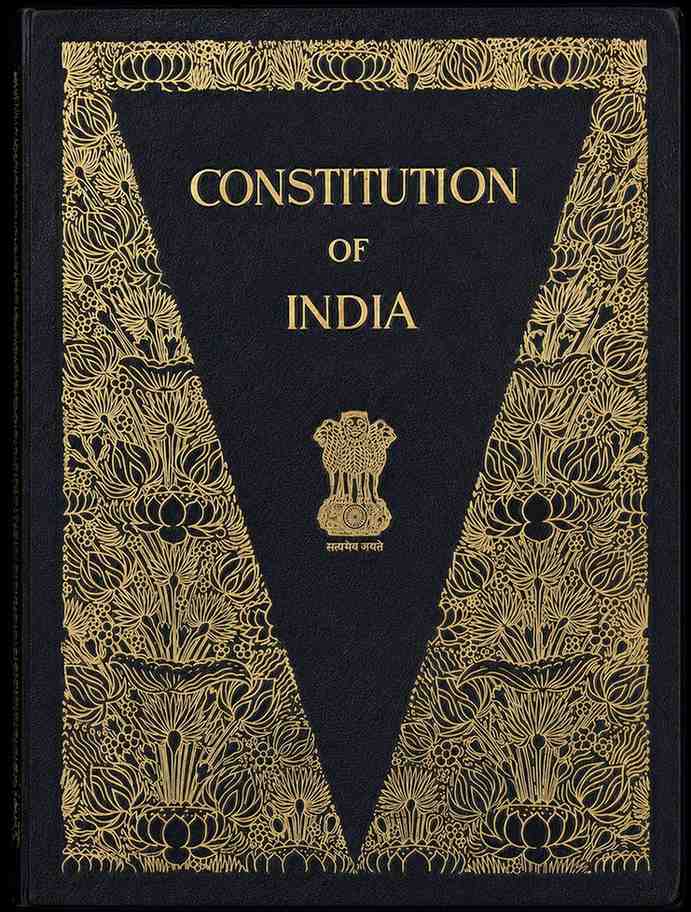
Key Highlights of the Constitution of India
These are the most important things to know about the Indian Constitution:
| Particular | Details |
| Official Name | Constitution of India |
| Name in Hindi | भारत का संविधान |
| Nature | Sovereign, Socialist, Secular, Democratic Republic |
| Adopted On | 26 November 1949 |
| Came Into Effect | 26 January 1950 |
| Drafting Committee Chairman | Dr. B.R. Ambedkar |
| Father of Indian Constitution | Dr. B.R. Ambedkar |
| Parts of Indian Constitution | 25 Parts |
| Articles of Indian Constitution | 448 Articles |
| Total Schedules | 12 Schedules |
| Total Amendments | 100+ Amendments |
| Time Taken to Draft | 2 years, 11 months, 18 days |
| Members of Constituent Assembly | 389 (original strength) |
| Original Number of Articles | 395 Articles |
| Original Number of Schedules | 8 Schedules |
| Longest Written Constitution | Yes |
| Original Languages | Hindi and English |
| Source of Ideas | USA, UK, Ireland, Canada, Australia and others |
| Republic Day Connection | Constitution became effective on this day |
| Highest Authority | Constitution of India itself |
Also checkout Facts About Indian Constitution
History of Indian Constitution
From British rule to becoming an independent democratic nation, India went through many important events before getting its Constitution. The journey was not completed in a single day. It took years of discussions, planning, and efforts by many leaders to create a system that could guide the country in the future.
1. Early British Rule and Laws
Before independence, India was ruled by the British government, and many laws were created according to British interests. Rules such as the Regulating Act of 1773, Charter Acts, and Government of India Acts controlled administration in India. However, these laws were primarily enacted by the British for governance, not to grant equal rights or representation to Indian people.
2. Growing Demand for Self-Governance
As freedom movements became stronger, Indian leaders started asking for a system where Indians could govern themselves. People wanted laws made according to India’s needs instead of foreign rule.
Gradually, the demand for a separate Constitution and a democratic government started becoming stronger across the country.
3. Idea of a Constituent Assembly
The idea of creating a Constituent Assembly was first suggested by M.N. Roy in 1934. The purpose was simple: India should have a group of representatives who would create rules and principles for the country’s future. This idea later gained support from many political leaders.
The Constituent Assembly was formed in 1946 to prepare the Constitution for independent India. Members from different regions and communities became part of it. The Assembly held many meetings where important issues like rights, governance, equality, and citizenship were discussed.
4. Drafting Committee and Dr. B.R. Ambedkar’s Role
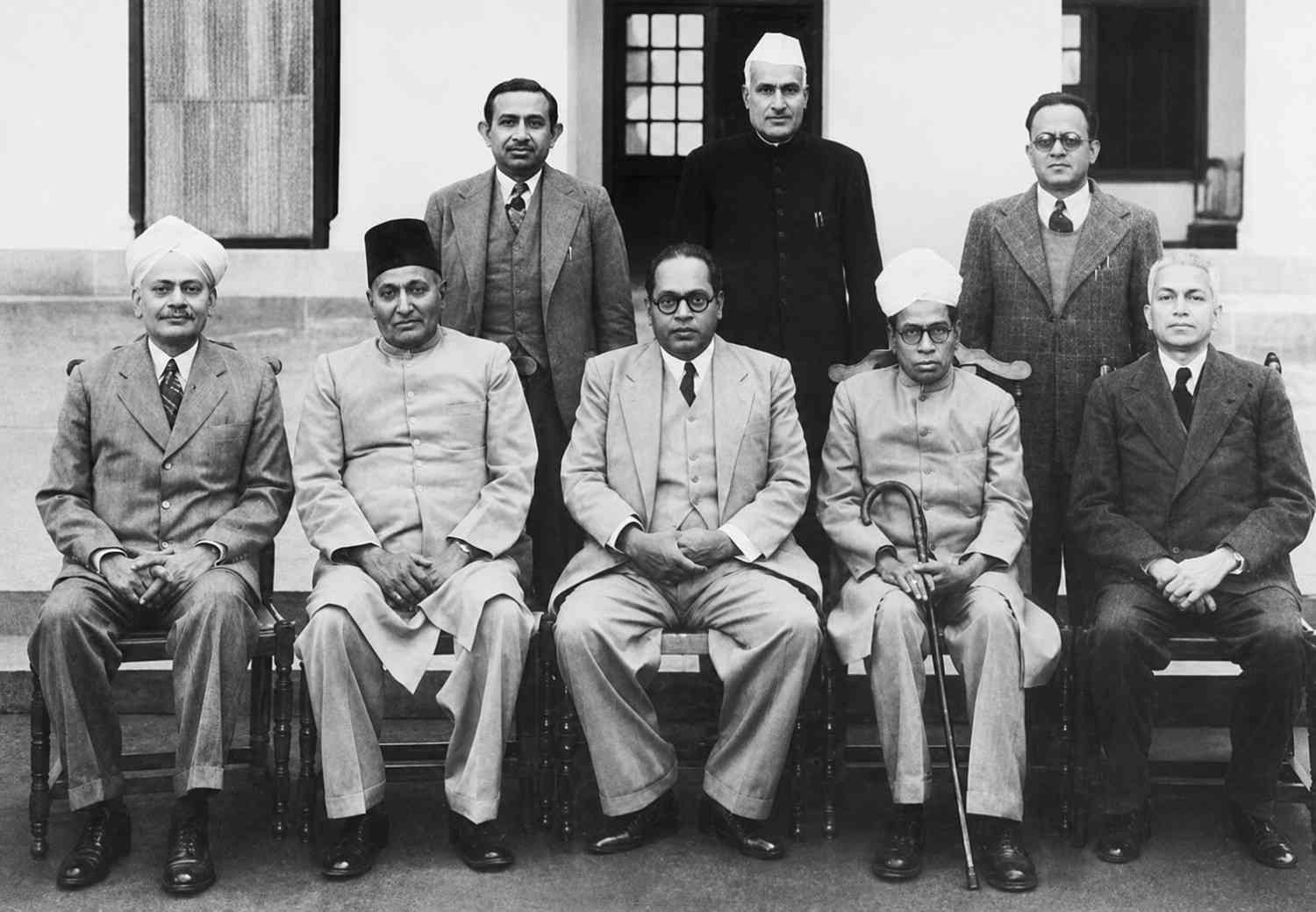
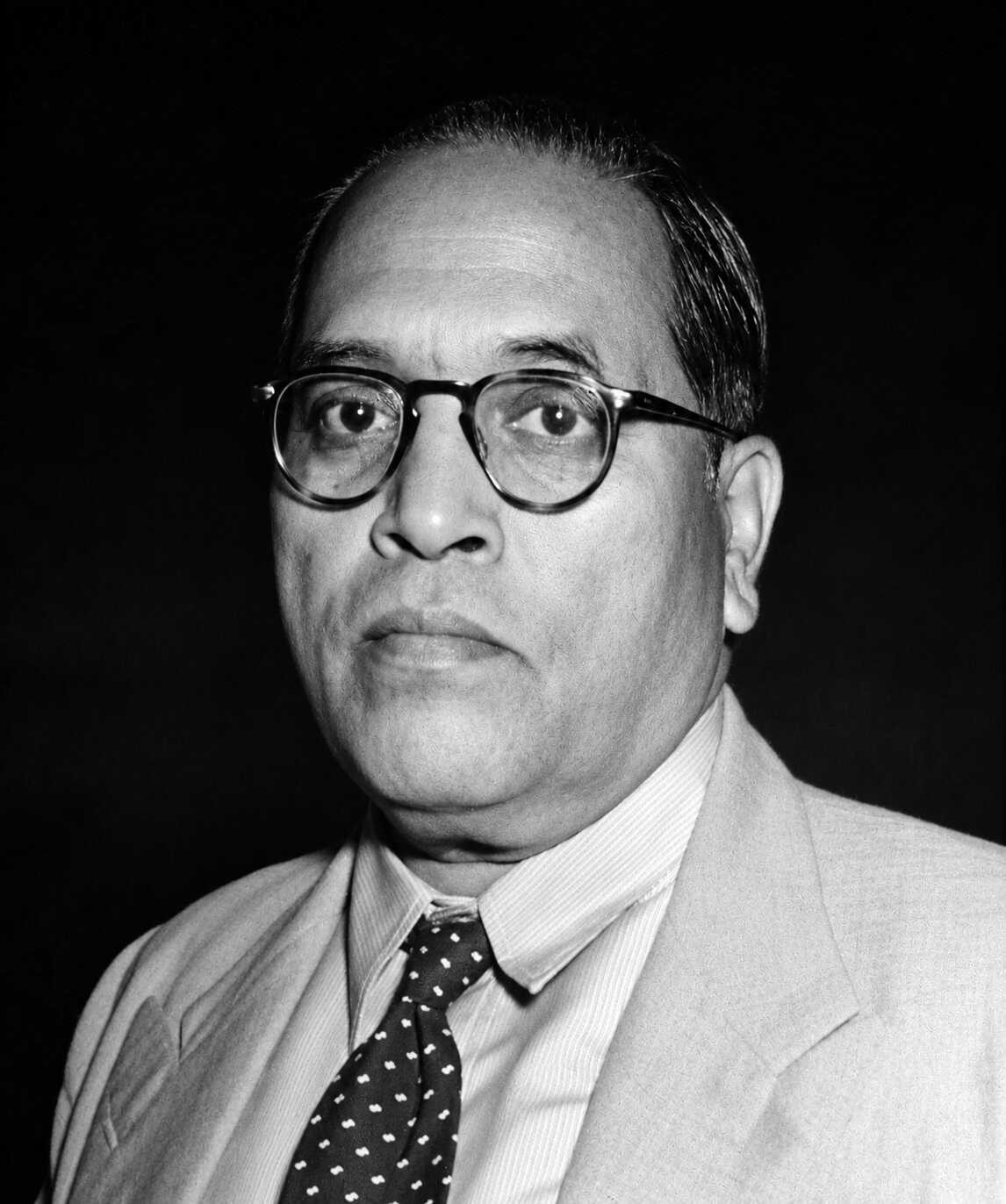
A Drafting Committee of Indian Constitution was created to prepare the final document of the Constitution of India. Dr. B.R. Ambedkar was appointed as the Chairman of this committee. He played a major role in shaping the Constitution and bringing together ideas that would help create a fair system for the country.
5. Long Discussions and Debates
The Constitution of India was not prepared quickly. Members discussed every important point carefully. Debates were held on topics like fundamental rights, powers of states, elections, and responsibilities of citizens. Different opinions were considered before final decisions were taken.
6. Adoption of the Indian Constitution
After nearly three years of work, the Constitution of India was finally adopted on 26 November 1949. This day is now observed as Constitution Day in India. The final document reflected the vision of creating a democratic nation with equal opportunities for all citizens.
7. Constitution Comes Into Effect
The Constitution of India officially came into force on 26 January 1950. This date was selected because of its connection with the country’s freedom movement and the declaration of Purna Swaraj in 1930. From this day onwards, India became a democratic republic with its own governing system.
Get the complete details about Nani Palkhivala here!
Time Taken to Make Indian Constitution
The Constituent Assembly worked for 2 years, 11 months, and 18 days to complete the Indian Constitution. During this period, members held many meetings and discussions before preparing the final Constitution for India.
Drafting Committee Members of Indian Constitution
This is the list of all members in drafting committee of Constitution of India:
| Member | Position |
| Dr. B.R. Ambedkar | Chairman |
| N. Gopalaswami Ayyangar | Member |
| Alladi Krishnaswami Ayyar | Member |
| K.M. Munshi | Member |
| Mohammad Saadulla | Member |
| B.L. Mitter* | Member |
| D.P. Khaitan* | Member |
Later changes in members:
- B.L. Mitter resigned and was replaced by N. Madhava Rao
- D.P. Khaitan passed away and was replaced by T.T. Krishnamachari
1. Dr. B.R. Ambedkar
Dr. B.R. Ambedkar was the Chairman of the Drafting Committee and played the biggest role in preparing the Constitution of India. He carefully studied constitutions of different countries and helped create a balanced system for India. Because of his contribution, he is called the Father of the Indian Constitution.
2. N. Gopalaswami Ayyangar
He contributed to administrative matters and helped create systems related to government functioning. His experience in public administration helped in shaping important parts of the Constitution.
3. Alladi Krishnaswami Ayyar
He was a respected lawyer who provided legal knowledge during the drafting process. He helped create strong legal foundations and supported many constitutional discussions.
4. K.M. Munshi
K.M. Munshi played an important role in topics related to rights, culture, and national values. He also contributed ideas related to Fundamental Rights.
5. Mohammad Saadulla
Mohammad Saadulla represented different social interests and gave valuable suggestions during discussions on important constitutional matters.
6. B.L. Mitter
B.L. Mitter initially worked as a member of the committee and contributed during the early stages before resigning due to health reasons.
7. D.P. Khaitan
D.P. Khaitan was a well-known legal expert and contributed to discussions related to laws and constitutional structure before his death.
8. N. Madhava Rao
After replacing B.L. Mitter, he continued the committee’s work and supported the drafting process.
9. T.T. Krishnamachari
After replacing D.P. Khaitan, he helped complete the remaining work of the committee and assisted in finalizing the Constitution.
Find more about the Nani Palkhiwala Moot Court Competition
Preamble of Constitution of India
The Preamble of Indian Constitution is called the introduction or identity card of the Constitution because it explains the basic values, goals, and vision of India. It tells us what kind of nation we are and what the Constitution wants to provide to every citizen. The Constitution of India preamble starts with “We, the People of India”, which clearly shows that the Constitution gets its power from the people of the country.
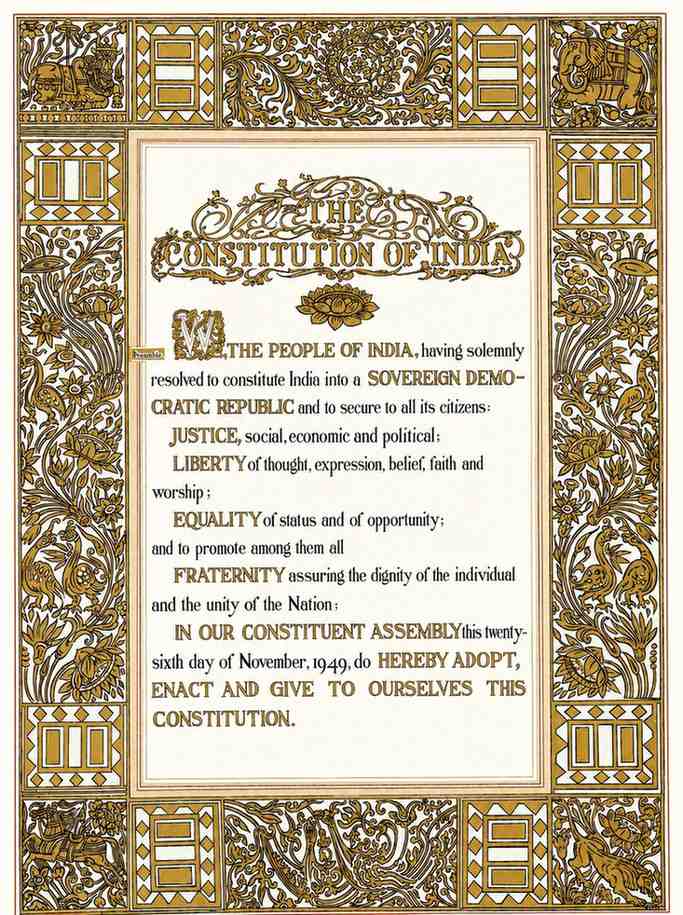
This is the current Preamble of India:
“WE, THE PEOPLE OF INDIA, having solemnly resolved to constitute India into a SOVEREIGN SOCIALIST SECULAR DEMOCRATIC REPUBLIC and to secure to all its citizens:
- JUSTICE, social, economic and political;
- LIBERTY of thought, expression, belief, faith and worship;
- EQUALITY of status and of opportunity;
- and to promote among them all
- FRATERNITY assuring the dignity of the individual and the unity and integrity of the Nation;
- IN OUR CONSTITUENT ASSEMBLY this twenty-sixth day of November, 1949, do HEREBY ADOPT, ENACT AND GIVE TO OURSELVES THIS CONSTITUTION.”
Meaning of Important Words in the Preamble:
- Sovereign: Sovereign means India is completely independent and no other country can control its decisions or government.
- Socialist: Socialist means the country aims to reduce inequality and create fair opportunities so that people from different backgrounds can progress together.
- Secular: Secular means India does not follow or support any one religion as the official religion. Every citizen has the freedom to follow any religion.
- Democratic: Democratic means people choose their representatives through elections and have the right to participate in governing the country.
- Republic: Republic means the head of the country is elected and not chosen through hereditary rule.
- Justice: Justice means every citizen should receive fair treatment in social, economic, and political matters.
- Liberty: Liberty gives people freedom to think, express opinions, practice religion, and live according to their beliefs.
- Equality: Equality means every citizen should get equal treatment and equal opportunities.
- Fraternity: Fraternity means creating a feeling of unity, brotherhood, dignity, and respect among all people in the country.
Checkout the Difference between Act and Law now!
Indian Constitution Salient Features
The following are the salient features of the Constitution of India that help maintain democracy, protect citizens’ rights, and create a balanced system for governing the nation.
1. Lengthiest Written Constitution
The Indian Constitution is the longest written Constitution in the world. It contains detailed rules related to government powers, citizen rights, administration, elections, emergency provisions, and many other matters. Detailed explanations were added to reduce confusion and handle the needs of a diverse country like India.
2. Combination of Rigidity and Flexibility
The Indian Constitution is both rigid and flexible. Some provisions can be changed easily through a simple process, while some important provisions need special approval. This system helps India make necessary changes without affecting the basic structure of the Constitution.
3. Federal System with Unitary Features
India follows a federal system where powers are divided between the Central Government and State Governments. At the same time, during special situations like emergencies, the Central Government gets more authority, giving the Constitution some unitary features as well.
4. Parliamentary Form of Government
India follows a parliamentary system where the Prime Minister and Council of Ministers are responsible for running the government. The President is the constitutional head, while the elected government takes major decisions and remains accountable to Parliament.
5. Single Citizenship
Unlike some countries that have dual citizenship systems, India provides only one citizenship for all citizens. A person living in any state remains an Indian citizen first, helping strengthen national unity and avoid regional divisions.
6. Independent Judiciary
The Constitution of India provides an independent judicial system so that courts can function without pressure from the government. The judiciary protects the Constitution, settles disputes, and ensures that laws and actions remain within constitutional limits.
7. Fundamental Rights for Citizens
The Constitution gives important rights to citizens such as equality, freedom, religious freedom, and protection from exploitation. These rights help people live with dignity and protect them from unfair treatment.
8. Directive Principles of State Policy
Directive Principles are guidelines given to the government for creating laws and policies that improve people’s lives. They aim to promote social welfare, reduce inequality, and build a fair society.
9. Fundamental Duties
Apart from rights, citizens are also given certain responsibilities known as Fundamental Duties. These duties encourage citizens to respect the Constitution, protect national unity, preserve culture, and contribute positively to society.
10. Universal Adult Franchise
Every citizen who is 18 years of age or older has the right to vote without discrimination based on religion, caste, gender, income, or background. This feature ensures equal participation in democracy.
11. Secular Nature of the State
India follows a secular system where no religion receives special treatment from the government. Citizens are free to follow, practice, and promote any religion according to their beliefs.
12. Emergency Provisions
The Constitution of India includes special emergency provisions to handle situations such as war, external threats, internal disturbances, or financial crises. These powers help the government respond quickly during difficult situations.
13. Rule of Law
The Constitution of India follows the principle that everyone is equal before the law. No person, institution, or authority stands above the law, and legal rules apply equally to all citizens.
14. Universal Values and Global Ideas
While creating the Constitution, many ideas were taken from the constitutions of different countries and adjusted according to India’s needs. This helped create a balanced system that combines international ideas with Indian values and conditions.
Discover How to study Law in India here!
Structure of Constitution of India
The Constitution of India is arranged into different Parts, and each Part covers a specific area. Inside these Parts, Articles explain rules and provisions in detail. This structure helps organize the Constitution in a systematic way so important topics can be understood easily.
| Part | Important Articles Covered |
| Part I – Union and its Territory | Article 1 – Name and Territory of India Article 2 – Admission of New States Article 3 – Formation of New States Article 4 – Supplemental Provisions |
| Part II – Citizenship | Article 5 – Citizenship at Commencement Article 6 – Rights of Citizenship of Migrants from Pakistan Article 7 – Rights of Certain Migrants |
| Part III – Fundamental Rights | Article 14 – Equality Before Law Article 15 – Prohibition of Discrimination Article 19 – Freedom Rights Article 21 – Protection of Life and Personal Liberty Article 32 – Constitutional Remedies |
| Part IV – Directive Principles of State Policy | Article 38 – Social Order Article 39 – Principles of Policy Article 44 – Uniform Civil Code Article 48A – Environment Protection |
| Part IV-A – Fundamental Duties | Article 51A – Fundamental Duties of Citizens |
| Part V – The Union | Article 52 – President of India Article 74 – Council of Ministers Article 79 – Parliament Article 124 – Supreme Court |
| Part VI – The States | Article 153 – Governor Article 163 – Council of Ministers of State Article 168 – State Legislature |
| Part VIII – Union Territories | Article 239 – Administration of Union Territories |
| Part IX – Panchayats | Article 243 – Panchayats Definition Article 243B – Constitution of Panchayats |
| Part IX-A – Municipalities | Article 243P – Definitions Article 243Q – Constitution of Municipalities |
| Part IX-B – Cooperative Societies | Article 243ZH – Definitions Article 243ZI – Incorporation of Cooperative Societies |
| Part X – Scheduled and Tribal Areas | Article 244 – Administration of Scheduled Areas |
| Part XI – Relations Between Union and States | Article 245 – Extent of Laws Article 246 – Distribution of Legislative Powers |
| Part XII – Finance, Property, Contracts and Suits | Article 266 – Consolidated Fund of India Article 280 – Finance Commission Article 300A – Right to Property |
| Part XIII – Trade and Commerce | Article 301 – Freedom of Trade and Commerce |
| Part XIV – Services under Union and States | Article 309 – Recruitment and Service Conditions Article 315 – Public Service Commission |
| Part XIV-A – Tribunals | Article 323A – Administrative Tribunals Article 323B – Other Tribunals |
| Part XV – Elections | Article 324 – Election Commission |
| Part XVI – Special Provisions for Certain Classes | Article 330 – Reservation of Seats Article 338 – National Commission for SCs |
| Part XVII – Official Language | Article 343 – Official Language of India Article 351 – Development of Hindi |
| Part XVIII – Emergency Provisions | Article 352 – National Emergency Article 356 – President’s Rule Article 360 – Financial Emergency |
| Part XIX – Miscellaneous | Article 361 – Protection to President and Governors |
| Part XX – Amendment of Constitution | Article 368 – Procedure for Amendment |
| Part XXI – Temporary and Special Provisions | Article 370 – Special Status of Jammu and Kashmir (earlier provision) Article 371 – Special Provisions for States |
| Part XXII – Short Title and Repeals | Article 393 – Short Title Article 394 – Commencement of Constitution |
Note: Part VII was removed after constitutional changes, and several new Parts like Part IV-A, Part IX-A, and Part IX-B were added later through amendments.
Also Read: Republic Feature of Indian Constitution is Borrowed From Which Country?
Schedules of Indian Constitution
The Schedules of the Constitution of India contain additional details and information related to different constitutional provisions. Instead of making the Articles too long, many subjects are explained separately through Schedules. Originally, the Indian Constitution had 8 Schedules, but today it has 12 Schedules.
| Schedule | Details |
| First Schedule | Contains the names of States and Union Territories along with their territorial areas |
| Second Schedule | Contains provisions related to salaries, allowances, and benefits of important constitutional authorities like the President, Governors, Judges, and others |
| Third Schedule | Contains forms of oath and affirmations for ministers, judges, Members of Parliament, and constitutional officials |
| Fourth Schedule | Contains allocation of seats of states and Union Territories in the Rajya Sabha |
| Fifth Schedule | Contains provisions related to administration and control of Scheduled Areas and Scheduled Tribes |
| Sixth Schedule | Contains provisions related to administration of tribal areas in Assam, Meghalaya, Tripura, and Mizoram |
| Seventh Schedule | Contains division of powers between the Central Government and State Governments through Union List, State List, and Concurrent List |
| Eighth Schedule | Contains the list of officially recognized languages of India |
| Ninth Schedule | Contains laws and acts protected from judicial review in certain situations |
| Tenth Schedule | Contains provisions related to disqualification of elected representatives under the Anti-Defection Law |
| Eleventh Schedule | Contains powers, functions, and responsibilities of Panchayats |
| Twelfth Schedule | Contains powers, functions, and responsibilities of Municipalities |
Quick Facts About Schedules:
- Original Constitution: 8 Schedules
- Present Constitution: 12 Schedules
- Ninth Schedule was added through the First Constitutional Amendment Act, 1951
- Tenth Schedule was added through the 52nd Constitutional Amendment Act, 1985
- Eleventh and Twelfth Schedules were added through the 73rd and 74th Constitutional Amendments, 1992
Fundamental Rights in Constitution of India
Fundamental Rights are the basic rights given to every citizen by the Constitution of India. These rights help people live with freedom, dignity, and equality. They also protect citizens from unfair treatment and misuse of power. Fundamental Rights are mainly covered under Articles 12 to 35 of the Constitution.
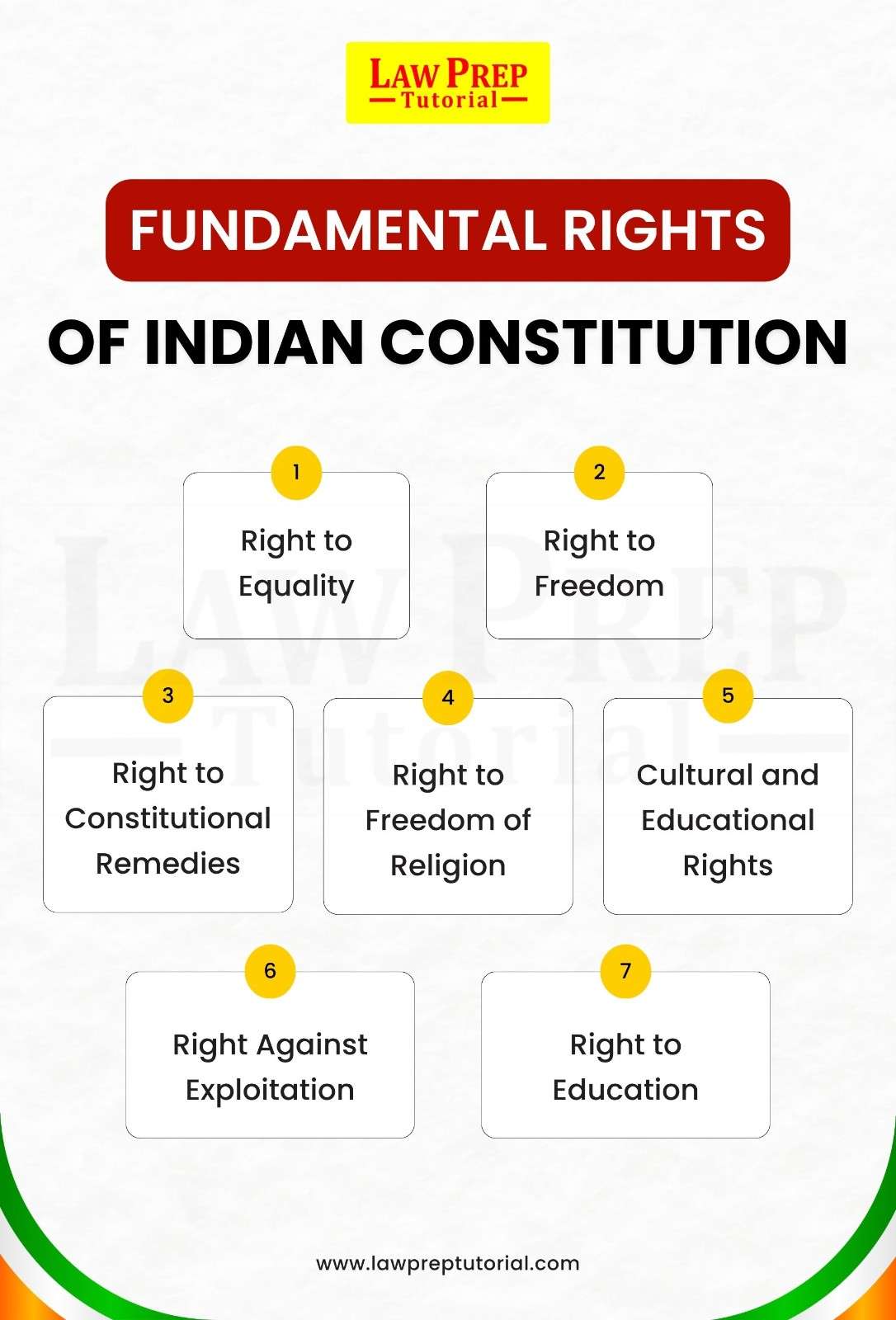
1. Right to Equality (Articles 14–18)
The Right to Equality ensures that every citizen is treated equally before the law. No person can be discriminated against based on religion, caste, race, gender, or place of birth. It also removes practices such as untouchability and gives equal opportunities to everyone.
2. Right to Freedom (Articles 19–22)
The Right to Freedom gives citizens several important freedoms such as freedom of speech and expression, movement, residence, and profession. It also protects people from unlawful arrest and ensures certain legal protections.
3. Right Against Exploitation (Articles 23–24)
This right protects people from forced labor, human trafficking, and child labor. It prevents any person from being used unfairly for work or treated in an inhuman way.
4. Right to Freedom of Religion (Articles 25–28)
India follows a secular system, and this right allows citizens to freely follow, practice, and promote any religion according to their beliefs. At the same time, the government cannot force any person to follow a particular religion.
5. Cultural and Educational Rights (Articles 29–30)
These rights help protect the culture, language, and traditions of minority communities. They also allow minorities to establish and manage educational institutions according to their needs.
6. Right to Constitutional Remedies (Article 32)
This right gives citizens the power to approach courts if any Fundamental Right is violated. Dr. B.R. Ambedkar called Article 32 the “Heart and Soul of the Constitution” because it helps protect all other rights.
7. Right to Education (Article 21A)
The Right to Education was added later through the 86th Constitutional Amendment Act, 2002. It provides free and compulsory education to children between 6 and 14 years of age.
Discover Where the Fundamental Rights of the Indian Constitution were borrowed from.
Directive Principles of State Policy (DPSP) in Indian Constitution
Directive Principles of State Policy are guidelines given to the government for creating laws and policies for the welfare of people. These principles are mentioned in Part IV of the Indian Constitution under Articles 36 to 51. Unlike Fundamental Rights, citizens cannot directly approach courts to enforce them, but they help the government work toward building a fair and better society.
The main purpose of DPSP is to guide the government in making decisions that improve the lives of citizens. These principles aim to reduce inequality, provide social welfare, and create a better standard of living for people.
1. Socialistic Principles
These principles focus on reducing economic inequality and creating social justice. They encourage equal opportunities, fair distribution of resources, better working conditions, and support for weaker sections of society.
2. Gandhian Principles
These principles are inspired by the ideas of Mahatma Gandhi. They focus on village development, promotion of cottage industries, protection of weaker sections, and improving rural life.
3. Liberal and Intellectual Principles
These principles support ideas such as equal justice, international peace, environmental protection, and separation of the judiciary from executive powers. Their goal is to create a balanced and progressive system.
Fundamental Duties of Citizens As per Indian Constitution
Fundamental Duties are the responsibilities that citizens should follow for the development and unity of the country. These duties were added through the 42nd Constitutional Amendment Act, 1976 under Article 51A. At present, there are 11 Fundamental Duties in the Constitution of India.
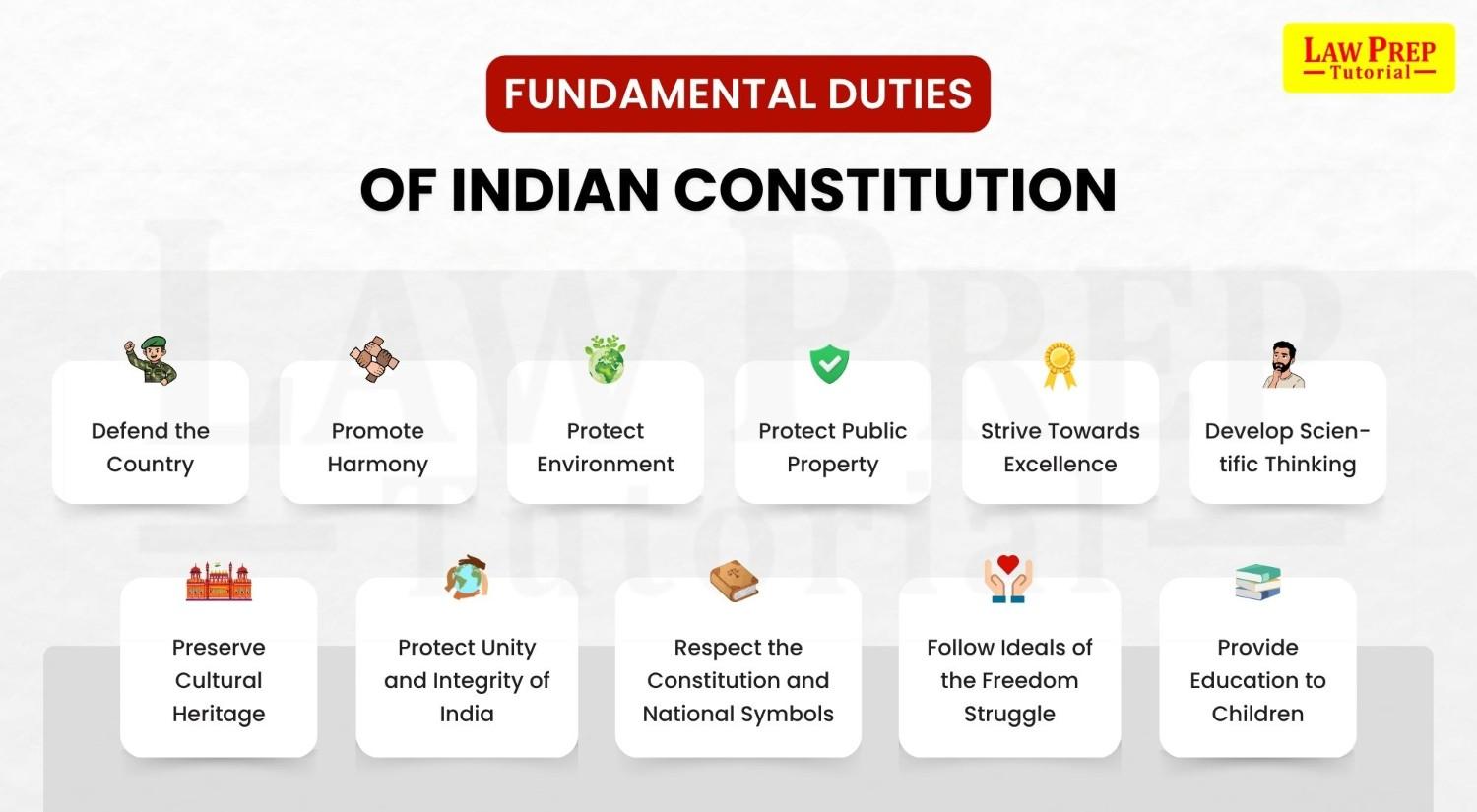
| Fundamental Duty | Meaning |
| Respect the Constitution and National Symbols | Citizens should respect the Constitution, National Flag, and National Anthem |
| Follow Ideals of the Freedom Struggle | Citizens should remember and follow the values that inspired India’s freedom movement |
| Protect Unity and Integrity of India | Citizens should work towards maintaining national unity and integrity |
| Defend the Country | Every citizen should be ready to serve and protect the nation when required |
| Promote Harmony | Citizens should encourage brotherhood and avoid discrimination based on religion, language, caste, or region |
| Preserve Cultural Heritage | Citizens should protect India’s rich culture, traditions, and historical heritage |
| Protect Environment | Citizens should protect forests, rivers, lakes, wildlife, and maintain a healthy environment |
| Develop Scientific Thinking | Citizens should encourage scientific thinking, learning, and a spirit of inquiry |
| Protect Public Property | Citizens should safeguard public property and avoid violence or destruction |
| Strive Towards Excellence | Citizens should continuously work to improve themselves and contribute to the country’s progress |
| Provide Education to Children | Parents or guardians should ensure education for children between 6 and 14 years of age |
Find out Where the Fundamental Duties of the Indian Constitution were borrowed from.
Constitutional Bodies in India
Constitutional Bodies are organizations created directly by the Constitution of India. These bodies perform important duties such as conducting elections, protecting rights, managing finances, and ensuring smooth functioning of the government.
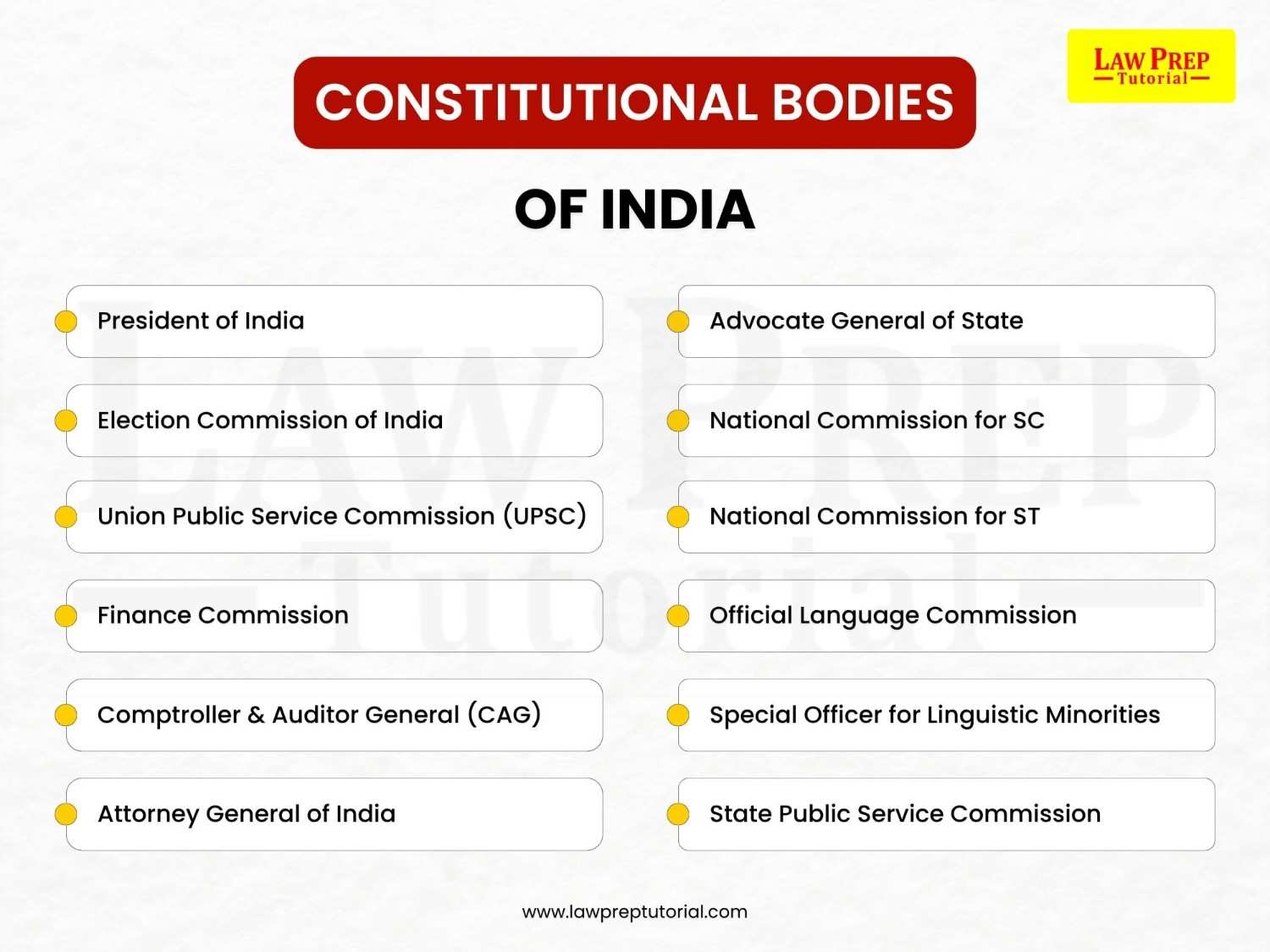
| Constitutional Body | Article | Main Function |
| President of India | Article 52 | Constitutional head of the country and important executive authority |
| Election Commission of India | Article 324 | Conducts free and fair elections in the country |
| Union Public Service Commission (UPSC) | Article 315 | Conducts examinations and recruitment for government services |
| Finance Commission | Article 280 | Recommends distribution of financial resources between Centre and States |
| Comptroller and Auditor General (CAG) | Article 148 | Audits government accounts and spending |
| Attorney General of India | Article 76 | Provides legal advice to the government |
| Advocate General of State | Article 165 | Provides legal advice to State Governments |
| National Commission for Scheduled Castes | Article 338 | Protects the interests of Scheduled Castes |
| National Commission for Scheduled Tribes | Article 338A | Protects the interests of Scheduled Tribes |
| Official Language Commission | Article 344 | Makes recommendations related to official languages |
| Special Officer for Linguistic Minorities | Article 350B | Protects the interests of linguistic minority groups |
| State Public Service Commission | Article 315 | Conducts recruitment for state government services |
Read more about Lesser Known Law in India
Emergency Provisions in Constitution of India
The Constitution of India includes special provisions to deal with unusual situations such as war, threats to national security, breakdown of government systems, or financial crises. These emergency provisions allow the government to take quick action and maintain stability in the country. Emergency provisions are covered under Articles 352 to 360.
1. National Emergency (Article 352)
A National Emergency can be declared when the country faces war, external attack, or armed rebellion.
Important points:
- Declared by the President of India
- Applies to the whole country or specific areas
- Fundamental Rights under certain Articles can be restricted
- Central Government gets more powers over states
- Must be approved by Parliament
Examples:
- 1962: During the India-China War
- 1971: During the India-Pakistan War
- 1975–1977: Internal Emergency
2. State Emergency or President’s Rule (Article 356)
This emergency can be declared if the constitutional system of a state fails and the state government cannot function properly.
Important points:
- President takes control of the state’s administration
- State government may be removed
- State Assembly can be suspended or dissolved
- Parliament takes responsibility for law-making in that state
Examples:
President’s Rule has been imposed many times in different states under special situations
3. Financial Emergency (Article 360)
A Financial Emergency can be declared when India’s financial stability or credit system faces serious danger.
Important points:
- President can declare it
- Central Government can control state financial matters
- Salaries of government employees and judges may be reduced
- States may receive financial instructions from the Centre
Interesting fact:
India has never declared a Financial Emergency till now
Find more about the Wildlife Protection Act 1972
Amendments of Constitution of India
A Constitutional Amendment of India means making changes, additions, or improvements to the Constitution according to changing needs of the country. Since society, technology, laws, and governance keep changing with time, the Constitution also needs updates to remain useful and relevant.
Process of Constitutional Amendment
- Step 1: Introduction of Amendment Bill: A Constitutional Amendment Bill can be introduced in either the Lok Sabha or Rajya Sabha.
- Step 2: Approval by Parliament: The bill must be approved by a special majority in both Houses of Parliament.
- Step 3: Approval by States (if required): For some amendments related to federal matters, approval from at least half of the State Legislatures is needed.
- Step 4: President’s Approval: After Parliament passes the bill, it goes to the President for approval.
- Step 5: Amendment Becomes Law: After the President signs it, the amendment officially becomes part of the Constitution.
Important Constitutional Amendments in India
| Amendment | Year | Importance |
| First Amendment | 1951 | Added Ninth Schedule and placed certain restrictions on freedom rights |
| Seventh Amendment | 1956 | Reorganized states on a linguistic basis |
| Twenty-Fourth Amendment | 1971 | Gave Parliament power to amend Fundamental Rights |
| Twenty-Fifth Amendment | 1971 | Strengthened government powers related to property laws |
| Forty-Second Amendment | 1976 | Known as Mini Constitution; added Socialist, Secular, and Integrity |
| Forty-Fourth Amendment | 1978 | Reduced some powers added during Emergency |
| Fifty-Second Amendment | 1985 | Added Anti-Defection Law |
| Sixty-First Amendment | 1989 | Reduced voting age from 21 years to 18 years |
| Seventy-Third Amendment | 1992 | Strengthened Panchayati Raj system |
| Seventy-Fourth Amendment | 1992 | Strengthened Municipal bodies |
| Eighty-Sixth Amendment | 2002 | Added Right to Education under Article 21A |
| One Hundred and First Amendment | 2016 | Introduced Goods and Services Tax (GST) |
| One Hundred and Third Amendment | 2019 | Introduced 10% EWS reservation |
Explore the Sources of Indian Constitution in detail!
Important Supreme Court Judgments Related to Constitution of India
Many Supreme Court decisions have shaped how the Constitution works in practice. These judgments clarified powers, rights, and constitutional principles.
| Case | Importance |
| Kesavananda Bharati vs State of Kerala (1973) | Introduced the Basic Structure Doctrine and stated that Parliament cannot change the basic structure of the Constitution |
| Golaknath vs State of Punjab (1967) | Held that Parliament cannot amend Fundamental Rights through constitutional amendments |
| Maneka Gandhi vs Union of India (1978) | Expanded the meaning of Article 21 and personal liberty |
| A.K. Gopalan vs State of Madras (1950) | Early interpretation of personal liberty under Article 21 |
| Minerva Mills vs Union of India (1980) | Balanced Fundamental Rights and Directive Principles |
| S.R. Bommai vs Union of India (1994) | Limited misuse of President’s Rule and protected federalism |
| Indira Gandhi vs Raj Narain (1975) | Reinforced democratic principles and judicial review |
| Vishaka vs State of Rajasthan (1997) | Created guidelines against workplace harassment of women |
| K.S. Puttaswamy vs Union of India (2017) | Declared Right to Privacy as a Fundamental Right |
| Shreya Singhal vs Union of India (2015) | Struck down Section 66A and protected freedom of speech |
| Navtej Singh Johar vs Union of India (2018) | Decriminalized Section 377 and protected individual dignity |
| I.R. Coelho vs State of Tamil Nadu (2007) | Held that laws under Ninth Schedule can also be reviewed by courts in some situations |
Constitution of India PDF Download
Download the Constitution of India PDF containing important Articles, Parts, Schedules, Fundamental Rights, Fundamental Duties, Amendments, Supreme Court judgments, and other important topics.
FAQs About Constitution of India
Dr. B.R. Ambedkar is called the Father of the Indian Constitution because he served as the Chairman of the Drafting Committee and played a major role in preparing and shaping the Constitution.
The Constitution of India was adopted on 26 November 1949 after discussions and debates in the Constituent Assembly.
The Constitution officially came into effect on 26 January 1950, and this day is celebrated as Republic Day every year.
At present, the Constitution of India contains 448 Articles, arranged under different Parts and provisions.
The Indian Constitution currently contains 12 Schedules that provide additional details on specific subjects.
The Constitution of India is considered the longest written Constitution in the world.
India needed a Constitution to create a common system for governing a diverse country and to ensure equality, rights, justice, and a democratic structure.
Article 32 is called the “Heart and Soul of the Constitution” by Dr. B.R. Ambedkar because it allows citizens to approach courts when their rights are violated.
Article 14 provides the Right to Equality and ensures equal treatment before the law.
Article 21A gives free and compulsory education rights to children between 6 and 14 years of age.
The 42nd Constitutional Amendment Act, 1976 is called the Mini Constitution because it made several major changes.
The Constituent Assembly took 2 years, 11 months, and 18 days to complete the Constitution.
The Indian Constitution borrowed ideas from several countries such as the United Kingdom, USA, Ireland, Canada, Australia, and France, while modifying them according to India’s needs.
Checkout more Law-Related Topics here: