
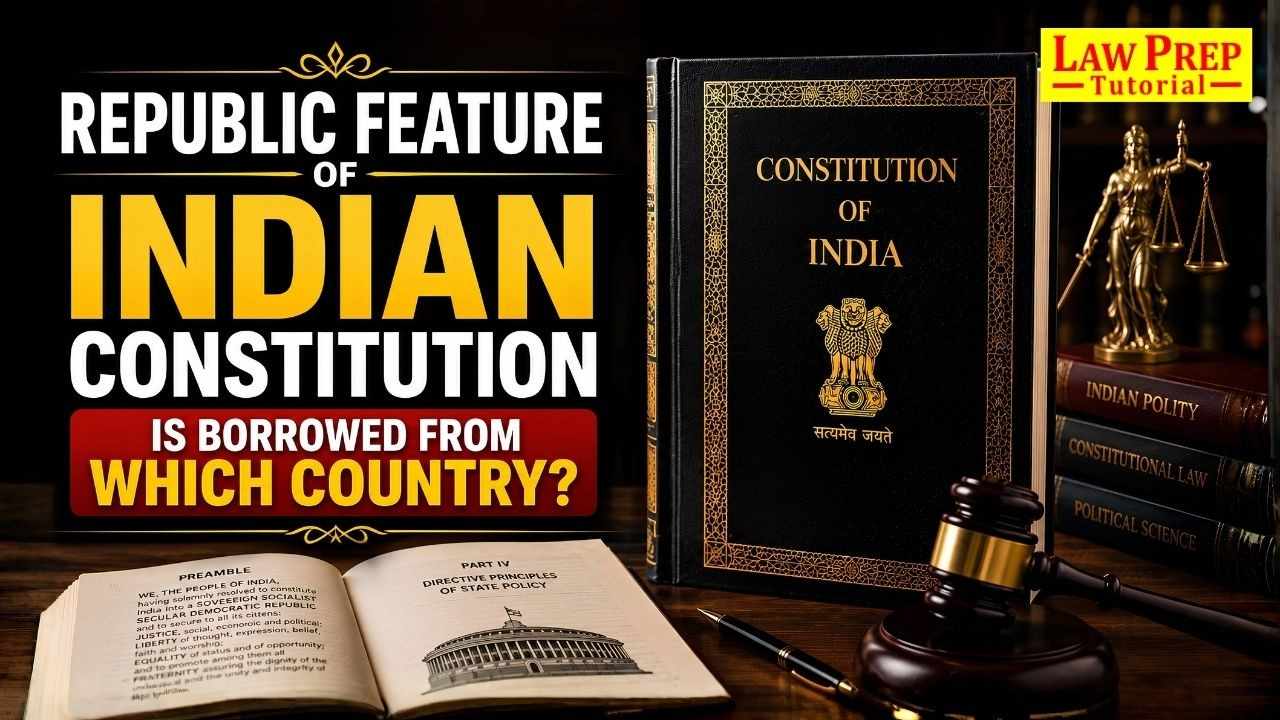

The republic feature of Indian Constitution is borrowed from the French Constitution. However, India did not copy the French model. India adopted the idea of a republic and shaped it according to its own parliamentary democracy.
A republic means the head of the State is elected and does not get power by birth. In India, the President is the elected head of the State. This feature is important because it rejects monarchy and shows that public power comes from the people and the Constitution.
Republic Feature of Indian Constitution Borrowed From Which Country?
The republic feature of Indian Constitution is borrowed from France. It means India has an elected head of State instead of a hereditary ruler. In India, the President is the head of the State and is elected indirectly through an electoral college. The word Republic is also mentioned in the Preamble of the Indian Constitution.
Why is India Called a Republic?
India is called a republic because the head of the State is elected and not hereditary. In a monarchy, the king or queen gets the position by birth. But in India, the President is elected through a constitutional process. This shows that no public office belongs to any family, dynasty, or royal line.
The people are the real source of power, and all constitutional offices work under the Constitution. India is also a democratic republic because people elect their representatives, and the highest constitutional office is also filled through election, not inheritance.
Check out other important Indian Constitution topics here:
Republic Feature Borrowed From France: How India Adapted It?
The republic feature of Indian Constitution was borrowed from France, where the idea of a republic became a strong symbol against monarchy and hereditary rule. France also influenced the ideals of liberty, equality, and fraternity, which are found in the Preamble of the Indian Constitution. India adopted the republic feature to show that independent India would not have a king, queen, or hereditary ruler.
However, India adapted this idea according to its own system. India follows a parliamentary form of government, where the President is the constitutional head of the State, while real executive power is exercised by the Prime Minister and the Council of Ministers. So, unlike some republics where the President may have strong executive powers, India made the President an elected constitutional head. This makes India a parliamentary republic, where democracy, constitutional limits, and people’s authority work together.
Why Did India Borrow the Republic Feature From France?
- To reject monarchy: India wanted a system where the head of the State would not be a king or queen.
- To support equality: A republic shows that no person gets the highest office only because of birth.
- To reflect people’s power: The idea of republic supports the belief that power comes from the people.
- To match democratic values: A republic works well with India’s democratic system and elected institutions.
- To create a modern constitutional State: India wanted public offices to work under law, not royal authority.
- To strengthen the Preamble’s ideals: The French ideas of republic, liberty, equality, and fraternity fit India’s constitutional vision.
Explore important Legal Education resources here:
| Articles of Indian Constitution | Article 14 of Indian Constitution |
| Legal Awareness and Law Resources | Article 15 of Indian Constitution |
Features of Republic in Indian Constitution
| Feature | Explanation |
| Elected Head of State | The President of India is elected and does not get the post by birth. |
| No Hereditary Rule | India does not have a king, queen, or royal ruler as head of State. |
| People as Source of Power | The Constitution begins with “We, the People of India,” showing that power comes from the people. |
| Constitutional Supremacy | All offices, including the President, function according to the Constitution. |
| Equal Access to Public Office | Public offices are not based on royal status or family line. |
| Parliamentary Republic | India has an elected President, but real executive power is with the Prime Minister and Council of Ministers. |
| Democratic Process | The head of State is chosen through a constitutional election process. |
| No Rule by Birth | Authority in India comes through law and election, not inheritance. |
Important Articles Related to Republic Feature
| Article | Relation With Republic Feature |
| Article 52 | Provides that there shall be a President of India. |
| Article 53 | States that the executive power of the Union is vested in the President. |
| Article 54 | Deals with the election of the President. |
| Article 55 | Explains the manner of election of the President. |
| Article 56 | Mentions the term of office of the President. |
| Article 58 | Lists the qualifications required for election as President. |
| Article 61 | Deals with the impeachment of the President. |
| Article 74 | Provides for the Council of Ministers to aid and advise the President. |
Checkout more Law-Related Topics here:
FAQs About Republic Feature of Indian Constitution
Republic means the head of the State is elected and does not get power by birth or heredity.
The President of India is the head of State.
No, India is not a monarchy. India is a republic because it has an elected head of State.
No, the President of India is indirectly elected by an electoral college
The word Republic is mentioned in the Preamble of the Indian Constitution.
In a republic, the head of State is elected. In a monarchy, the head of State gets power by birth or royal family line.
Democracy means people elect their government. Republic means the head of State is elected and not hereditary.
India became a republic on 26 January 1950, when the Constitution came into force.
Article 52 provides for the President of India.
Article 54 deals with the election of the President of India.
Explore essential Legal Learning resources: