
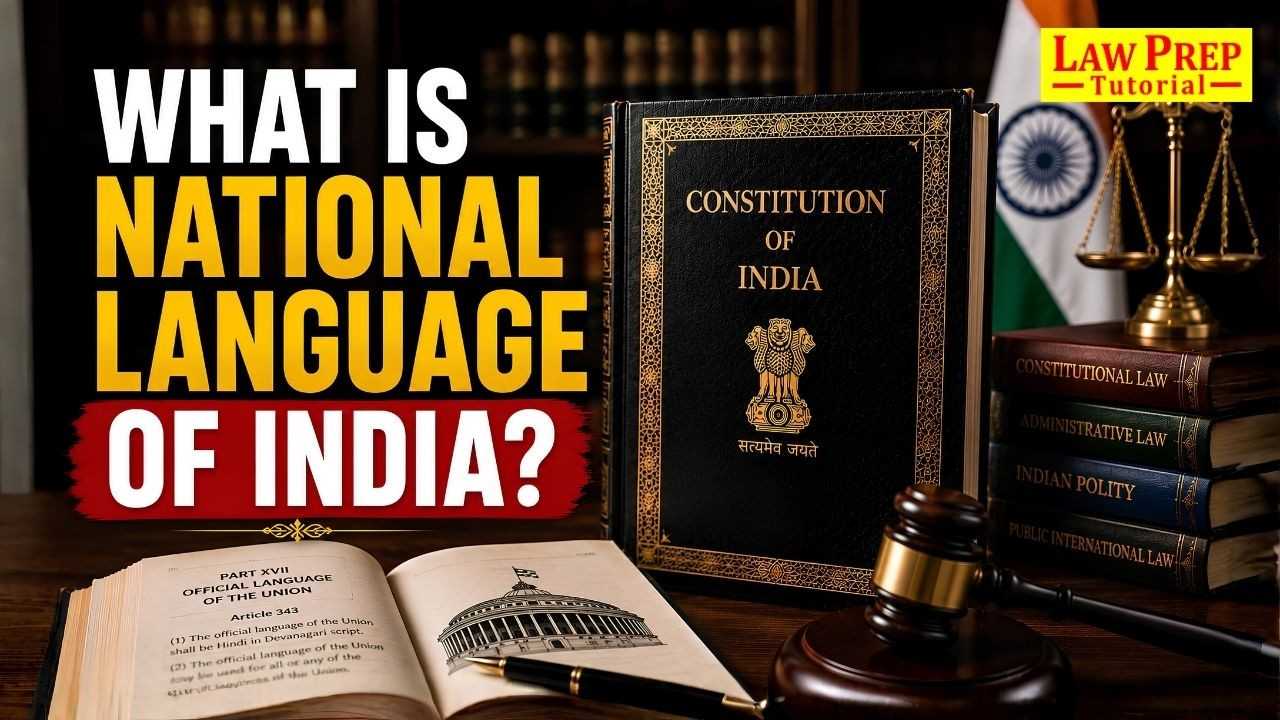

There is no national language in India. Hindi and English are official languages of the Union Government, but no language has been declared as the national language of India. Many people believe that Hindi is India’s national language, but the Constitution does not say this.
Hindi has the status of official language of the Union, while English continues to be used for official purposes. India is a multilingual country with hundreds of languages and 22 scheduled languages recognized in the Constitution.
Does India Have a National Language?
No, India does not have a national language. The Constitution of India does not declare any language as the national language.
India follows a multilingual approach because the country has deep linguistic diversity.
Why Hindi is Not the National Language of India?
Hindi is not the national language of India because the Constitution only gives it the status of official language of the Union, not national language.
Key reasons:
- Article 343 mentions Hindi as the official language of the Union:
- It says that the official language of the Union shall be Hindi in Devanagari script.
- The Constitution does not call Hindi the national language:
- No Article in the Constitution declares Hindi or any other language as the national language of India.
English also continues for official purposes:
- Article 343 allowed English to continue for official work even after the Constitution came into force.
- Many Indian states have their own official languages:
- Tamil Nadu uses Tamil, Maharashtra uses Marathi, West Bengal uses Bengali, Gujarat uses Gujarati, and so on.
- India has 22 scheduled languages:
- These languages are recognized in the Eighth Schedule of the Constitution, but they are not national languages.
Official Language vs National Language in India
| Basis | Official Language | National Language |
| Meaning | A language used for government work and official communication | A language symbolically representing the nation |
| India’s Position | India has official languages | India has no national language |
| Hindi’s Status | Official language of the Union under Article 343 | Not the national language |
| English’s Status | Used for official purposes | Not the national language |
| Constitutional Basis | Article 343 and related provisions | No Article declares a national language |
| Use in India | Union work, Parliament, administration, inter-state communication | Not applicable in India |
Checkout more GK related topics:
Article 343: Official Language of the Union
Article 343 of Indian Constitution is the most important provision for understanding the language question in India. It says that the official language of the Union shall be Hindi in Devanagari script. It also says that the form of numerals used for official purposes of the Union shall be the international form of Indian numerals.
However, Article 343 did not remove English immediately. It allowed English to continue for official purposes for 15 years from the commencement of the Constitution. It also allowed Parliament to make a law for the continued use of English even after this period. This is why English still continues in Union government work.
Most importantly, Article 343 talks about the official language, not the national language.
Constituent Assembly Debate on Official Language of India
The question of language led to intense debate in the Constituent Assembly. The Draft Constitution of 1948 did not originally contain Draft Article 301A. On 12 September 1949, a Drafting Committee member introduced this provision, which later became the basis of Article 343.
This proposal was popularly known as the Munshi-Ayyangar formula. It declared Hindi in Devanagari script as the official language of the Union and accepted the international form of Indian numerals for official purposes. The Assembly discussed it on 12, 13, and 14 September 1949.
Some members opposed Hindi as the official language and warned that no language should be imposed on India simply by writing it into the Constitution. Some members even wanted Hindustani in place of Hindi. On the other side, supporters of Hindi wanted faster replacement of English and also wanted Devanagari numerals.
Finally, after debate and compromise, the Assembly adopted the provision on 14 September 1949. This is why Hindi got the status of official language of the Union, but not national language.
Explore important Legal Education resources here:
| Articles of Indian Constitution | Article 14 of Indian Constitution |
| Legal Awareness and Law Resources | Article 15 of Indian Constitution |
Official Languages of India (Scheduled Languages)
India recognizes 22 languages under the Eighth Schedule of the Constitution. These are called scheduled languages. They are constitutionally recognized languages, but they are not national languages.
| No. | Scheduled Language | Script/Common Usage |
| 1 | Assamese | Assamese script |
| 2 | Bengali | Bengali script |
| 3 | Bodo | Devanagari script |
| 4 | Dogri | Devanagari script |
| 5 | Gujarati | Gujarati script |
| 6 | Hindi | Devanagari script |
| 7 | Kannada | Kannada script |
| 8 | Kashmiri | Perso-Arabic/Devanagari usage |
| 9 | Konkani | Devanagari and other scripts |
| 10 | Maithili | Devanagari script |
| 11 | Malayalam | Malayalam script |
| 12 | Manipuri | Meitei Mayek/Bengali script |
| 13 | Marathi | Devanagari script |
| 14 | Nepali | Devanagari script |
| 15 | Odia | Odia script |
| 16 | Punjabi | Gurmukhi script |
| 17 | Sanskrit | Devanagari script |
| 18 | Santhali | Ol Chiki and other scripts |
| 19 | Sindhi | Perso-Arabic/Devanagari usage |
| 20 | Tamil | Tamil script |
| 21 | Telugu | Telugu script |
| 22 | Urdu | Perso-Arabic script |
Check out other important Indian Constitution topics here:
Official Languages Act, 1963
The Official Languages Act, 1963 was passed to provide for the languages used for official purposes of the Union, business in Parliament, Central and State Acts, and certain purposes in High Courts. It became important because Article 343 allowed English to continue for 15 years after the Constitution came into force, but Parliament could provide for its continued use after that period.
Section 3 of the Act allows English to continue, in addition to Hindi, for official purposes of the Union and for use in Parliament. This is why English is still used in central government work, laws, Parliament, courts, and official communication. The Act helped India balance Hindi as the official language of the Union with the need for English in a multilingual country.
Important Articles Related to Languages in India
| Article | What It Covers |
| Article 343 | Official language of the Union; Hindi in Devanagari script and international form of Indian numerals |
| Article 344 | Commission and Committee of Parliament on official language |
| Article 345 | Official language or languages of a state |
| Article 346 | Official language for communication between states and the Union |
| Article 347 | Special provision for language spoken by a section of a state’s population |
| Article 348 | Language used in Supreme Court, High Courts, Bills, Acts, Ordinances, and legal texts |
| Article 349 | Special procedure for laws relating to language |
| Article 350 | Right to submit representation for grievance in any language used in the Union or state |
| Article 350A | Facilities for instruction in mother tongue at primary stage |
| Article 350B | Special Officer for linguistic minorities |
| Article 351 | Directive for development of Hindi language |
FAQs About National Language of India
India has no national language. The Constitution does not declare any language as the national language of India.
No, English is not the national language of India. English is used for official purposes of the Union and in Parliament along with Hindi.
At the Union level, Hindi in Devanagari script is the official language. English also continues to be used for official purposes.
India has no national language because it is a multilingual country with many major languages. The Constitution follows a balanced approach instead of giving one language national status.
No, scheduled languages are not national languages. They are constitutionally recognized languages listed in the Eighth Schedule.
No, Sanskrit is not the national language of India. Sanskrit is one of the 22 scheduled languages.
Checkout more Law-Related Topics here:
Discover More Legal Concepts:
| Amendment of Indian Constitution | Courtroom Genius by Nani Palkhivala |
| Salary of President of India | Basic Structure Doctrine of Indian Constitution |
| Indian Vice President Salary | Indian Prime Minister Salary |
Explore essential Legal Learning resources: